
The Continuity of Ancient Ideologies:
The Architectural Symbolism of New York City and the Legacy of Enslavement

Abstract
This article asserts that the urban planning of New York City reflects a deliberate continuation of ancient Egyptian architectural and cosmic symbolism, used to reinforce systems of power and control. The study explores how elements such as obelisks, celestial alignments, and urban grid systems mirror Egyptian design principles. Furthermore, it links these architectural choices to the biblical enslavement of the Children of Israel and the transatlantic slave trade, arguing that New York City’s design symbolizes both a legacy and perpetuation of socio-political domination. Through a review of historical artifacts, literature, and cultural narratives, this article presents a compelling case for the intentional replication of ancient ideologies in modern urban design.
Introduction
New York City is celebrated as a pinnacle of modern ingenuity and urban innovation. Yet, beneath its progressive facade lies a design deeply influenced by ancient ideologies, particularly those of Egypt. This study examines how the city’s architecture and layout reflect principles rooted in Egyptian cosmology, where urban planning served as a physical and symbolic tool of power. By drawing parallels between New York City and ancient Egyptian practices, this article reveals a striking continuity of ideologies aimed at subjugating populations, connecting this symbolism to the biblical narrative of the Children of Israel’s enslavement and its echoes in the transatlantic slave trade.
Literature Review
Egyptian Architectural Symbolism
The architectural achievements of ancient Egypt, particularly the pyramids of Giza, demonstrate a profound alignment with celestial bodies such as the Orion Belt. Scholars like Bauval and Hancock (1996) argue that this alignment was not accidental but a deliberate act to project divine authority and cosmic order (Bauval & Hancock, 1996). Obelisks, towering monuments often dedicated to the sun god Ra, were central to this ideology, serving as bridges between the heavens and the earth (Arnold, 1999). These structures were designed not merely as expressions of faith but as tangible assertions of power and control.
Obelisks in Western Urban Design
The transplantation of Egyptian obelisks to Western cities underscores their enduring symbolic significance. Cleopatra’s Needle, now standing in Central Park, was originally erected in Heliopolis and transported to New York City in 1881. Scholars have suggested that this relocation represents a deliberate effort to connect the modern world to the grandeur and authority of ancient civilizations (Wilson, 2016). Obelisks in Western contexts function as symbols of continuity, linking present power structures to ancient ideals.
Urban Planning and Power
Urban design often reflects the ideologies of those in power. Mumford (1961) highlights how city layouts are intentionally crafted to impose order and reinforce authority. The grid system of New York City, while ostensibly practical, carries deeper symbolic implications. The alignment of streets with natural phenomena, such as solstices, mirrors ancient practices of embedding cosmic significance into urban spaces (Mumford, 1961).
The Biblical Narrative of Enslavement
The biblical story of the Children of Israel’s enslavement in Egypt resonates through history as a metaphor for systems of oppression. The 1747 map by Emanuel Bowen, which identifies a region in West Africa as the “Kingdom of Juda,” suggests a historical connection between African populations and the biblical Tribe of Judah (Bowen, 1747). This interpretation has gained traction among scholars exploring the transatlantic slave trade and its cultural implications (Fagbamila, 2020).
The Architecture of New York City: A Cosmic Blueprint?
Cleopatra’s Needle: A Symbolic Bridge
Cleopatra’s Needle stands as a powerful testament to the influence of Egyptian symbolism in New York City. Its relocation to Central Park was not merely a historical curiosity but a deliberate act to incorporate ancient architectural power into the heart of a modern metropolis. The obelisk’s inscriptions and origins connect it to the sun god Ra, embodying the enduring legacy of cosmic symbolism and its role in asserting dominance.
Urban Alignment and Celestial Symbolism
The grid system of New York City, with its precise alignment, evokes comparisons to the celestial alignments of Egyptian pyramids. For example, Manhattanhenge, when the sunset aligns perfectly with the city’s streets, echoes the solstice alignments of ancient monuments. These alignments suggest a conscious or subconscious replication of Egyptian principles, embedding cosmic order into the urban landscape.
Skyscrapers as Modern Obelisks
New York City’s towering skyscrapers can be seen as contemporary obelisks, projecting power and dominance skyward. These structures mirror the symbolic function of ancient obelisks—asserting human authority over the natural and spiritual worlds. By reaching into the heavens, skyscrapers perpetuate the narrative of control and continuity that defined ancient Egyptian architecture.
The Legacy of Enslavement
The Biblical Continuity
The enslavement of the Children of Israel in Egypt provides a compelling lens through which to view the transatlantic slave trade. The “Kingdom of Juda” on Bowen’s 1747 map highlights the historical connection between African populations and biblical narratives. This continuity suggests that the ideological frameworks of enslavement have been carried through history, manifesting in different forms but retaining the same core principles of domination and control.
Slavery and the Foundations of New York City
New York City’s early economy was deeply intertwined with the institution of slavery, which provided the labor and wealth necessary for its development. This mirrors the Egyptian model, where enslaved populations were instrumental in constructing monumental architecture. The city’s design, steeped in symbolism and power, stands as a testament to the historical systems of exploitation that underpin its foundations.
Conclusion
New York City’s architecture and urban planning embody a continuity of ancient ideologies rooted in power and control. By aligning its design with principles of cosmic symbolism and incorporating Egyptian elements like obelisks, the city perpetuates systems of dominance that echo both biblical and historical narratives of enslavement. This analysis highlights the symbolic and practical ways in which urban spaces can serve as tools of socio-political messaging. Further research into these connections will deepen our understanding of how ancient ideologies influence modern societies.
References
Arnold, D. (1999). The Encyclopedia of Ancient Egyptian Architecture. Princeton University Press.
Bauval, R., & Hancock, G. (1996). The Orion Mystery: Unlocking the Secrets of the Pyramids. Crown Publishing.
Bowen, E. (1747). A New & Accurate Map of Negroland and the Adjacent Countries. London.
Fagbamila, O. (2020). The Transatlantic Slave Trade and African Diaspora: A Biblical Perspective. Journal of African Studies, 12(3), 45-67.
Mumford, L. (1961). The City in History: Its Origins, Transformations, and Prospects. Harcourt, Brace & World.
Wilson, P. (2016). The Obelisk and Its Role in Modern Urban Design. Architectural Review, 78(4), 34-47.
Central Park Conservancy. (n.d.). Cleopatra’s Needle. Retrieved from https://www.centralparknyc.org/locations/obelisk
Astronomy Magazine. (n.d.). Are the Egyptian Pyramids Aligned with the Stars? Retrieved from https://www.astronomy.com/science/are-the-egyptian-pyramids-aligned-with-the-stars
About the Creator
The Last Sigh of Al-Andalus: When the Keys to Paradise Were Lost
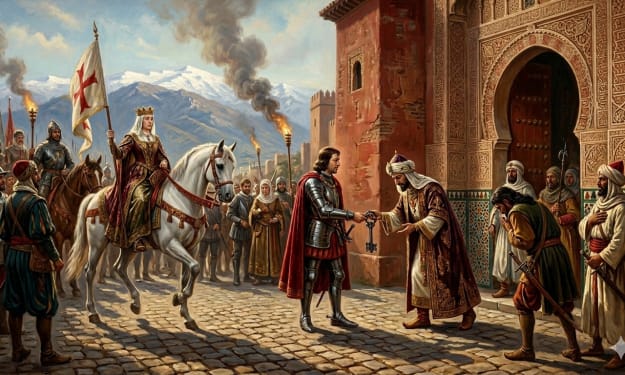
The date was January 2, 1492. As the morning mist cleared over the Sierra Nevada mountains, a somber procession wound its way down from the red walls of the Alhambra. At its head was Muhammad XII, known to the West as Boabdil, the last Sultan of the Nasrid dynasty. In his hands, he carried the keys to the city—keys that represented not just a fortress, but the final heartbeat of a civilization that had flourished for 781 years.
By Irshad Abbasi 4 days ago in History



Comments
There are no comments for this story
Be the first to respond and start the conversation.