
The Catastrophic Aftermath of the Dinosaur-Killing Asteroid
How a Space Rock 10 Kilometers Wide Reshaped Earth’s Climate, Life, and Geological History

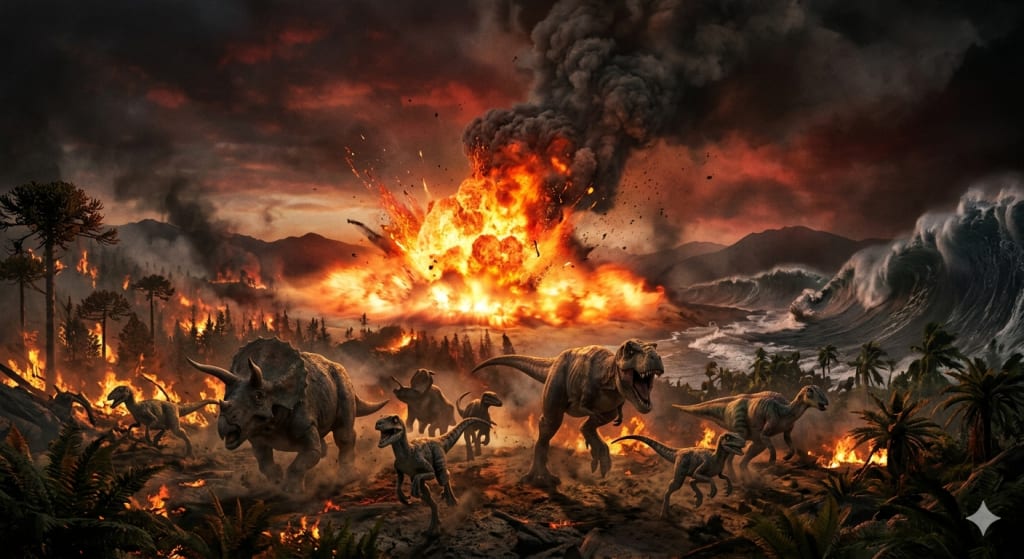
Approximately 66 million years ago, the Earth experienced one of the most dramatic and catastrophic events in its history: a massive asteroid, now identified as the Chicxulub impactor, collided with the planet near what is today the Yucatán Peninsula in Mexico. Measuring roughly 10 kilometers in diameter, this space rock unleashed energy equivalent to billions of atomic bombs, marking the end of the Cretaceous period and triggering a chain of events that wiped out approximately 75% of all species on Earth, including the iconic non-avian dinosaurs.
The immediate aftermath of the impact was nothing short of apocalyptic. The collision generated an enormous shockwave, instantly vaporizing the asteroid and a massive portion of the Earth’s crust at the impact site. This released an unimaginable amount of energy, forming a crater over 180 kilometers wide and 20 kilometers deep. The intense heat produced by the collision likely ignited widespread wildfires across vast regions, turning forests and coastal areas into smoldering wastelands within hours. Evidence of these fires has been discovered in the form of charcoal deposits in sediment layers dating to the time of the impact.
Alongside firestorms, the asteroid’s impact sent billions of tons of debris, dust, and aerosols high into the atmosphere. This material formed a global veil, blocking sunlight and causing a phenomenon known as an “impact winter.” Temperatures plummeted dramatically, photosynthesis slowed, and ecosystems collapsed as plants and phytoplankton—the primary producers of the food chain—died off. This chain reaction affected herbivorous dinosaurs first, followed by the carnivores that depended on them. Within months to years, vast portions of Earth’s biodiversity vanished.
Another devastating consequence of the impact was a series of massive tsunamis. The asteroid struck near a shallow sea, displacing enormous amounts of water and generating waves hundreds of meters high that inundated coastal areas thousands of kilometers away. Sedimentary evidence shows that these tsunamis scoured coastlines, leaving behind thick layers of chaotic deposits rich in marine and terrestrial fossils, a stark record of nature’s fury.
In addition to firestorms, darkness, and tsunamis, the impact triggered long-term climatic disruptions. The sulfur-rich rocks vaporized during the collision injected massive amounts of sulfur dioxide into the stratosphere, causing acid rain and further cooling the planet. For years after the impact, Earth experienced harsh, unstable climates with temperature swings, acidified oceans, and disrupted weather patterns. These prolonged environmental stresses contributed to the extinction of many marine species, including ammonites and marine reptiles, alongside the terrestrial fauna.
Despite the scale of destruction, the asteroid impact also set the stage for a new evolutionary chapter. With the extinction of the dominant dinosaurs, ecological niches were suddenly left vacant. This allowed mammals, birds, and eventually flowering plants to diversify and flourish, shaping the future of life on Earth. Scientists often view the impact as a turning point, a brutal yet pivotal moment that reshaped terrestrial ecosystems and paved the way for the rise of mammals and, ultimately, humans.
Modern research on the Chicxulub crater, including drilling projects and geochemical studies, continues to reveal insights about the Earth’s resilience and vulnerability. Layers of impact ejecta, shocked minerals, and iridium-rich deposits serve as a stark reminder of how a single celestial body can alter the course of life on Earth. While the dinosaurs’ reign ended abruptly, their legacy lives on in birds, their closest living relatives, which survived the catastrophe and evolved into the diverse avian species we see today.
In conclusion, the impact of the Chicxulub asteroid was an unprecedented global disaster. It unleashed fire, darkness, acid rain, tsunamis, and climatic upheavals, leaving a lasting mark on the geological record and the evolutionary trajectory of life. The extinction of the dinosaurs was not a singular event but a complex series of cascading catastrophes—an extreme reminder of the fragility of life when the cosmos intervenes. Yet, from this devastation emerged a new world, one that would eventually support mammals, primates, and humans. The story of the asteroid’s aftermath is a vivid illustration of both destruction and rebirth in the natural world.
About the Creator
Irshad Abbasi
Ali ibn Abi Talib (RA) said 📚
“Knowledge is better than wealth, because knowledge protects you, while you have to protect wealth.
Keep reading
More stories from Irshad Abbasi and writers in History and other communities.
Why Was the Asteroid That Wiped Out the Dinosaurs So Deadly?
Around 66 million years ago, Earth experienced one of the most catastrophic events in its history. A giant asteroid slammed into the planet and triggered a chain reaction of destruction that eventually led to the extinction of the dinosaurs. Scientists have spent decades studying this event, trying to understand why this particular asteroid impact was so devastating that it wiped out nearly 75 percent of all species on Earth.
By Irshad Abbasi about 13 hours ago in History
Worst Mid-Air Crash in Aviation History
It was evening over Delhi, and two airplanes carrying a total of 349 people were moving toward each other in the sky. One aircraft was preparing to land at Indira Gandhi International Airport, while the other had just taken off from the same airport.
By Imran Ali Shahabout 7 hours ago in History


Comments
There are no comments for this story
Be the first to respond and start the conversation.