
Why Was the Asteroid That Wiped Out the Dinosaurs So Deadly?
The massive space rock that struck Earth 66 million years ago triggered fires, darkness, and climate chaos that changed life on the planet forever.

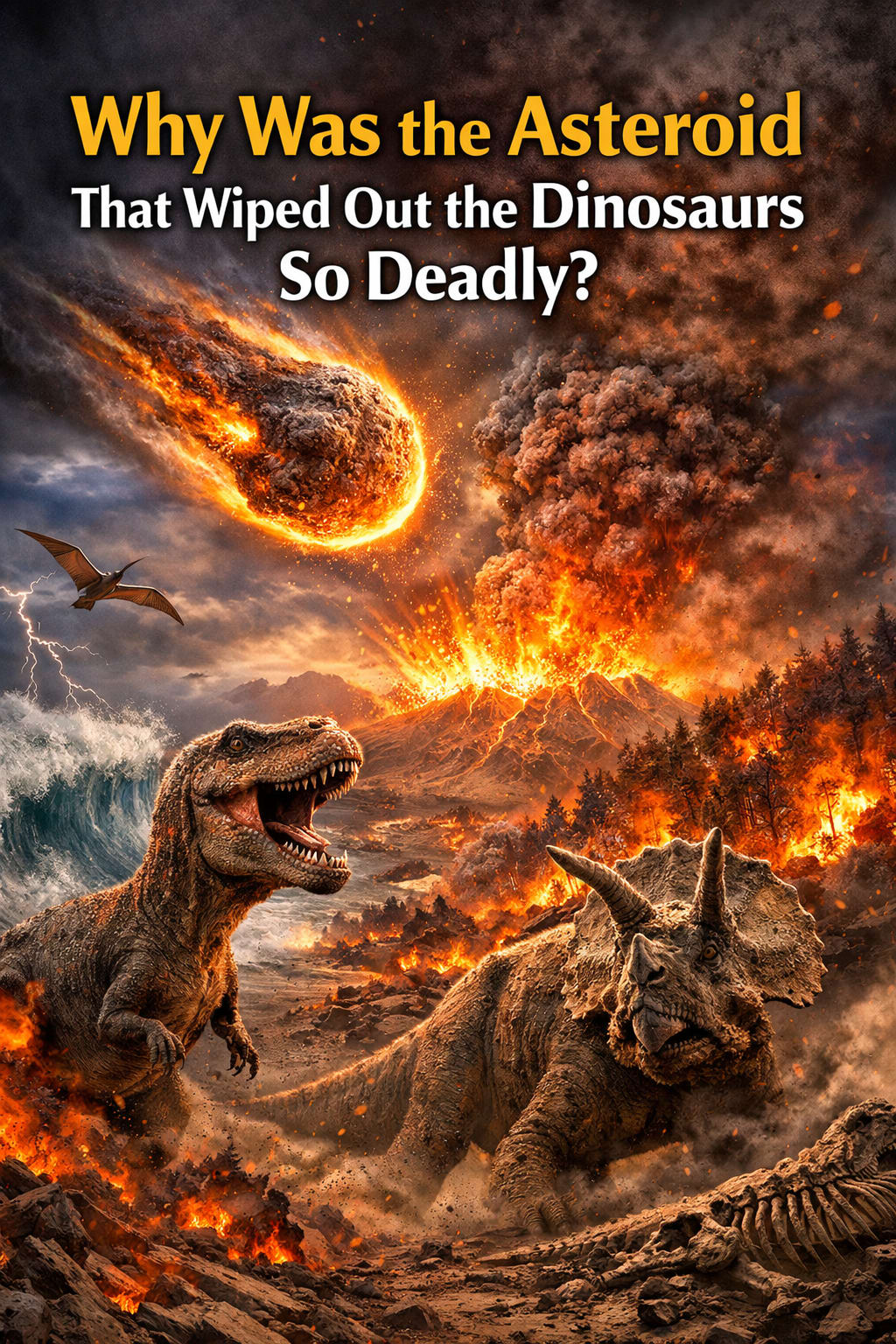
Around 66 million years ago, Earth experienced one of the most catastrophic events in its history. A giant asteroid slammed into the planet and triggered a chain reaction of destruction that eventually led to the extinction of the dinosaurs. Scientists have spent decades studying this event, trying to understand why this particular asteroid impact was so devastating that it wiped out nearly 75 percent of all species on Earth.
The event is closely linked to what scientists call the Cretaceous–Paleogene extinction event, often shortened to the K–Pg extinction. This extinction event marked the end of the age of dinosaurs and opened the door for mammals—including humans millions of years later—to dominate the planet.
At the center of this disaster was a massive asteroid that struck the Earth near present-day Chicxulub Crater in Mexico’s Yucatán Peninsula. Scientists estimate that the asteroid was about 10 kilometers (6 miles) wide—large enough to cause global devastation.
When the asteroid hit Earth, it released an unimaginable amount of energy. Researchers believe the impact was equivalent to billions of atomic bombs exploding at once. The collision created a crater more than 180 kilometers wide and instantly vaporized rock, water, and the asteroid itself. The shockwave from the impact would have caused massive earthquakes and tsunamis thousands of meters high that swept across nearby continents.
However, the real reason the asteroid was so deadly was not just the impact itself—it was the global chain reaction that followed.
First, the impact launched trillions of tons of debris into the atmosphere. Molten rock and dust were blasted high into the sky and spread around the planet. As these hot particles fell back toward Earth, they heated the atmosphere so intensely that forests across the world likely ignited in massive wildfires. Many scientists believe the heat from falling debris could have cooked animals on the surface.
Next came darkness.
The dust, ash, and sulfur released from the impact blocked sunlight for months or possibly years. Without sunlight, plants could not perform Photosynthesis, the process that allows them to produce food using sunlight. As plants died, the entire food chain began to collapse. Herbivores starved first, followed by carnivores that depended on them.
Dinosaurs, which had dominated Earth for more than 160 million years, were particularly vulnerable to this sudden environmental collapse. Large animals require huge amounts of food to survive, and when vegetation disappeared, they simply could not adapt quickly enough.
In addition to darkness and cold, the asteroid impact also caused severe climate changes. Sulfur-rich rocks at the impact site released enormous quantities of sulfur dioxide into the atmosphere. This gas formed aerosols that reflected sunlight and cooled the planet dramatically, creating what scientists call an “impact winter.” Temperatures may have dropped sharply across the globe.
Acid rain was another deadly consequence. Chemicals released into the atmosphere combined with water vapor to form acidic precipitation, which damaged plants and poisoned freshwater ecosystems.
Marine life was also devastated. With sunlight blocked, phytoplankton—the microscopic organisms that form the base of ocean food chains—declined drastically. As a result, many marine species, including large reptiles and numerous fish species, went extinct.
Interestingly, not all life was wiped out. Smaller animals such as early mammals, birds, amphibians, and insects had better chances of survival. Many of them could hide underground, live on limited food supplies, or adapt more quickly to changing conditions.
Birds, in fact, are considered the only surviving descendants of dinosaurs. Over millions of years after the extinction, mammals diversified and evolved into many new forms of life.
Today, scientists continue to study the Chicxulub Crater to better understand the event. Drilling projects and geological research have confirmed that the asteroid impact was the main cause of the mass extinction.
The story of the dinosaur-killing asteroid is more than just a tale of destruction—it is a reminder of how fragile life on Earth can be. A single cosmic event changed the course of evolution and reshaped the planet’s future.
Without that asteroid, dinosaurs might still rule the Earth today—and humans might never have appeared at all.
About the Creator
Irshad Abbasi
Ali ibn Abi Talib (RA) said 📚
“Knowledge is better than wealth, because knowledge protects you, while you have to protect wealth.
Keep reading
More stories from Irshad Abbasi and writers in History and other communities.
A 40,000‑Year‑Old Masterpiece Offers New Insight into Early Human Art
In a remarkable archaeological discovery that reshapes our understanding of early human creativity, scientists have identified a 40,000‑year‑old painting of a cow‑like animal on a cave wall, potentially making it one of the earliest examples of figurative art ever documented. The site — located deep within the dense forests of Indonesian Borneo — reveals that our distant ancestors were not merely marking surfaces with abstract symbols but were intentionally depicting real‑world animals tens of thousands of years ago.
By Irshad Abbasi about 12 hours ago in History
The Year 1979 in Review: Fun Facts, Trivia, and Historic Highlights
This quick read is a collection of fun facts, trivia, and historic events from the year 1979. Discover the year’s top news stories, most influential people, sports facts, the cost of living, erratic weather patterns, entertainment trivia, and much more.
By Gregory DeVictor6 days ago in History




Comments
There are no comments for this story
Be the first to respond and start the conversation.