


The real story behind the butterfly effect was about a meteorologist, Edward Lorenz. (https://www.aps.org/publications/apsnews/200301/history.cfm)
EDWARD LORENZ, METEOROLOGIST
Lorenz, in 1961, had an opportunity to use a new-fangled tool in mathematics, a computer. He wanted to know why predicting the weather was so, well, unpredictable. And unreliable.
So, he used a set of differential equations that represented changes in temperature, pressure, wind velocity, etc. He set up on the computer a continuous simulation that could produce a day's worth of virtual weather for every minute. He succeeded in producing data of weather patterns which, although not being exactly the same every day, seemed to demonstrate a definite underlying pattern.
On one simulation run in 1961, Lorenz wanted to examine a particular sequence at greater length, but he took a shortcut. (Computers then were notoriously slow.) Originally, for each condition he had metered out to six decimal places. Computer storage being what it was at the time (well before Moore's Law ignited), his values of six digits were eating into his computer's memory. He took a shortcut. To save space, he changed the numbers by rounding off, e.g., 0.506127 to 0.506. He figured the one-in-a-thousand difference was negligible.
The story goes that he went off to grab a cup of coffee, although there are some who said he went to the Men's room. When he returned, with either coffee in hand (or less "on board," depending on which story you accept), a few months of virtual weather had passed on the simulation.
And it was not pretty.
There were wild fluctuations on this simulated world of consistent conditions (level terrain, initial temperature, etc.) and now he encountered tornadoes, hurricanes, fast-moving troughs and fronts, highs and lows, and other inclement phenomena and Acts of God.
To make a long story short, he concluded that the one-thousandth difference in initial conditions--countless numbers of them--summated into what he saw now. (He first thought it was a blown vacuum tube.) He likened that 1/1000th difference, that tiny perturbation, to the force of a butterfly's flap of its wings. And while one butterfly flap in Brazil really couldn't cause a tornado in Texas, as Lorenz colorfully explained, he knew his oversimplification underscored the reality: that butterflies all over the world, and all the other imperceptible or subtle actions around the planet (e.g., blowing into a saxophone, fanning one's self, a triple Lutz on ice, etc.), mixed, counteracted, and summated into a mess of complexity from which the mathematical field of Chaos Theory emerged. With apologies to Ray Bradbury, it was Lorenz who first used the term, Butterfly Effect.
Because...the mess had a pattern.
It was that breeder-reactor called recursion: small changes in countless numbers creating a non-linear (non-Euclidean) geometry, circling back recursively to redefine the initial condtions. Graphed out, these presented into amazing patterns called fractals. Lorenz determined that it took, on average, about 5 days for gazillions of perturbations to co-mingle into the chaotic patterns seen around the world, meaning any weather predictions beyond 5 days were impossible.
ME
After writing out my entire first novel in cursive (remember that?), I was one of the first to jump on the computer bandwagon. I typed it out on a 4.77 MHz Intel 8088 computer. But it wasn't all work. I farted around with some rudimentary fractal programs and--even on my 4-color, cathode ray tube--I was amazed at how beautiful chaos was. From there I explored Chaos Theory history which led me to Lorenz and his "strange attractor" representation of 3 dimensions.
PHOEBE
When my daughter was in 5th Grade, she had a choice of either doing a science experiment or another stupid diorama. (There's a special place in Hell for the one who first thought up the idea that dioramas--the bane of parental educational involvement--taught anybody anything.)
Science it would be! By this time I was using Pentium chips, and my fractals were exploding in hundreds of colors. And I thought of Lorenz.
THE EXPERIMENT
Phoebe and I would look in each day's weather section of the newspaper, the New Orleans Times-Picayune, and chart out their 7-day forecasts. Our hypothesis was that although weather prediction was fairly accurate the first few days out, as they approached 5 days they became increasingly unreliable. And after 5 days ("the week's forecast"), well, forget it. It was science fiction.
Sure enough, we compared what was predicted all those days out with the actual weather recorded on those days as they happened.
WE WERE RIGHT!
All hail Edward Lorenz! Science rules!
5-7 days' out predictions were no more accurate than what the horse-tapping Clever Hans would predict. We had proved our hypothesis. And while we proved Lorenz right, for which we're still expecting some sort of thank-you note, we also got to escape having to construct a diorama.
ME AGAIN
I was at some charity cocktail party which had in attendance some local New Orleans "celebrities." One of them was Bob Breck, a "dandy" of a meteorologist, on WVUE Channel 8, who was popular due to his glib personality and vivacious weather spots on the news. Everyone loved Bob. Bob was fun.
I found myself in line behind him trying to finish my bourbon-and-Coke before I reached the bar to order my next bourbon-and-Coke. It's a New Orleans thing--you might not understand.
"Hi, Bob Breck, right?" I said to him. He snapped around, basking in the thrill of recognition.
"Yes!"
"I enjoy your broadcasts."
"Why, thank you, sir," he said.
"But, y'know, Bob--I can call you that?"
"Sure."
"Well, y'know Bob, I've noticed you give a forecast that extends up to ten days."
"Yes, my 10-day forecast," he confirmed. "Many find it very useful. Especially the Gulf fishermen."
"Yea, but Bob, I'm a little curious, given the Butterfly Effect."
His smile neutralized and then distorted into something ugly. "I don't believe in that!" It was a tone a white supremecist might use in denying the holocaust.
"Really?" I asked, incredulous.
"Yea, really," he said, and turned away. He was done with me, it seemed.
"Because, y'know Bob, Lorenz--the father of Chaos Theory which launched the whole fractal geometry movement--he was able to prove how small initial conditions can be deterministic and have significant, important impacts on large-scale features of the weather. Especially after five days."
He kept his back turned away from me. Yep, we were all done here.
CONCLUSION
Phoebe continued her education. I moved on from bourbon-and-Cokes to bourbon-and-Diet-Cokes. Bob Breck continued his 10-day forecasts, the accuracy of which relentlessly suffered considerable Lorenzian attrition after 4 days.
Today, if I happen to be watching the weather with Phoebe, by Bob or otherwise, and the extended forecast comes on, we both just grin in ironic resentment, but not because of the weather uncertainties we knew were to come. No, our bad blood frothed because she only got a C on her science experiment, while all the stupid dioramas got As.
PS: THE BUTTERFLY EFFECT AND TIME TRAVEL
Ray Bradbury's 1952 short story, "A Sound of Thunder," about using time travel to hunt dinosaurs, first popularized the idea of the the Butterfly Effect: a time traveler accidentally steps on a butterfly back in the dinosaur era, and when he returns, Fascism has become the way of life. Although the term, Butterfly Effect, is not overtly used, it's the same thing: small perturbances can feed a recursive path that results in major impacts elsewhere or, in sci-fi stories, elsewhen. The 2004 movie, "The Butterfly Effect," also explored this theme.
But it is Edward Lorenz who coined the term, in spite of Ray Bradbury or Ashton Kutcher's movie. I'm happy to set the record straight.
About the Creator
Gerard DiLeo
Retired, not tired. Hippocampus, behave!
Make me rich! https://www.amazon.com/Gerard-DiLeo/e/B00JE6LL2W/
My substrack at https://substack.com/@drdileo
Keep reading
More stories from Gerard DiLeo and writers in History and other communities.
Valentine Day
February is named after "februa," strips of leather used to whip the bare buttocks of infertile women during the Roman Lupercalia (wolf). This annual Roman festival was a fertility "Mystery," or secret rite, similar — or akin to — the Dionysian Mysteries and the worship of Bacchus, the god of debauchery, and Pan, a fertility god.
By Gerard DiLeo2 years ago in History
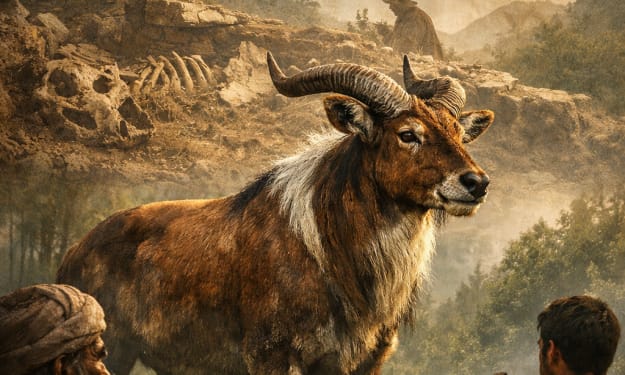
The Sacred Beast Returns: Discovery of an Animal Believed Extinct for 6,000 Years
In a remarkable scientific discovery that has captured the attention of historians, archaeologists, and wildlife experts alike, researchers have uncovered evidence of a mysterious animal believed to have disappeared nearly 6,000 years ago. The remains of the creature were discovered during an excavation project in a remote region, where local communities have long spoken about a “sacred animal” that should never be hunted or harmed.
By Irshad Abbasi 3 days ago in History



Comments (2)
Lol, the way Bob ignored you after you brought up the butterfly effect! Also, so sorry that Phoebe got a C on her science experiment 🥺
Thus is a fascinating article. Well done..