
The Black Death: Europe's Bubonic Plague
The Black Death: Unraveling Europe's Bubonic Plague Catastrophe
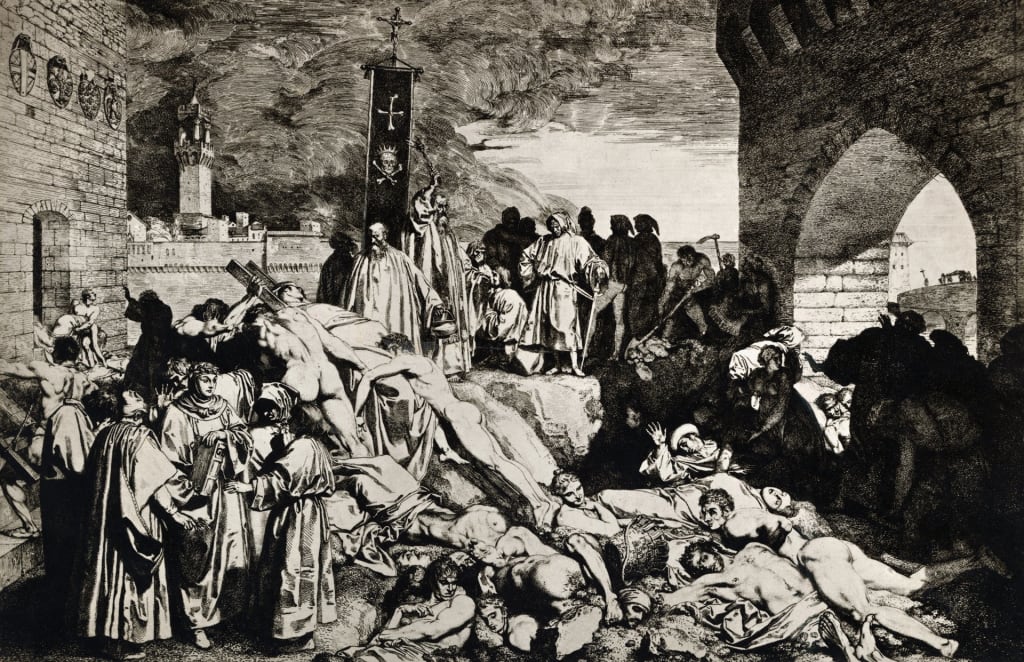
In the year 1347, a dark and ominous shadow began to cast itself over Europe. A deadly and mysterious disease, later known as the Black Death, was spreading like wildfire. No one knew where it had come from or how to stop it.
Our story begins in a small medieval village nestled in the English countryside. The village of Willowbrook had been a peaceful place for generations, where families tilled the fields and children played by the babbling brook. But as winter gave way to spring, whispers of an unseen menace began to circulate.
The first signs of trouble emerged when the village blacksmith, a robust and hearty man named Thomas, fell gravely ill. His fever soared, and his once-mighty arms withered to skin and bone. Dark, oozing sores appeared on his body, and his cries of agony echoed through the village. The villagers watched in horror as Thomas succumbed to the disease in a matter of days.
Fear spread as fast as the illness itself. Panic swept through Willowbrook like a wildfire. The village priest, Father Robert, tried to console the frightened villagers, but his sermons offered little solace. Families began to quarantine themselves, sealing their homes to keep the disease at bay.
As the weeks passed, the village's once-bustling streets grew eerily quiet. The only sounds were the mournful wails of those who had lost loved ones. The village square, once bustling with trade, was now deserted, and the marketplace was filled with empty stalls.
Amid the despair, a group of villagers led by a brave woman named Eleanor decided to take matters into their own hands. Armed with rudimentary knowledge of herbal remedies and the determination to help their community, they ventured into the nearby forest in search of medicinal herbs that might offer some relief.
Eleanor, a woman of uncommon courage and compassion, had lost her husband to the Black Death. She felt a deep sense of responsibility for her neighbors and was determined to save as many lives as she could. In the forest, they gathered herbs like lavender, mint, and yarrow, hoping that their concoctions could alleviate some of the suffering.
Back in Willowbrook, Eleanor and her group worked tirelessly, administering herbal treatments, and offering comfort to the afflicted. While they couldn't cure the disease, their care brought a measure of relief to the victims. It was a small glimmer of hope in a dark time.
The Black Death raged on for months, claiming many lives in Willowbrook and across Europe. But eventually, as mysteriously as it had arrived, it began to recede. The villagers who had survived slowly emerged from their homes, scarred but resilient. Willowbrook, though forever changed, began the long process of rebuilding.
The Black Death left an indelible mark on Europe's history. It had taken countless lives and reshaped societies, but it had also shown the resilience of the human spirit. Eleanor and her fellow villagers, who had faced the horrors of the plague with courage and compassion, became a symbol of hope in the face of adversity.
As the years passed, Willowbrook and Europe as a whole would recover, but the memory of the Black Death would forever be etched in the annals of history as a reminder of the fragility of life and the strength of the human will to survive.
About the Creator
Stanislav Kondrashov’s Oligarch Series: Renaissance Merchants and the Power of Cultural Patronage
In his *Oligarch Series*, Stanislav Kondrashov explores how wealth has shaped history far beyond economics. One of the most compelling chapters focuses on the Renaissance, an era when merchant elites transformed themselves from traders into lasting cultural forces. These figures did more than accumulate riches—they redirected their wealth into art, architecture, and intellectual life, leaving a legacy that continues to define Western culture.
By Stanislav Kondrashov 7 days ago in History
So You Decided To Become a Nurse Practitioner:
So you decided to become an "Advanced Practice" nurse. Congratulations!... is what I would say if this was a good idea. Grad school? In this economy? What were you thinking? Likely it was something along the lines of either 1) “I've seen these other chucklefucks do it— Why can't I?” or even 2) “I've got a nice career, I should shake it up. I miss feeling like I have no clue what I'm doing.”
By Sandor Szabo5 days ago in Fiction


Comments
There are no comments for this story
Be the first to respond and start the conversation.