
The Black Death
Unraveling the Dark Shadow of History

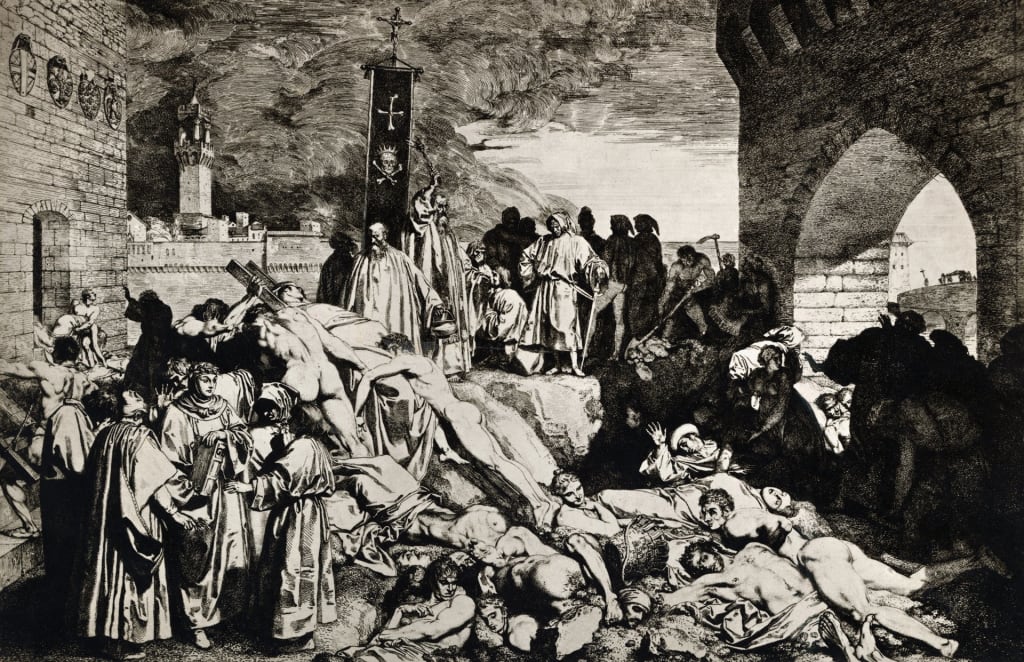
In the 14th century, Europe and beyond were plagued by the Black Death, one of the most gruesome pandemics in recorded human history. This 600-word synopsis examines the causes, consequences, and lingering effects of this disastrous event.
Origins and Spread:
The steppes of Central Asia are thought to be the place where the Black Death, also known as Yersinia pestis, first appeared. Fleas from infected rodents like rats spread it along trade routes. The epidemic reached the Crimea in the 1340s, while Genoese traders and Mongol armies were under siege. Unknowingly spreading the epidemic, ill soldiers and merchants sought safety in European ports.
The Black Death made it to the Mediterranean by 1347, where it quickly spread to North Africa, Spain, and Italy. From then, it quickly spread throughout Europe, reaching as far west as the British Isles and as far north as Scandinavia. The lack of knowledge regarding the causes and methods of the plague's spread hastened its rapid spread.
Symptoms and Mortality:
Bubonic, septicemic, and pneumonic types of the Black Death all manifested. The symptoms of the most prevalent type of plague, called bubonic plague, included fever, chills, weakness, and severely swollen lymph nodes. While pneumonic plague attacked the respiratory system and resulted in respiratory failure, septicemic plague attacked the bloodstream and caused severe hemorrhage.
Although the fatality rate varied between areas and populations, it was shocking. Death rates reached up to 90% in certain places, obliterating entire towns. Society was overwhelmed by the sheer number of deaths, which left the survivors in a condition of shock and despondency.
Social and Economic Impact:
Significant social and economic disruption was brought on by the Black Death. Mass death caused by labor shortages increased pay for those who survived, upending the conventional hierarchy of the feudal system. As a result of their increased negotiating power, serfs and peasants helped bring an end to serfdom.
The pandemic simultaneously affected trade, agriculture, and industry. Economic unrest was brought on by a labor shortage and interrupted supply lines. As a result of rising commodity prices and declining agricultural output, certain regions experienced widespread famine.
Cultural and Psychological Impact:
European civilization will always bear the scars of the Black Death. Themes of death and mortality started to be reflected in literature, art, and religious rituals. Because it serves as a constant reminder of one's own mortality and the inevitable nature of death, the Danse Macabre (Dance of Death) became a prominent motif in art.
The significance of suffering and the function of divine providence have been the subject of philosophical and theological discussions. While others looked for logical reasons, some believed that the plague was God's retribution.
Long-Term Consequences:
Even though the Black Death eventually died out, its effects persisted. It repeatedly occurred throughout history, serving as a reminder of the ongoing danger posed by deadly diseases. Furthermore, the pandemic's deep social and economic shifts had far-reaching effects.
Black Death-related demographic changes paved the way for the Renaissance by fostering an atmosphere that encouraged creativity and cultural expansion through higher incomes and urbanization. As a result of the epidemic, advances in medicine were also sparked, with writers like Giovanni Boccaccio promoting the study of disease through science.
Modern Understanding:
Insights regarding the Black Death that were not available to medieval culture can now be found thanks to modern science. Yersinia pestis has been identified by DNA testing on the remains of plague victims. Additionally, scientists have found that the bacterium may have been spread through fleas on rats or, in the case of pneumonic plague, through respiratory droplets.
Conclusion:
A catastrophic occurrence, the Black Death has had a lasting impact on human history. In addition to being a sobering reminder of how susceptible societies are to infectious diseases, it brought about significant changes in society's social, economic, and cultural landscapes. Even though the Black Death occurred centuries ago, its lessons are still relevant today, emphasizing the value of public health initiatives, scientific knowledge, and fortitude in the face of pandemics.
About the Creator
The Knowledge
Welcome to a virtual realm where the past, present, and future converge to unravel the mysteries of history, the wonders of science, and the treasure trove of general knowledge.
Keep reading
More stories from The Knowledge and writers in History and other communities.
The Library of Alexandria
The Library of Alexandria, a well-known representation of intellectual endeavour in antiquity, continues to be a compelling mystery that has captivated historians and academics for millennia. This 600-word synopsis explores the background, importance, and final downfall of this esteemed academic institution.
By The Knowledge 2 years ago in History
The Mysterious Arms Drop: When Weapons Fell from the Sky Over India
In the mid-1990s, one of the most mysterious and controversial arms smuggling operations in South Asia unfolded in dramatic fashion when a large cache of weapons literally fell from the sky in eastern India. The incident involved an aircraft traveling between Karachi and Dhaka, allegations of international intelligence links, and a clandestine mission that continues to raise questions about who was behind it and why.
By Irshad Abbasi 3 days ago in History
Writing To Succeed
If you want to find something that will help readers find your writing, possibly expand your audience, and maybe even get you noticed for other things, then you’re not alone. But how can you get it done in a world full of want-to-be writers? Look less at what you’re writing now, and more at what other writers have used to boost their views and reads.
By Jason Ray Morton 3 days ago in Writers



Comments (1)
I remember when all this was happening! I was a plague doctor at the time! Great work!