
The Library of Alexandria
A Beacon of Ancient Knowledge

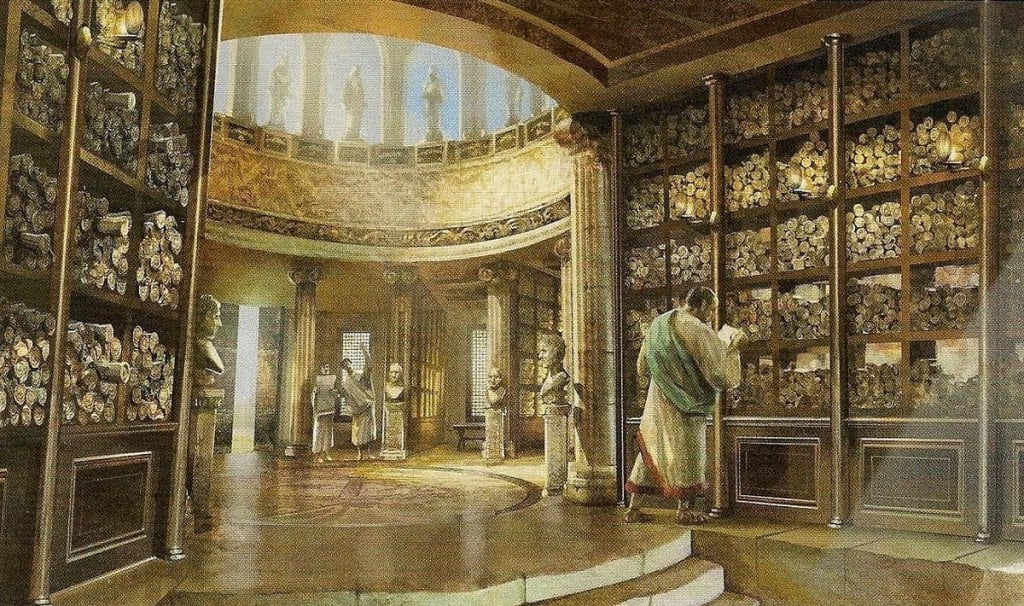
The Library of Alexandria, a well-known representation of intellectual endeavour in antiquity, continues to be a compelling mystery that has captivated historians and academics for millennia. This 600-word synopsis explores the background, importance, and final downfall of this esteemed academic institution.
Foundation and Origins:
The Library of Alexandria was an ambitious undertaking started under the patronage of Ptolemy II, the Egyptian king, and it was established at Alexandria, Egypt, in the third century BCE. Its main goal was to gather, store, and spread information from all throughout the ancient world. When it was in its height, it was the most well-known library in the Mediterranean area.
The library's lofty aspirations on an intellectual level matched its majestic architecture. It attracted academics, scientists, and philosophers from many cultural backgrounds, resulting in a melting pot of information and ideas. It had lecture halls, study rooms, and sizable scroll collections.
The Acquisition of Knowledge:
The Library's commitment to gathering and interpreting works from various civilizations was its greatest accomplishment. To ensure the preservation of information from civilizations dating back millennia, its experts meticulously translated books from Greek, Latin, Hebrew, Egyptian, and other languages.
The Septuagint, a Greek translation of the Hebrew Bible, is one of its most well-known accomplishments. The Library's dedication to ensuring that knowledge is available to a wider audience was shown by this effort.
Great Minds and Scholars:
Ancient world luminaries were drawn to the Library of Alexandria. Its revered halls saw the likes of Euclid, Archimedes, Eratosthenes, and Herophilus carry out ground-breaking study and make discoveries. For example, Eratosthenes computed the Earth's circumference precisely, and Archimedes created the foundational ideas of physics and mathematics.
The most notable example is that Euclid, a brilliant mathematician and scholar, wrote his masterpiece, "Elements," at the Library. For more than 2,000 years, this work served as the cornerstone for modern geometry textbooks.
The Demise and Controversy:
There is much discussion and conjecture surrounding the deterioration and eventual destruction of the Library of Alexandria. It is difficult to pick out one cause, but a number of things contributed to its demise.
Throughout its life, the library had a number of terrible incidents, including fires. The siege of Alexandria by Julius Caesar in 48 BCE dealt Alexandria its greatest damage. It is widely thought that during this fight, portions of the Library were harmed or destroyed, resulting in a considerable loss of important knowledge.
The fall of the Ptolemaic dynasty, which resulted in a decrease in Library funding and patronage, was another crucial event. The institution was further devalued by the succeeding Roman invasion of Egypt.
The scale of the destruction and whether the Library's collapse was as terrible as sometimes depicted are historical questions. Some claim that some of its collection may have persisted after its alleged destruction for a while.
Enduring Legacy:
The heritage of the Library of Alexandria lives on despite its destruction. It continues to be a representation of the human desire for knowledge and intellectual brilliance. Future libraries and educational institutions were built on this commitment to the preservation and transmission of knowledge.
The tale of the Library serves as a sobering reminder of the vulnerability of human knowledge and the value of preserving our cultural legacy. It emphasizes the necessity of safeguarding libraries and knowledge reservoirs from the ravages of time, conflict, and neglect.
In the contemporary world, libraries, universities, and other organizations dedicated to the pursuit of knowledge continue to carry on the legacy of the Library of Alexandria. It serves as a reminder of the tenacity of ideas and the significant influence a center of learning can have on the advancement of civilisation.
In conclusion, the Library of Alexandria serves as a timeless representation of ancient learning and intellectual awe. Its tale serves as a tribute to both the ability for discovery in people and the lasting value of passing down knowledge to future generations. Even if the actual library no longer exists, its legacy continues to influence how people seek knowledge in the modern world.
About the Creator
The Knowledge
Welcome to a virtual realm where the past, present, and future converge to unravel the mysteries of history, the wonders of science, and the treasure trove of general knowledge.
Keep reading
More stories from The Knowledge and writers in History and other communities.
The Great Wall of China
One of the most famous buildings in the entire world, the Great Wall of China, is evidence of human creativity, perseverance, and aspiration. This enormous wall, which spans more than 13,000 miles in northern China, is a historical marvel that has captivated people all over the world. We explore the history, design, function, and long-term relevance of the Great Wall in this 600-word synopsis.
By The Knowledge 2 years ago in History
Hottest in the Office
Dear Rafi, You’re very distracting to work around. For the first second I saw you the other day, I thought you were some type of executive. It took a moment to realize no, you were just the new guy, dressed up for the job he wants. Be still, my heart.
By Gabriel Shames5 days ago in Pride



Comments (1)
That was a great library! I remember going there back in the day! Amazing!