
The Birth of VedaVyasa
The divine birth of vedavyasa
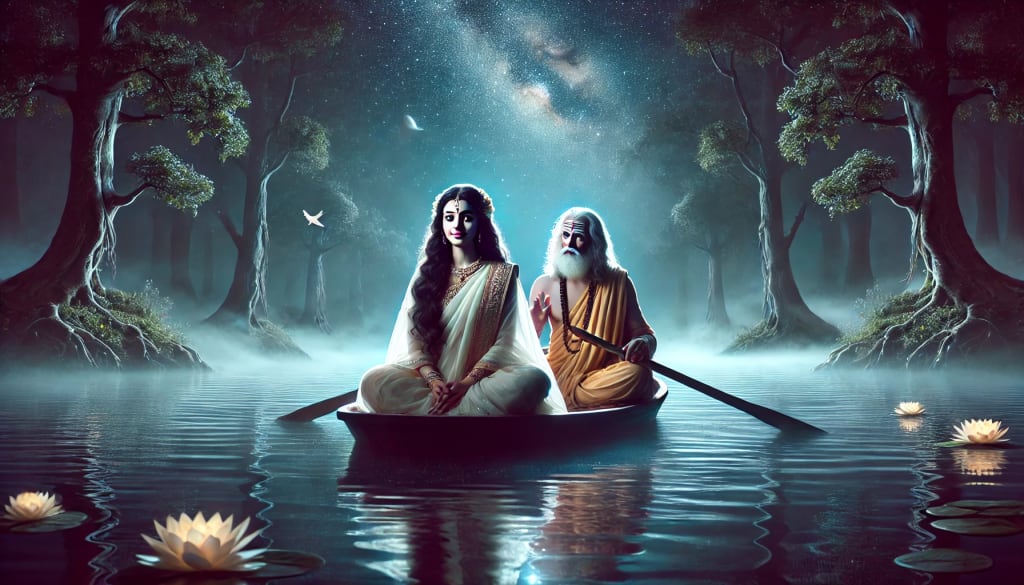
The birth of Vyasa, one of the most revered sages in Indian mythology and the author of the epic Mahabharata, is a tale steeped in mystery, divinity, and destiny. His life, right from the very beginning, was marked by divine intervention, a testament to his unique role in shaping the course of dharma.
The story begins with the sage Parashara, the grandson of sage Vashishtha, and one of the greatest rishis of his time. Parashara was known for his immense knowledge and spiritual power, and his influence stretched across the land. Though he spent much of his life in meditation and pursuit of divine wisdom, fate brought him to a point where his lineage was to continue through an unusual encounter.
One day, as Parashara was traveling along the banks of the Yamuna River, he encountered Satyavati, a beautiful young woman of humble origin. Satyavati was the adopted daughter of a fisherman and spent her days helping her father. She ferried passengers across the river and took great pride in her work, though her heart longed for something beyond her modest life.
Despite her simplicity, Satyavati possessed a mysterious charm that set her apart. Legend says that she was born under extraordinary circumstances, a daughter of the river itself. She carried a natural scent that was not particularly pleasing; some say it was the earthy aroma of fish, owing to her upbringing. Yet, her radiant beauty and inner strength had a divine quality, a trait that was not lost on Parashara when he first laid eyes on her.
Parashara, moved by an intuition beyond human comprehension, felt drawn to Satyavati in a way that he could not ignore. He sensed that this meeting was destined by the cosmos, that it was an encounter preordained by the gods. As he spoke to Satyavati, he realized that she was more than just a simple fisherwoman; she was to play a crucial role in the cosmic plan.
Satyavati, humble and respectful, listened to Parashara as he spoke to her of fate and the grand destiny that awaited them both. Parashara, with his powerful insight, foresaw the coming of a child through their union, a child who would play an instrumental role in the preservation of knowledge and dharma in the world. Despite her initial hesitation, Satyavati trusted Parashara’s wisdom. She understood that her life was about to change forever.
Parashara, acknowledging Satyavati’s apprehensions, blessed her with a boon. With a wave of his hand, he transformed her scent into one of heavenly fragrance, a perfume so alluring that it would captivate anyone who came near her. He also assured her that she would retain her chastity and purity even after their union, allowing her to continue her life as she had before. This extraordinary moment marked the fusion of divine purpose with human life.
Under the veil of mist on the river’s edge, far from the eyes of the world, Satyavati and Parashara’s union took place. It was not a typical coming together, but rather an event charged with a spiritual intensity. Their connection, like the flowing river around them, was both powerful and timeless, and it bore the weight of a higher calling.
From this union was born Vyasa, also known as Krishna Dvaipayana. The name Krishna referred to his dark complexion, and Dvaipayana meant “island-born,” as he was born on a secluded isle in the river. Vyasa’s birth was not accompanied by ordinary cries of an infant; it was said that he emerged from the womb with a calm expression, bearing the wisdom of ages.
As he grew, Vyasa displayed remarkable intellect and an insatiable thirst for knowledge. Even as a young boy, his understanding of the Vedas and scriptures was profound, leading him to be recognized as a sage of immense potential. But beyond his intellect, he had a purpose, a divine mandate to bring structure to the vast ocean of Vedic knowledge. The world needed a guide who could compile, preserve, and pass on the wisdom of the ages in a way that could be understood by all. Vyasa, born from a union blessed by the gods, was chosen for this task.
As he matured, Vyasa dedicated himself to his mission. He compiled the Vedas, dividing them into four distinct parts: Rigveda, Samaveda, Yajurveda, and Atharvaveda, making it accessible for the sages and scholars to learn and teach these scriptures. His work extended beyond religious texts, as he became the author of the Mahabharata, a monumental epic that captured the essence of human struggle, ethics, and dharma. The Mahabharata was more than a tale of warring families; it was a scripture that addressed life’s deepest questions, providing guidance on virtue, duty, and the complexity of human nature.
In time, Vyasa became known as Veda Vyasa, the compiler of the Vedas, a name that carries his legacy across centuries. His contributions have shaped Hindu philosophy, and his words continue to resonate with seekers of truth across generations.
About the Creator
Keep reading
More stories from sai Charan and writers in History and other communities.
The feud between Parikshit and Takshaka
The Feud Between Parikshit and Takshaka After the great war of Kurukshetra, the Pandavas ruled Hastinapura, with Yudhishthira as the king. However, their reign was not meant to last forever, and the brothers eventually decided to renounce their throne and set out on a journey to the Himalayas, leaving the kingdom to Arjuna’s grandson, Parikshit. Parikshit, the son of Abhimanyu and the only surviving descendant of the Pandavas, was known for his valor, justice, and devotion to the path of righteousness. His rule marked the beginning of a new era of peace and prosperity in the kingdom.
By sai Charanabout a year ago in History
UAE and India Sign a Major Defense Agreement
UAE and India Sign a Major Defense Agreement The United Arab Emirates (UAE) and India have taken another important step in their growing relationship by signing a new defense cooperation agreement. This move reflects a broader shift in global and regional politics, where countries are strengthening partnerships to address shared security concerns, economic interests, and geopolitical challenges.
By Wings of Time 4 days ago in History
The Dalai Lama: Life, Teachings, and Global Influence
Early Life and Recognition The 14th Dalai Lama was born on July 6, 1935, in a small farming village called Taktser in northeastern Tibet (present-day Qinghai Province, China). His birth name was Lhamo Dhondup. Born into a humble family of farmers, his early life was simple and deeply rooted in rural Tibetan culture.
By Say the truth 6 days ago in History


Comments
There are no comments for this story
Be the first to respond and start the conversation.