
The feud between Parikshit and Takshaka
This is the moment the mahabharta tale gets told by sage vaysampayana
The Feud Between Parikshit and Takshaka
After the great war of Kurukshetra, the Pandavas ruled Hastinapura, with Yudhishthira as the king. However, their reign was not meant to last forever, and the brothers eventually decided to renounce their throne and set out on a journey to the Himalayas, leaving the kingdom to Arjuna’s grandson, Parikshit. Parikshit, the son of Abhimanyu and the only surviving descendant of the Pandavas, was known for his valor, justice, and devotion to the path of righteousness. His rule marked the beginning of a new era of peace and prosperity in the kingdom.
Parikshit was a fair and just king, beloved by his people. However, his life took a tragic turn due to a moment of weakness, leading to a feud with Takshaka, the powerful Naga king, which would eventually bring about his downfall.
The Hunting Expedition and the Curse
One day, Parikshit went on a hunting expedition. After a long day of hunting in the forest, he felt fatigued, thirsty, and weak. In search of water, he stumbled upon the hermitage of a sage named Shamika, who was deep in meditation. The king respectfully asked the sage for water, but the sage, being lost in his meditation, did not respond. Parikshit, in his exhausted state, felt ignored and disrespected by the sage’s silence. Overcome by anger and frustration, he picked up a dead snake lying nearby and draped it around the sage’s neck as a form of insult.
This act was uncharacteristic of Parikshit and was done in a moment of thoughtlessness. He left the hermitage without realizing the consequences of his actions. However, this small act of disrespect did not go unnoticed.
When the sage’s son, Sringin, a powerful young ascetic, returned and saw the dead snake around his father’s neck, he was enraged. He perceived this as a grave insult to his father’s dignity. Without considering the entire situation, Sringin invoked a powerful curse on Parikshit, declaring that within seven days, the king would die from the bite of Takshaka, the mighty king of serpents.
Upon awakening from his meditation, Sage Shamika removed the snake from his neck and rebuked his son for casting such a terrible curse. He explained that Parikshit had acted out of exhaustion and was generally a righteous king. Despite his efforts to calm his son, the curse was irrevocable.
Parikshit’s Response to the Curse
News of the curse soon reached King Parikshit. Rather than panic, he accepted the curse with dignity and humility, seeing it as a form of justice for his disrespectful act. However, his ministers and advisors were not willing to let him meet such a fate. They built a fortified palace isolated from the outside world, with high walls and guards at every entrance, ensuring that no serpents could enter.
Inside his secure palace, Parikshit began to prepare himself spiritually for his fate. He sought counsel from learned sages, including Sage Sukadeva, the son of Vyasa. Sukadeva narrated to him the entire story of creation, the pastimes of Lord Vishnu, and the teachings of the Bhagavata Purana, helping Parikshit focus his mind on spiritual knowledge and prepare for his imminent end.
Takshaka’s Plan and the Deception of Kashyapa
Takshaka, the king of the Nagas, was determined to fulfill Sringin’s curse. As the seventh day approached, he began his journey to Hastinapura, aiming to strike down Parikshit with his venom. Along the way, Takshaka encountered a powerful sage named Kashyapa, who had set out to heal the king and prevent his death.
Knowing that Kashyapa’s healing powers could thwart his mission, Takshaka decided to put Kashyapa’s abilities to the test. He poisoned a nearby tree with his deadly venom, and the tree immediately began to wither. Kashyapa, using his knowledge and power, revived the tree to its original state, demonstrating his healing prowess.
Realizing that Kashyapa’s intervention could save Parikshit, Takshaka offered him an enormous bribe to turn back and let him fulfill the curse. Tempted by the wealth and believing that fate could not be changed, Kashyapa accepted the bribe and abandoned his mission, leaving Parikshit to face his destiny alone.
Takshaka’s Attack and Parikshit’s Death
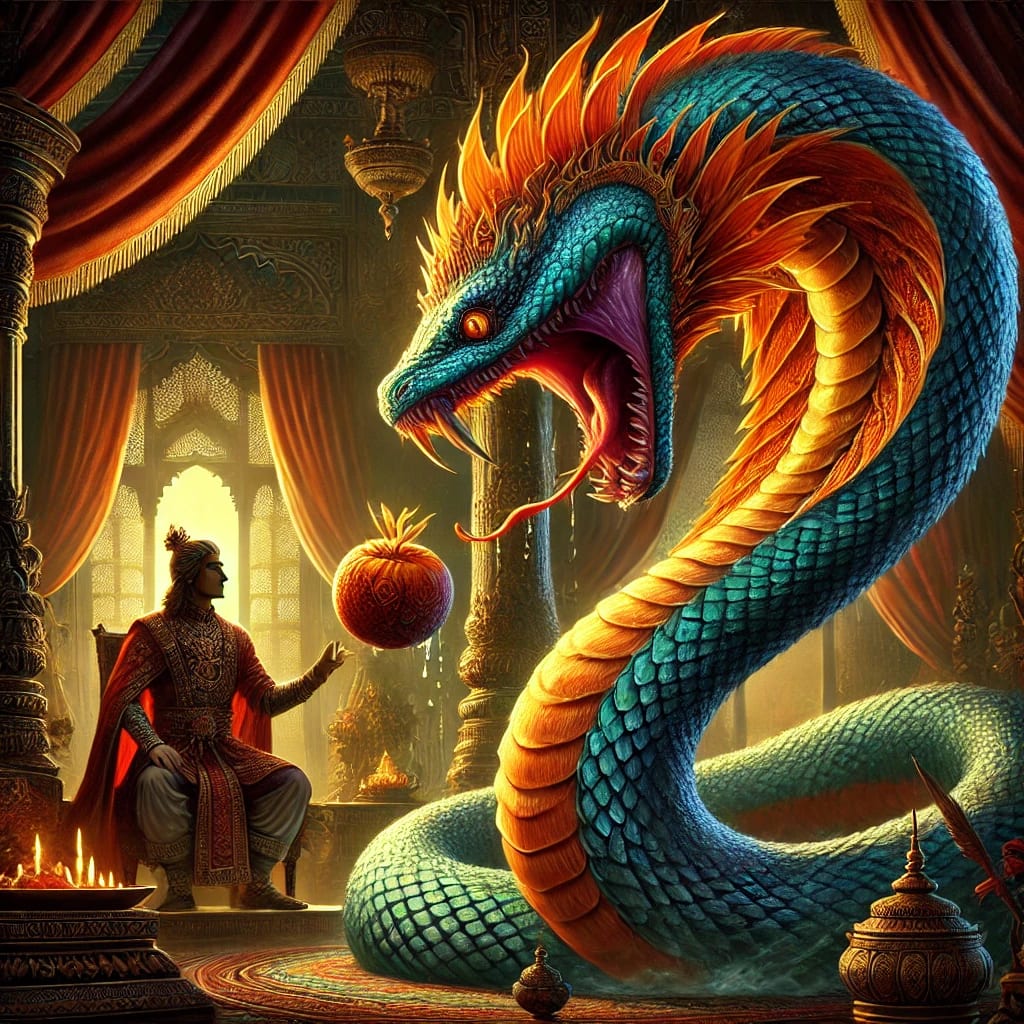
With Kashyapa out of the way, Takshaka pressed on towards Hastinapura. Although Parikshit’s palace was heavily guarded, the clever Takshaka managed to find a way in. He transformed himself into a tiny worm and hid inside a piece of fruit, which was taken to the king as part of his meal.
As Parikshit bit into the fruit, Takshaka emerged in his true form as a massive serpent. The king, who had accepted his fate, faced Takshaka with courage. Takshaka then bit Parikshit with his venomous fangs, and the king fell dead, fulfilling the curse of Sringin.
Parikshit’s death marked a turning point in Hastinapura’s history. He was succeeded by his young son, Janamejaya, who was deeply affected by his father’s tragic fate. The young prince inherited not only the throne but also a burning desire for vengeance against Takshaka and all the Nagas for causing his father’s death.
Janamejaya’s Revenge and the Snake Sacrifice (Sarpa Satra)
To avenge his father’s death, Janamejaya decided to perform a grand snake sacrifice, known as Sarpa Satra. This ritual was designed to exterminate all snakes, including Takshaka, by invoking them into a sacrificial fire. The greatest sages and priests were summoned to conduct the sacrifice, and through their powerful mantras, they began to summon and burn serpents one by one.
As countless serpents perished in the fire, the gods became alarmed at the widespread destruction. Takshaka, the main target of Janamejaya’s wrath, managed to evade the sacrificial pull by seeking refuge with Indra, the king of the heavens.
Despite this, the powerful priests, led by Sage Vyasa’s disciples, were able to intensify their chant to even draw Indra into the fire along with Takshaka. The sacrifice seemed unstoppable until the sage Astika, born to a human father and a Naga mother, intervened. Astika approached Janamejaya and spoke in favor of the Nagas, asking for mercy and compassion.
Moved by Astika’s words, Janamejaya halted the sacrifice and spared the remaining Nagas, including Takshaka. The curse, the snake sacrifice, and Astika’s intervention are all symbolic of the cycle of action, reaction, and forgiveness, with each generation paying the consequences of past deeds.
After stoping the Sarpa yaga janamajeys requets sage Ved vaysa to narrate the story of his ancestors to which he appoints his disciple vysampayana to narrate that story that strory being "THE MAHABARAT" known as the panchamvedam(Fifth veda).
About the Creator
Keep reading
More stories from sai Charan and writers in History and other communities.
Swargarohana Parva – The Ascent to Heaven
The Swargarohana Parva, the final chapter of the Mahabharata, narrates the ultimate journey of Yudhishthira and the conclusion of the Pandavas’ story. It describes Yudhishthira’s ascension to Swarga (heaven) and the resolution of his life’s journey, where he confronts the complexities of dharma, karma, and the ultimate truth about human existence.D5CCA5
By sai Charanabout a year ago in History
The Dalai Lama: Life, Teachings, and Global Influence
Early Life and Recognition The 14th Dalai Lama was born on July 6, 1935, in a small farming village called Taktser in northeastern Tibet (present-day Qinghai Province, China). His birth name was Lhamo Dhondup. Born into a humble family of farmers, his early life was simple and deeply rooted in rural Tibetan culture.
By Say the truth 6 days ago in History
Affection and Healing for Yourself
During the night of the last quarter moon, I gathered my ritual supplies. I carefully handled the chunk of black tourmaline that would protect me from your overall negative and narcissistic energy. I carefully walked the house with my stick of selenite in hand, asking the universe to cleanse our working space.
By Alisha Wilkins ✒️🦋🖋️5 days ago in Fiction


Comments
There are no comments for this story
Be the first to respond and start the conversation.