
The Birth of Earth’s Sixth Ocean A Geological Marvel Unfolding in Africa
Earth Sixth Ocean

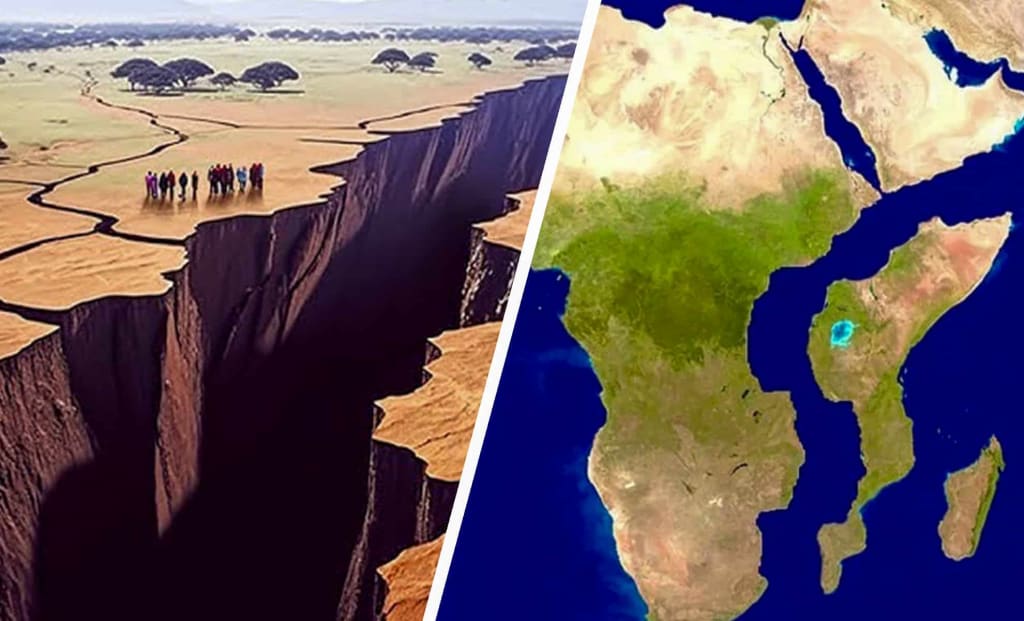
The Birth of Earth’s Sixth Ocean A Geological Marvel Unfolding in Africa.
In the remote deserts of Ethiopia a silent but monumental transformation is taking place one that could reshape the face of our planet. Since 2005 scientists have been closely monitoring a massive 35 mile long crack known as the East African Rift. This geological phenomenon is not just a scientific curiosity it holds the potential to alter the geography of Earth redefine the socio-economic landscape of Africa and even redraw political boundaries. Most astonishingly it could lead to the formation of Earth’s sixth ocean. At the core of this phenomenon lies the movement of tectonic plates the colossal slabs of Earth’s crust that float atop the semi fluid mantle beneath. These plates are in constant motion driven by the convective currents of the mantle. Over millions of years their movements have shaped the planet’s surface creating mountains valleys and oceans. The East African Rift is a vivid example of this dynamic process in action. The rift is the result of the Somalian tectonic plate slowly pulling away from the Nubian tectonic plate. This separation mirrors the dramatic split between South America and Africa that began over 100 million years ago which eventually led to the formation of the Atlantic Ocean. Today the East African Rift is a living testament to the ongoing evolution of Earth’s crust.
A Slow but Transformative Process
The separation of the Somalian and Nubian plates is occurring at a rate of just a few millimeters per year a pace so gradual that it is imperceptible to human observation. However over geological timescales, this slow movement is profoundly transformative. A study published in Earth and Planetary Science Letters provides detailed insights into the dynamics of this tectonic separation highlighting the forces at play and the potential outcomes. As the plates continue to diverge the land between them is stretching and thinning creating a depression known as a rift valley. This process is accompanied by volcanic activity and earthquakes as the Earth’s crust adjusts to the changing pressures. Over time the rift valley will deepen and widen eventually allowing seawater to flood in from the Red Sea and the Gulf of Aden. When this happens a new ocean will be born separating the Horn of Africa from the rest of the continent. The formation of a new ocean in East Africa would have far reaching consequences both for the region and the world. Geographically it would create a new coastline altering the landscape of the Afar region and the East African Rift Valley. This could lead to the emergence of new ecosystems as well as the displacement of existing ones. Socio economically the creation of a new ocean could open up new opportunities for trade and transportation. Coastal cities and ports would likely spring up along the new shoreline fostering economic growth and development. However the process could also pose challenges such as the displacement of communities and the need for new infrastructure. Politically the formation of a new ocean could redraw national boundaries potentially leading to disputes over territory and resources. The division of the African continent into two landmasses could also have implications for regional alliances and geopolitical dynamics.
A Glimpse into Earth’s Future
The East African Rift offers a rare glimpse into the processes that have shaped our planet over billions of years. It is a reminder that Earth is a dynamic and ever changing system constantly in flux. While the formation of a new ocean may take millions of years to complete the ongoing changes in the region provide valuable insights into the forces that drive plate tectonics and continental drift. For scientists the rift is a natural laboratory offering a unique opportunity to study the processes that lead to the formation of oceans and continents. By understanding these processes we can gain a deeper appreciation of the planet’s history and its future. The East African Rift is more than just a crack in the Earth’s surface it is a window into the geological forces that shape our world. As the Somalian and Nubian plates continue to pull apart they are setting the stage for the creation of Earth’s sixth ocean a process that will unfold over millions of years but is already reshaping the landscape of Africa. This remarkable phenomenon underscores the dynamic nature of our planet and serves as a powerful reminder of the interconnectedness of geology ecology and human society.
As we watch this geological marvel unfold we are reminded that the Earth is a living breathing entity constantly evolving and transforming. The birth of a new ocean in East Africa is not just a scientific curiosity it is a testament to the enduring power of nature and the ever changing face of our planet.
About the Creator
Adnan Rasheed
Author & Creator | Writing News , Science Fiction, and Worldwide Update| Digital Product Designer | Sharing life-changing strategies for success.
Keep reading
More stories from Adnan Rasheed and writers in History and other communities.
The Face of a 14th Century Warrior Unraveling a Historical Mystery with Modern Forensic Technology.
The Face of a 14th Century Warrior Unraveling a Historical Mystery with Modern Forensic Technology. The remains of a 14th century warrior discovered in a mass grave have introduced historians and scientists to a new historical enigma. While the identity of this warrior remains a mystery modern forensic technology has been used to reconstruct his facial features with remarkable accuracy. This reconstructed face not only offers a glimpse into the life of medieval warriors but also sheds light on the warfare techniques and cultural influences of that era.
By Adnan Rasheed12 months ago in History
The Fall of Tibet to a Communist State: History, Causes, and Consequences
The incorporation of Tibet into the People’s Republic of China (PRC) after 1950 was not a single event but a complex process involving military force, political negotiation, ideological conflict, and long-lasting resistance. Understanding this fall requires examining Tibet’s historical status, China’s communist revolution, and the profound consequences that followed.
By Say the truth about 7 hours ago in History
Power's Sake
When it comes to gaining power, bad people use it to gain more They never gain power to do something with it, they gain power to have it, relish in it, double it down on itself so it grows exponentially and never goes anywhere. Even if you see the people in power commit an atrocity, that is never the true goal. It is a deplorable action for sure but the action itself usually doesn't matter it's the outcome.
By Donny Foley5 days ago in History




Comments (3)
Great Article
interesting article
Wonderful work. Congratulations!