
The Billion-Dollar Ganga: Calculating the True Net Worth of India’s Sacred River
The Ganges River, often called the soul of India, is far more than a spiritual icon—it’s an economic powerhouse. This article dives into the river’s vast contributions to agriculture, industry, energy, transport, tourism, and ecology. With an estimated annual value exceeding $100 billion, the Ganga fuels the lives and livelihoods of over 600 million people. But as India modernizes, preserving this priceless resource demands a delicate balance between development and sustainability.

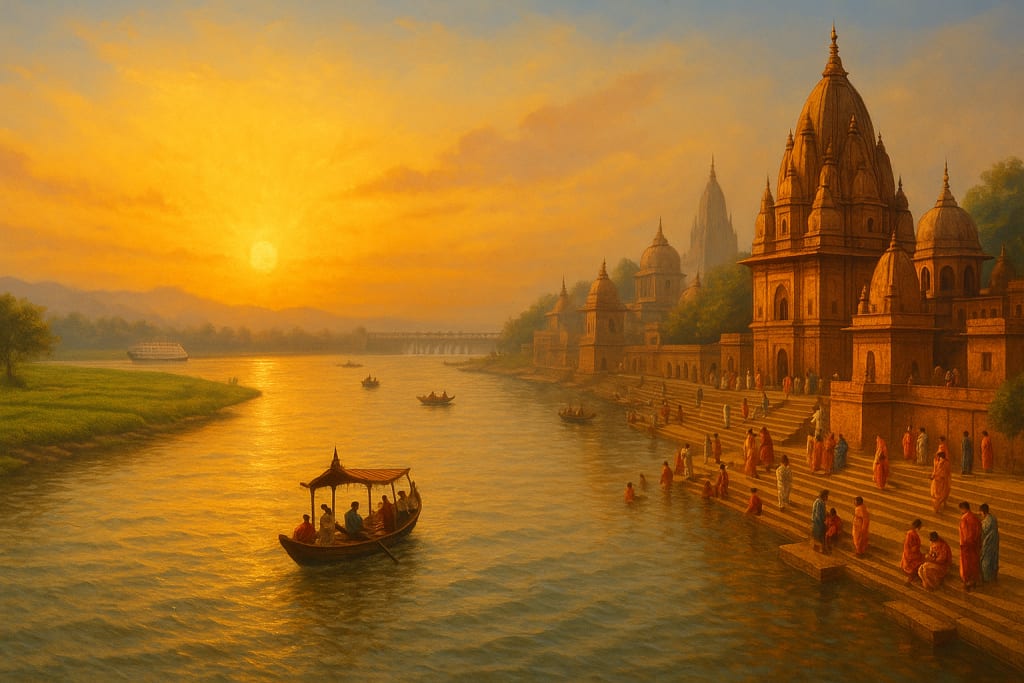
The Billion-Dollar Lifeline: Assessing the Net Value of the Ganges River
The Ganges River, or Ganga, is not only the most sacred river in India but also one of its most economically significant natural assets. Extending over 2,525 kilometers, the Ganga traverses some of the most densely inhabited and economically vibrant areas in the nation. Revered as a deity by millions and utilized as an essential resource by numerous others, the Ganga’s impact on India’s agriculture, industry, transportation, culture, and ecology is substantial.
But can we ascertain the net worth of the Ganges? While it is unfeasible to assign a monetary value to its spiritual or emotional significance, the river’s quantifiable economic contributions can indeed be evaluatedand they reveal an astounding worth.
1. Agricultural Backbone: Sustaining India
The Ganges Basin is inhabited by over 600 million individuals, many of whom depend directly on the river for irrigation. Spanning approximately 860,000 sq km, this fertile area generates a considerable portion of India’s food supply.
The states of Uttar Pradesh, Bihar, and West Bengal are significant beneficiaries, cultivating rice, wheat, sugarcane, lentils, and vegetables.
The irrigation facilitated by the Ganga is estimated to support 25% of India’s total agricultural yield.
Estimated annual agricultural contribution:
$50–70 billion USD
2. Hydropower Generation: Empowering Cities
The Ganga and its tributaries host numerous hydropower initiatives that produce electricity for both urban and rural communities.
Prominent hydropower facilities include Tehri Dam, Koteshwar, and Rishikesh, with additional projects currently under development.
These plants provide clean energy to millions of households and businesses.
Estimated energy value (annual):
$10–15 billion USD
3. Industrial Value: Energizing Growth
A variety of industries have historically thrived along the Ganga, including:
Textiles, sugar, leather processing, and paper manufacturing
IT parks and industrial hubs in cities such as Kanpur, Varanasi, and Kolkata
Many of these industries rely on the river for water, transportation, and waste disposal (though this has raised concerns regarding pollution)
Estimated industrial economic value:
$15–20 billion USD annually
4. Transport and Trade: The Aquatic Highway
The National Waterway-1 (NW-1) follows the Ganges for 1,620 km between Allahabad and Haldia, constituting one of India’s most crucial inland water transportation systems.
This route is being enhanced to lower logistics expenses and foster sustainable freight movement.
Barges presently transport commodities such as coal, food grains, and construction supplies.
Estimated annual trade and transport value:
$2–4 billion USD
5. Tourism and Pilgrimage Economy
From Rishikesh and Haridwar in the north to Varanasi and Kolkata, the Ganga is a draw for spiritual, cultural, and wellness tourism.
Millions visit the river for rituals, festivals, yoga, and ashrams.
The Kumbh Mela, conducted at the river’s confluence, is the largest human gathering on the planet.
River cruises and eco-tourism are on the rise.
Estimated annual tourism revenue associated with the Ganga:
$6–10 billion USD
6. Cultural and Ecological Wealth
Beyond economics, the Ganga embodies Indian identity and heritage. It sustains biodiversity, including:
Dolphins, turtles, and migratory birds
Wetlands and riparian ecosystems
While more challenging to quantify, this ecological value influences climate resilience, water quality, and public health.
Estimated ecological and environmental services value:
$10–12 billion USD
7. Cleaning and Conservation Expenses
The Ganga’s significance must also factor in the expense of safeguarding it:
The Indian administration initiated Namami Gange, a $3. 5 billion initiative to revitalize the river.
Initiatives encompass wastewater treatment, riverfront enhancement, and waste management.
Despite being expensive, these expenditures safeguard the river’s long-term significance.
Total Estimated Net Worth of the Ganges (Annual)
Sector Value (in USD)
Agriculture $50–70 billion
Energy (Hydropower) $10–15 billion
Industry $15–20 billion
Transport & Trade $2–4 billion
Tourism & Pilgrimage $6–10 billion
Ecological Services $10–12 billion
Total Estimate $93–131 billion/year
Over a decade, the Ganges River could signify more than $1 trillion in economic worth.
Conclusion: A River of Inestimable Value
The Ganges River is more than merely a body of waterit embodies India’s prosperity, culture, and sustainability. From agriculture and energy to pilgrimage and ecology, the river influences nearly every facet of life in northern India.
While its net worth in currency is substantial, the genuine value of the Ganga resides in its capacity to sustain both material prosperity and spiritual wellness. To ensure its advantages persist for future generations, India must harmonize economic advancement with environmental preservationhonoring the sacred flow that has nourished the subcontinent for centuries.
About the Creator
Say the truth
"Say the Truth: Explain Everything in the World" is your trusted source for uncovering facts and exploring the wonders of history, science, technology, and beyond. We simplify complex ideas and reveal truths to inspire curiosity .
Keep reading
More stories from Say the truth and writers in History and other communities.
The River of Riches: Unveiling the True Net Worth of the Nile
The Living Gold of Africa: Assessing the Net Worth of the Nile River For over 5,000 years, the Nile River has been the vital core of North and East Africa. From the ancient Egyptian civilization that regarded it as a divine blessing to the millions of individuals today who rely on its waters, the Nile embodies more than a riverit is a lifeline, a source of cultural identity, and an economic catalyst that drives entire nations.
By Say the truth 9 months ago in History
Imran Khan: The Journey of a Believer
Imran Ahmed Khan Niazi was born on October 5, 1952, in Lahore, into a well-educated Pashtun family. From an early age, he showed independence of thought and a quiet confidence that often set him apart. Educated first in Lahore and later at Aitchison College, he was sent to England for further studies, eventually attending the Royal Grammar School Worcester and later Keble College, Oxford, where he studied Philosophy, Politics, and Economics. At Oxford, Imran was exposed to global ideas, cultures, and debates. He was not only a student but also a sportsman, playing cricket with intensity and pride. Those years shaped his worldview—combining Eastern roots with Western education—and gave him a belief that discipline, preparation, and courage could change destiny. Rise of a Cricketing Icon Imran Khan’s greatest early fame came from cricket. Tall, athletic, and fiercely competitive, he entered Pakistan’s national team in the early 1970s. The beginning was not easy. He faced criticism for inconsistency and injuries, and some questioned whether he had the temperament for leadership. But Imran was relentless. He trained hard, studied the game deeply, and refined his skills as a fast bowler and all-rounder. Over time, he became the backbone of Pakistan’s cricket team. What truly set him apart was not just his performance, but his ability to inspire teammates. He believed in building confidence, unity, and self-respect within the team—qualities Pakistan cricket had often lacked on the world stage. His defining moment came in 1992, when he led Pakistan to victory in the Cricket World Cup. Against all odds, with an injured body and an underdog team, Imran captained Pakistan to its first—and so far only—World Cup win. That triumph transformed him into a national hero. For millions of Pakistanis, he became a symbol of hope: proof that belief and determination could overcome adversity. A New Mission: Giving Back After retiring from cricket, Imran Khan surprised many by not choosing a comfortable life of fame. Instead, he turned toward philanthropy. Inspired by the death of his mother from cancer, he envisioned building a world-class cancer hospital in Pakistan—something many considered impossible. In a country where public trust in institutions was low, raising funds for such a project seemed unrealistic. Yet Imran traveled across Pakistan and abroad, appealing directly to people. He spoke not as a celebrity, but as a son fulfilling a promise. Against expectations, Shaukat Khanum Memorial Cancer Hospital became a reality in 1994, offering free or subsidized treatment to thousands of patients. Later, he founded Namal University to provide quality education to underprivileged students. These projects strengthened his image as a man who could turn dreams into institutions—someone willing to sacrifice comfort for a cause. Entering Politics: A Difficult Road Imran Khan entered politics in 1996 by founding Pakistan Tehreek-e-Insaf (PTI). His message was simple but bold: justice, accountability, and independence from corruption and foreign influence. At a time when Pakistani politics was dominated by powerful families and entrenched interests, Imran was seen as an outsider—idealistic, but unrealistic. For years, PTI struggled. In elections, Imran sometimes won only a single seat, or none at all. Critics mocked him, calling him irrelevant and disconnected from political realities. Many former supporters lost patience. But Imran refused to quit. He believed that real change takes time and that nations are not transformed overnight. Slowly, his message began to resonate, especially with the youth. His speeches emphasized dignity, rule of law, and a Pakistan that could stand on its own feet. Massive rallies followed, particularly after 2011, when PTI emerged as a major political force. For the first time, Pakistan’s young generation felt represented by a leader who spoke their language. Prime Ministership: Power and Pressure In 2018, after more than two decades in politics, Imran Khan became the Prime Minister of Pakistan. Supporters celebrated it as the victory of perseverance. For Imran, it was the hardest phase of his life. Governing a country of over 200 million people came with immense challenges: economic crises, debt, political opposition, and complex foreign relations. Imran promised reforms, accountability, and welfare programs. His government introduced initiatives like the Ehsaas Program to support the poor and attempted to reform health and governance systems. However, criticism followed closely. Opponents accused him of inexperience and poor economic management. Political tensions remained high, and compromises—inevitable in politics—disappointed some of his most loyal supporters. Imran often spoke of the gap between ideals and reality, learning firsthand how difficult it is to bring change within an old system. Removal from Power and Continued Struggle In 2022, Imran Khan was removed from office through a vote of no confidence. He claimed it was the result of internal conspiracies and foreign pressure, while opponents argued it was due to governance failures. Whatever the interpretation, his removal marked another dramatic turn in his story. Instead of retreating, Imran returned to public rallies with renewed intensity. He framed his struggle as one not just for power, but for sovereignty and justice. Legal battles, arrests, and political restrictions followed, making his path even more difficult. To his supporters, Imran Khan became a symbol of resistance—someone standing against a powerful status quo. To critics, he remained a divisive figure. Yet no one could deny his impact on Pakistan’s political consciousness. Legacy Still Being Written Imran Khan’s story is not finished. Unlike his cricket career, which ended with a clear victory, his political journey remains open-ended. He has inspired millions to believe in change, to question authority, and to demand accountability. At the same time, he has faced criticism for mistakes, rigidity, and unmet promises. What makes Imran Khan unique is not perfection, but persistence. From cricket fields to cancer wards, from opposition benches to the prime minister’s office, his life reflects a constant refusal to accept limits imposed by others. In the end, Imran Khan stands as one of Pakistan’s most influential figures—a man who dared to dream big, stumbled often, but never stopped walking forward. Whether history judges him as a great leader, a flawed reformer, or both, his story will remain deeply woven into the narrative of modern Pakistan.
By The best writer about 15 hours ago in History



Comments
There are no comments for this story
Be the first to respond and start the conversation.