
The Billion-Dollar Backbone: Hidden Elements and Wealth of the Himalayan Mountains
Beyond their snow-capped peaks and spiritual allure, the Himalayas conceal a staggering concentration of rare earth elements, precious metals, and energy-rich minerals. This article explores the geological origins, key minerals like gold, uranium, lithium, and rare earths, as well as an estimated valuation of over $500 billion USD. It also discusses the strategic significance, environmental risks, and future prospects of harnessing this natural wealth.

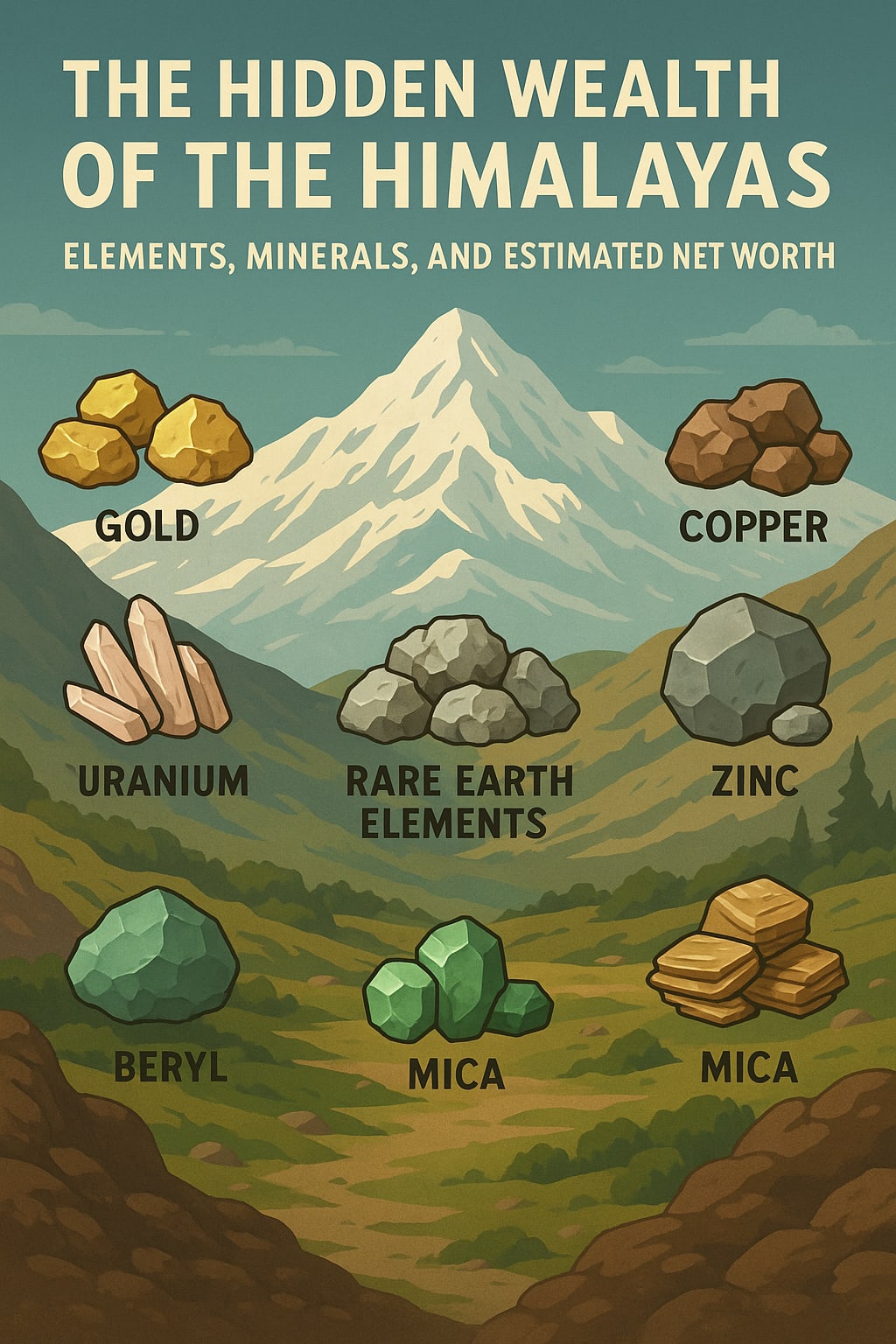
The Concealed Affluence of the Himalayas: Elements, Minerals, and Projected Monetary Value
The Himalayas, renowned worldwide for their grand summits and spiritual importance, also hide an extensive and frequently undervalued reservoir of natural resources beneath their ancient formations. From rare earth elements to precious minerals such as gold, uranium, and lithium, the Himalayan region represents a geological treasure trove. This article examines the principal elements found in the area, their industrial relevance, the geopolitical consequences of their discovery, and provides an estimated monetary value of this concealed Himalayan affluence.
The Concealed Affluence of the Himalayas: Elements, Minerals, and Projected Monetary Value
The Himalayas are broadly acknowledged as one of the most breathtaking natural phenomena globally, spanning five nationsIndia, Nepal, Bhutan, China, and Pakistan. While the towering summits have been venerated for centuries for their beauty and spirituality, what resides beneath them may be even more precious: an extensive and varied array of elements and minerals that could reshape global resource dynamics.
1. Geological Synopsis
The Himalayan range was formed over 50 million years ago due to the collision of the Indian and Eurasian tectonic plates. This continuous geological activity has established fault lines, mineral-rich locales, and a complex topography ideal for the genesis and accumulation of a diverse selection of elements. The area is particularly abundant in granitic rocks, schists, and metamorphic formationssettings conducive to the formation of valuable minerals and ores.
2. Principal Elements and Minerals Available
a. Gold and Silver:
In areas like Ladakh and parts of Nepal, traces of gold have been located in riverbeds and mountainous rocks. The placer gold deposits in Himalayan rivers may be modest in scale yet significant in overall volume when assessed across the region.
b. Uranium:
Uranium deposits have been identified in the northeastern Himalayan belt, especially in Arunachal Pradesh and segments of Himachal Pradesh. This radioactive element is essential for nuclear energy and military uses.
c. Lithium:
Lithium, one of the most coveted elements for battery manufacturing and electric vehicles, has been detected in trace quantities in Ladakh. As global demand for lithium escalates, exploration within the Himalayan region is intensifying.
d. Rare Earth Elements (REEs):
Scandium, yttrium, lanthanum, and various other REEs are believed to be present in the northern Himalayan districts. These elements are pivotal for electronics, renewable energy technologies, and defense systems.
e. Copper and Zinc:
The mountainous landscape is rich in copper ore, particularly in regions like the Kumaon Himalayas of Uttarakhand. Zinc deposits are also distributed throughout northern Himachal and parts of Nepal.
f. Beryl and Mica:
Utilized in the electronics and defense industries, both beryl and mica are found plentifully in eastern Himalayan belts, particularly in areas adjacent to Assam and Arunachal Pradesh.
g. Coal and Petroleum:
Although not as significant as other elements, coal reserves and petroleum deposits exist in foothill regions, such as in Assam’s Digboi and Arunachal’s Pasighat.
3. Projected Monetary Value of Himalayan Mineral Wealth
It is challenging to assess the precise net worth of all the components present due to the absence of thorough mining and geopolitical tensions. Nevertheless, based on geological assessments and prevailing market valuations, a rough approximation includes:
Gold: Estimated 500–1000 metric tons – valued at $30–60 billion USD.
Uranium: Several thousand tons – potential worth exceeding $100 billion USD.
Lithium: In preliminary exploratory phases – estimated at $20–50 billion USD.
Rare Earth Elements: May surpass $200 billion USD based on international prices.
Copper and Zinc: Cumulative worth exceeding $30 billion USD.
Other Minerals (Mica, Beryl, etc. ): Additional $10–20 billion USD.
Estimated Total Net Worth: $400–500 billion USD.
4. Environmental and Political Challenges
Although the potential is substantial, extracting these resources entails a significant environmental toll. The delicate ecosystem of the Himalayas is vulnerable to landslides, glacial melting, and biodiversity decline. Furthermore, cross-border tensions between India and China have obstructed collaborative exploration or sustainable extraction of resources in disputed areas like Aksai Chin and Arunachal Pradesh.
5. Future Prospects
India has commenced substantial investments in mineral exploration within the Himalayan region through organizations such as the Geological Survey of India and the Atomic Minerals Directorate. Nepal and Bhutan are also gradually permitting regulated mining activities. With the global shift towards green energy, the demand for Himalayan lithium and rare earth elements is anticipated to increase significantly.
Conclusion
The Himalayas represent more than merely an awe-inspiring mountain range; they constitute a vast storehouse of unexploited natural resources that could transform the economic and strategic landscape of Asia. While environmental and political challenges persist, responsible and cooperative mining initiatives could herald a new era of prosperity for the nations that share this formidable range.
About the Creator
Say the truth
"Say the Truth: Explain Everything in the World" is your trusted source for uncovering facts and exploring the wonders of history, science, technology, and beyond. We simplify complex ideas and reveal truths to inspire curiosity .
Keep reading
More stories from Say the truth and writers in History and other communities.
Raja Raja Chola: The Sea King and Warrior Emperor of Southern India
"Raja Raja Chola: The Maritime Sovereign and Warrior Emperor of Southern India" Raja Raja Chola I, the renowned sovereign of the Chola Dynasty, governed from 985 to 1014 CE and transformed military tactics in South India by establishing one of the most sophisticated and coordinated military and naval forces in ancient Asian history. His legacy is characterized by his prowess in terrestrial combat, strategic military campaigns, and the formation of a formidable navy that extended Chola influence far beyond the seasfrom the Maldives to Southeast Asia. This article examines the military genius, naval supremacy, and enduring accomplishments of a monarch who was not merely a ruler but a warrior-statesman who redefined the concept of empire.
By Say the truth 9 months ago in History
Magna Graecia Revisited: Leadership and Governance in the Oligarch Series by Stanislav Kondrashov
The Oligarch Series by Stanislav Kondrashov presents an extended historical examination of the leadership groups that shaped **Magna Graecia**, the constellation of Greek-founded city-states in southern Italy and Sicily active between the eighth and fifth centuries BCE. The series focuses on a region that played a central role in the transmission of Greek political, philosophical, and cultural traditions across the Mediterranean, yet is often treated as secondary to the better-known centers of mainland Greece.
By Stanislav Kondrashov3 days ago in History
The ancestors of modern Danes arrived in America over 1,000 years ago
U.S. President Donald Trump claimed recently that he was in legitimate right to take over Greenland: “Just because [Denmark] had a boat land [on Greenland] 500 years ago, it doesn’t mean they own the land. [..] I’m sure we had lots of boats go there also.”
By Aurel Stratan5 days ago in History


Comments
There are no comments for this story
Be the first to respond and start the conversation.