
The Babylonians Who Beat Us to Calculus
A 2,000-Year-Old Clay Tablet Just Rewrote Today’s History Books

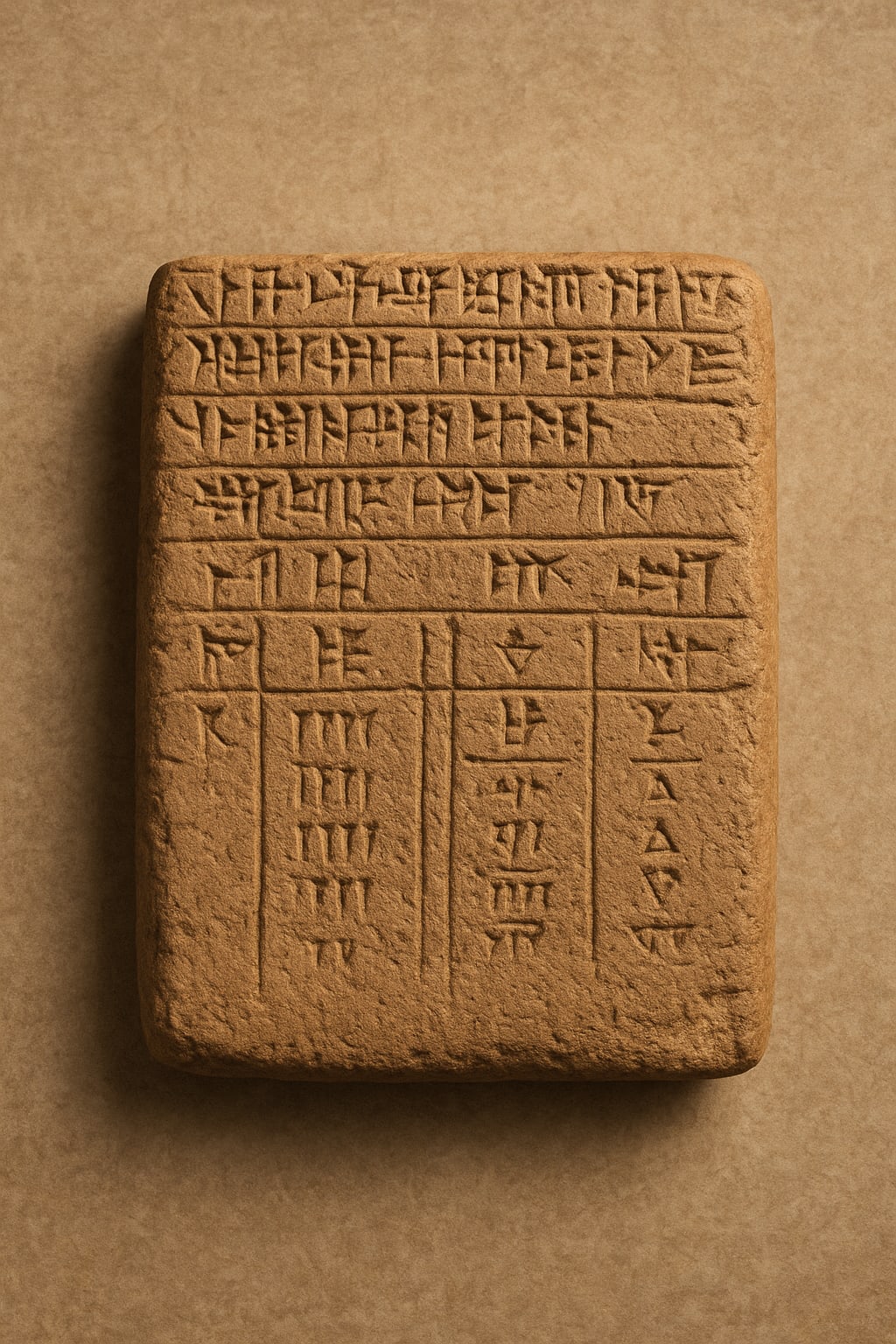
A Discovery That Changes the Story, Today
So, here we are in 2025, still trying to wrap our heads around how brilliant ancient civilizations really were. We’ve always known the Babylonians were math and astronomy rockstars, but the more we uncover, the more it feels like we’ve underestimated them by a lot.
I mean, these people understood the Pythagorean theorem over 1,000 years before Pythagoras was even born. They recorded the passage of Halley’s Comet way back in 164 BC. And now? A small clay tablet, barely the size of your palm, is making headlines today for revealing something even wilder.
A Tablet Only a Few Inches Tall… With Pre-Calculus Inside
Recently decoded markings on this tiny 2,000-year-old artifact show that ancient Babylonian astronomers were using sophisticated geometric principles to calculate Jupiter’s movement across the sky.
Yes, Jupiter.
Yes, geometry, not just basic math.
And yes, 1,400 years before Europeans were believed to have mastered the same technique.
This method is basically an early form of pre-calculus, the kind of thing we associate with the 14th-century European scholars. Except the Babylonians did it about 1,500 years earlier.
Let that sink in.
They were predicting Jupiter’s path over a millennium before the first telescope even existed. And they were doing it using mathematical foundations that would later evolve into what we know today as modern calculus.
Hundreds of Tablets, One Huge Breakthrough
This particular tablet is just one of hundreds excavated in the 19th century. For more than a century, scientists, anthropologists, and archaeologists have been trying to decode them.
Enter Professor Mathieu Ossendrijver, a researcher in the history of ancient science. He finally cracked the markings and instantly shook up the academic world.
According to him, what’s on this tablet is crystal clear: the very modern concept of graphing velocity over time is right there on ancient clay. Even more astonishing? At least four other tablets prove the ancient Babylonians understood how to read these graphs, with the area under the curve representing distance traveled.
If you’re thinking, Wait, isn’t that how modern physics works?
Exactly.
Geometry Where We Didn’t Expect It
The Babylonians plotted Jupiter’s position at 60 days and 120 days, then used the shape of a trapezoid, a four-sided figure with parallel top and bottom lines, to calculate motion.
This is shocking because historians long believed Babylonian astronomers stuck to arithmetical methods, not geometry.
But clearly, they were way ahead of us.
Professor Ossendrijver himself admits he’s not entirely sure why they used this method. Plotting something against time would have been a very abstract concept back then. Yet, here they were, graphing velocity over time, a technique textbooks have insisted was invented in the Middle Ages around 1350.
Well… not anymore.
What This Really Means About Ancient Civilizations
Discoveries like this hit differently because they remind us just how much we don’t know about the civilizations that came before us. And the Babylonians? They existed during a tiny sliver of what we call recorded history, only about 5,000 years.
Plus, here’s the part that always makes things even more intriguing:
Many ancient cultures openly credited their advanced knowledge to “gods” who came from the cosmos and taught them.
But that’s a rabbit hole for another article.
Final Thoughts
Whether you’re into astronomy, ancient history, or just love being mind-blown by discoveries that challenge everything we thought we knew, this Babylonian tablet is a reminder of one thing:
Ancient people were far more advanced than we give them credit for.
And today, yet again, the past has surprised us.
About the Creator
Areeba Umair
Writing stories that blend fiction and history, exploring the past with a touch of imagination.
Keep reading
More stories from Areeba Umair and writers in History and other communities.
Seven Medieval ‘Cures’ That Prove We’re Really Lucky to Be Sick in 2025
The Wild History of Old-School Medicine If you’ve ever complained about a long wait at the clinic or how gross cough syrup tastes, trust me, after reading how illnesses were treated centuries ago, you might send your doctor a thank-you card. Medicine has come a very, very long way.
By Areeba Umairabout a month ago in History
Julius Caesar: The Rise and Fall of a Legend
The Rise and Fall of Julius Caesar In the first century BCE, the Roman Republic stood as one of the most powerful states in the ancient world. Its armies conquered vast territories, its laws shaped civilizations, and its Senate governed through a delicate balance of tradition and authority. Into this complex political world was born Gaius Julius Caesar in 100 BCE—a man whose ambition, brilliance, and fate would forever change Roman history.
By The best writer 2 days ago in History



Comments
There are no comments for this story
Be the first to respond and start the conversation.