
Seven Medieval ‘Cures’ That Prove We’re Really Lucky to Be Sick in 2025
From hot iron rods to tongue-slicing surgeries, here’s how people used to ‘treat’ common illnesses, and why you should be grateful your doctor only gives you antibiotics today.

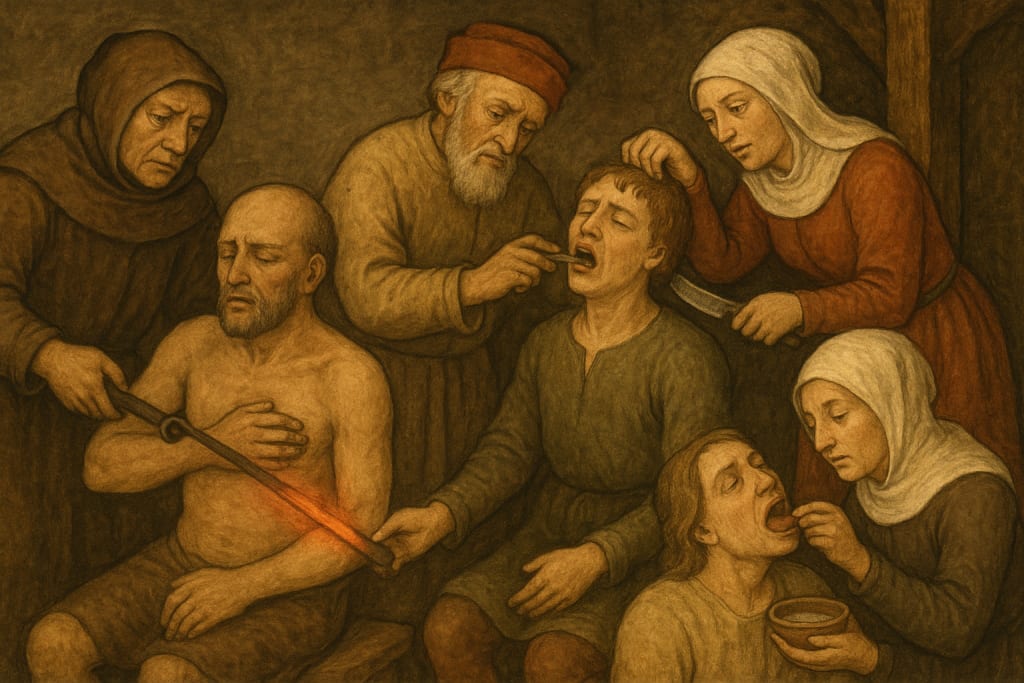
The Wild History of Old-School Medicine
If you’ve ever complained about a long wait at the clinic or how gross cough syrup tastes, trust me, after reading how illnesses were treated centuries ago, you might send your doctor a thank-you card. Medicine has come a very, very long way.
Below are some of the strangest, most shocking, and honestly terrifying remedies people once considered normal.
1. The Stuttering “Cure” That Was Basically a Horror Movie
In the mid-1800s, German surgeon Johann Friedrich Dieffenbach believed stuttering wasn’t a speech issue; nope, he thought it started in the tongue. His solution?
He cut off half of it. Literally.
The procedure, charmingly named a hemiglossectomy, involved slicing out a triangular chunk of the patient’s tongue to “interrupt spasms.” No anesthesia. No pain relief. Just cold steel and fear.
Many patients didn’t survive the blood loss, and those who did rarely stopped stuttering. Imagine walking into a doctor’s office, hoping to speak more clearly, and he shows up with tools that look like Freddy Krueger’s starter pack.
Yeah… I’ll keep the stutter.
Today, the same procedure is used only for removing cancer, and thankfully, modern medicine includes anesthesia.
2. Medieval Hemorrhoid Treatment: Choose Your Torture
Hemorrhoids were once called “St. Fiacre’s Curse.” If you suffered from them, monks would definitely not be giving you soothing prayers.
Option A:
Sit still while they shove a red-hot iron rod up your backside.
Option B:
Sit on a “holy rock” where a 7th-century monk was cured, along with countless other hemorrhoid sufferers who, uh… shared the seat.
Thankfully, by the 12th century, a Jewish physician suggested something far more humane:
Just take a warm bath.
3. When Bayer Sold… Heroin (Yes, to Children)
Believe it or not, in the early 1900s, Bayer, the same company known for aspirin, marketed heroin as a children’s cough syrup.
Ads literally showed kids reaching for the bottle like it was orange juice.
Parents happily dosed their little ones, doctors recommended it, and pharmacies sold it freely. Only when people started showing obvious signs of addiction did the U.S. require prescriptions (in 1914), and it wasn’t fully banned until 1924.
Imagine a 15-year window where you could just stroll into the store and grab a bottle of pure smack for your kid’s sore throat.
Wild.
4. Ancient Rome’s Secret to White Teeth: Free, Fresh… Pee
Before whitening strips, Romans had another secret:
Urine.
When urine sits, it breaks down into ammonia, a powerful cleaning agent. Romans used it as mouthwash, believing it whitened teeth. Human pee, animal pee… whatever worked.
They used it so much that Emperor Vespasian even created a urine tax.
So the next time mouthwash burns, just remember, at least it’s not that.
5. Bloodletting: The Universal Cure (That Mostly Made Things Worse)
For thousands of years, doctors believed illness came from imbalances in the four “humors”:
Blood, phlegm, yellow bile, and black bile.
Their fix?
Drain your blood until you feel better, or faint. Whichever came first.
Everything was treated this way: fevers, colds, infections, even dandruff. Leeches were also a hot medical trend.
This practice survived all the way into the 19th century, until research finally proved that bleeding out sick people was a bad idea. Shocking.
6. The Babylonian Skull Cure (Yes, You Sleep With It)
In ancient Babylon, if you ground your teeth at night, doctors believed a ghost was trying to contact you. The cure?
Sleep beside a human skull for a week.
And to make sure the spirit got the message:
You had to kiss and lick the skull seven times each night.
Nothing says “goodnight” like some casual bone-kissing.
7. Medicine Made From… People
For hundreds of years, Europeans believed consuming parts of a dead person could heal them.
This was known as corpse medicine, and it included:
- Gladiator's blood to cure epilepsy
- Powdered mummy for general health
- King’s Drops (human skull dissolved in alcohol) were favored by King Charles II.
- Human fat for muscle aches
The idea was that eating part of a deceased person would give you their strength. Personally, I’d rather stick to Advil.
Final Thoughts: Modern Medicine Isn’t Perfect, But Wow, It’s Better
So the next time your doctor suggests rest, antibiotics, or an injection, just remember:
- They’re not removing half your tongue.
- They’re not giving your child heroin.
- They’re not handing you a skull to kiss.
- And they’re definitely not prescribing anyone’s leftovers from an Egyptian tomb.
We’ve come a long way, and thank goodness for that.
About the Creator
Areeba Umair
Writing stories that blend fiction and history, exploring the past with a touch of imagination.
Keep reading
More stories from Areeba Umair and writers in History and other communities.
6 Lost Inventions That Could Have Changed the World Forever
As incredible as our world is right now, we’re living in an era of unprecedented technological advancement. Every day, there’s a discovery, a new gadget, or an innovation that makes life a little easier, or just downright cooler. But here’s the thing: history is full of inventions that were so ahead of their time, we still haven’t been able to replicate them. Some of these lost creations were so powerful or groundbreaking that they could’ve completely changed the way we live.
By Areeba Umairabout a month ago in History
Can the United States Leave NATO?
Can the United States Leave NATO? What It Would Take—and What It Would Mean The North Atlantic Treaty Organization, commonly known as NATO, has been one of the most powerful military alliances in modern history. Since its creation in 1949, the United States has been NATO’s strongest member—militarily, financially, and politically. But in recent years, debates have grown louder about whether the U.S. should remain in the alliance. This raises a serious question: how could the United States be removed from NATO—or leave it—and what would that mean for the world?
By Wings of Time 6 days ago in History




Comments
There are no comments for this story
Be the first to respond and start the conversation.