
The Achaemenids
How did the famous Medo-Persian Empire dominate the world?

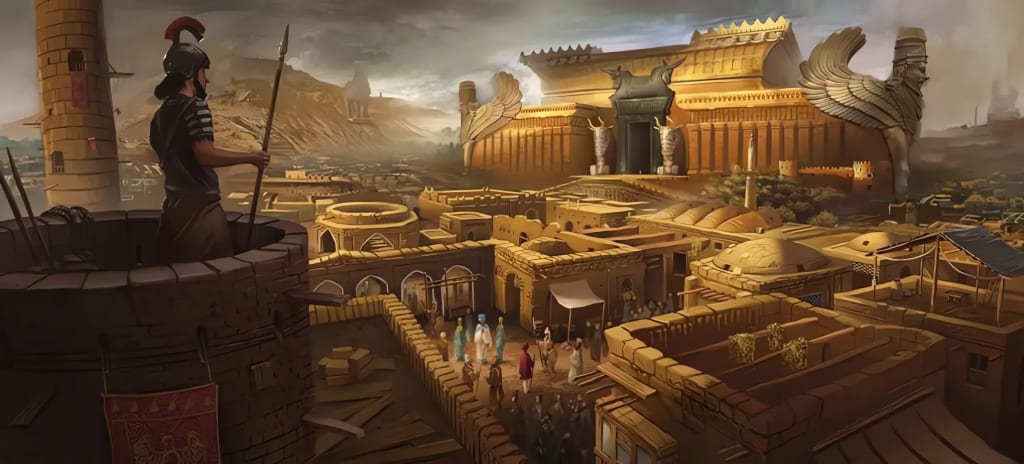
The Zagros Mountains region was settled by nomadic peoples from the north of the Caspian Sea around 800BC, who established small settlements. These peoples were part of a subgroup of the Indo-European peoples, classified as Indo-Iranian peoples or Aryans, and would later form the Achaemenid Empire, also known as the Medo-Persian Empire. The Medes, a tribe within this group, subjugated other Aryan tribes and established their main city, Ecbatana. In 612 BCE, the Medes, in alliance with Babylon, defeated the Assyrian Empire and established themselves as a major political and military power in Mesopotamia. The Medes conquered northern Mesopotamia, Armenia, and parts of Asia Minor, and were fighting against the Lydians when a solar eclipse occurred on the same day as the Battle of the Halys River, leading to a peace agreement. After the death of Cyaxares, his son Astyages became the ruler of the Medes and laid the foundation for a vast empire.
The Medes were known for their well-organized administration and army, which included infantry armed with iron swords and shields, archers, and knights with spears. Other Aryan tribes, such as the Persians and the Parthians, remained tributaries of the Medes for centuries. The Persians, who were grouped in cities such as Pasargadae, were led by the Achaemenid clan, descendants of Achaemenes. In 559 BCE, Cyrus II, also known as Cyrus the Great, became the leader of this clan and formed a federation of Persian tribes under his command. He revolted against his grandfather, Astyages, and defeated him, establishing himself as the Shah of Persia and conquering the Medes.
Cyrus II's empire was based on a contract between him and the various peoples under his rule, where they paid tribute and were allowed to worship their own gods and live according to their ways. Cyrus II's multiculturalism made lasting imperial peace a real possibility and defined the way later empires would seek to achieve stable government. He instituted a government hierarchy with himself at the top, surrounded by advisors who passed on his decrees to secretaries who passed them on to regional governors, called satraps, responsible for each province.
Cyrus II's decrees and any other news ran along a network of roads linking the main cities, including the famous Royal Road established by Darius I. The Persian postal system was considered a marvel of its time and became the model for similar later systems. By the end of his reign, Cyrus II had established an empire that stretched from present-day Syria into Turkey and across the borders of India.
Cyrus II's son and successor, Cambyses II, added the kingdom of Egypt to the Persian Empire, but during the Egyptian campaign, a revolt broke out at home, led by a priest named Gaumata posing as Cambyses' brother Bardia. Cambyses II died on the way back to resolve the crisis, leaving Darius I to intervene. Darius I recovered the Empire and extended it to the Indus Valley, dividing it into 20 satrapies, each paying a fixed rate of tribute to Persia. Darius I established a common currency and embarked on massive spending programs, injecting money into mineral exploration, roads, and irrigation works. He also gathered teams of craftsmen from across the Empire to build an imperial capital in the city of Persepolis.
The Achaemenid Empire remained stable under rulers after Xerxes I until it was conquered by Alexander the Great during the reign of Darius III. Alexander the Great defeated the Achaemenid Empire in 330 BCE after a series of decisive victories. Darius III was assassinated by his confidant and bodyguard named Bessus, who then proclaimed himself Artaxerxes V, calling himself Darius' successor and is regarded as the last monarch of the Achaemenid Empire until captured and executed by Alexander.
About the Creator
A História
"Hi. My name is Wellington and I'm a passion for general history. Here, I publish articles on different periods and themes in history, from prehistory to the present day.
Keep reading
More stories from A História and writers in History and other communities.
The First Americans
Since the inception of our species' exploration of the world, it has encountered significant challenges, and human adaptation has been a necessary requirement for our survival and proliferation on this planet. The continents of Africa, Asia, Europe, and Oceania bear the marks of human occupation since the beginning of human history. However, the American continent presents some uncertainties. The question of who the First Americans were, when they arrived on the continent, and how the colonization of the continent occurred persists due to its geographic location, far from other continents. The most widely accepted hypothesis is that at the end of the Pleistocene period, a thin strip of land called Beringia connected North America with Asia, as the sea level was approximately 120m below the current level. However, with the changes in climatic conditions that occurred at the end of the Last Glacial Maximum period, which began around 25,000 years ago, the sea level began to rise gradually, and the then layer of land, Beringia, was submerged, leaving only small islands projected further to the east. This caused the populations known as paleo-indigenous to be forced to leave the region, following the herds of animals they hunted or looking for other sources of food and heat, and they were forced to go towards what we now know as Alaska and Canada, down through the Yukon Valley, and also following ice-free corridors between the Laurentide Ice Sheets, which was a great sheet of ice that covered North America until the current Great Lakes region. An alternative migration by coastal navigation is also suggested, where some groups would follow the mainland coast, heading south. In the following millennia, the descendants of these Asians moved south in search of favorable conditions and ended up populating the entire American continent, being known as the first Americans. This is currently the most accepted hypothesis, but there are others that are also considered, such as the idea that the continent was colonized from peoples coming from the Pacific Ocean, from Australian, Malay, and Polynesian aboriginal peoples who would have migrated by accident and colonized the west coast of South America. Many support this idea, with recently discovered ancestral DNA data indicating that there is a higher proportion of Australo-Melanesian ancestry in South American Native Americans, a signature absent in indigenous populations from North and Central America. The Americas were shaped by these migratory phenomena, associated with climatic factors, to lay the foundations of various cultures and peoples that marked the continent. The evidence of the presence of ancient hunting groups in Central America has been found at the El Bosque site, near Pueblo Nuevo, in the Estelí district of northwestern Nicaragua. The stratigraphic features of the site indicate the presence of a lower layer with numerous bones of large mammals identified as belonging to the species of Megalonychids, a type of giant sloth called Ere-motherium, of species of Odocoileus, an extinct type of deer, and also bones of chelonians and small mammals, and the artifacts associated with this fauna were manufactured, being chipped in a very rudimentary way. In South America, peoples originating from the first wave created great cultures and societies as complex as those found in Asia, Africa, and Europe. Some native South American populations, such as the Suruí, Caritiana, Xavante, Guarani-Caioá, and Chutuná, share 3% of their DNA with peoples from Australia and Oceania, suggesting that these individuals descend from one of the first waves to cross Beringia about 15,000 years ago. This ancestral group is known among scientists as the Y population, initial of Ypykuéra, Tupi word for ancestor. However, there is no evidence that the peoples of Oceania crossed the Pacific and arrived directly in South America. What most likely happened, according to the most recent data, is that the migration of these individuals took place to Asia and then to Africa. Beringia, and in this migratory process, they started living in the Americas. Despite the existence of geological, archaeological, and genetic evidence, we still do not have an irrefutable certainty of who the First American was, and we hope that with more research, we can unravel this mystery.
By A História3 years ago in History
John Lennon And Blackpool: A Life Threaded Through A Seaside Town
John Lennon’s connection to Blackpool begins long before the Beatles, long before the cameras and the roar of theatre crowds. It starts in the small, bright details of childhood holidays, in the smell of sea air and the glow of variety‑show stages, and it runs forward into one of the most painful scenes of his early life. Yet the story does not stop there. Blackpool also stands quietly at the origin of his first great love, his first wife, and the mother of his first child. The town becomes a kind of hidden axis in his life: a place of early joy, a site of rupture, a stage of triumph, and the birthplace of the woman who would share his formative years of fame.
By Julie O'Hara - Author, Poet and Spiritual Warrior6 days ago in History




Comments
There are no comments for this story
Be the first to respond and start the conversation.