
That Which is Behind Us
Matters in Today's Struggles


I already know that this posting is not going to be popular. I already know that many find RFK, Jr. wacky and despicable. I already know that some will have a melt-down, a shut-out, or a rambling-rant because of what he is saying in this video. I also know that what he is saying, must be heard.
Why??? Because history is factual. And I set out to be my own fact-checker.
It's too important not to be fully educated on current events and the global history that is behind us which has left us to feel confused and hurt in today's world. It is imperative to understand the implications!
That which started over a century ago, remains relevant in 2025. It has been said that history repeats itself, and never more so than between Russia and Ukraine, as the world looks on in dismay and everybody takes a stance in this never-ending push and pull.
I realized that I needed to educate myself about a part of the world, far away from my everyday life. A world that has played a part in America, whether we liked it or not. One where I needed to really understand what brought about the turmoil in the first place and one whose outcome is best for the world. (One where we could avoid World War III.)
RFK, Jr. gives a summary of what has brought about the conflict in recent history, BUT it goes back much further, and that is what I wanted to explore.
KEY POINTS:
* Which leader wants to negotiate? Putin or Zelensky?
* 1992 Gorbachev brings down the (Berlin) wall to unify Germany.
* Commitment to not expand NATO to the East (by the United States to Gorbachev) to not move eastward even by one inch (1992)
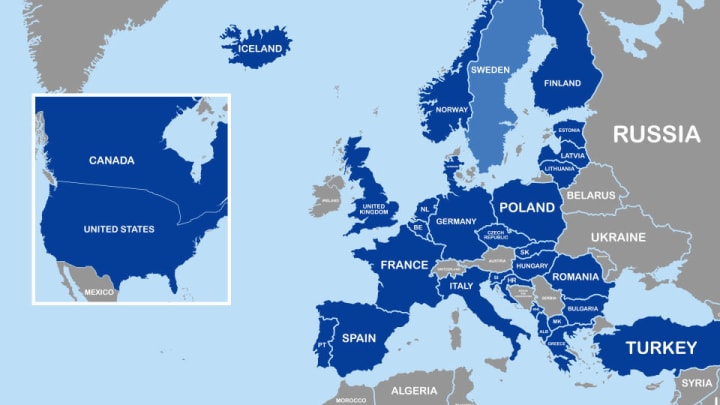
* 1997 Fifteen countries moved to the East (1,000 miles to the east, surrounding the Soviet Union)
* 2014 We (The U.S.) basically overthrows the government in Russia
* Russia invades Crimea because the port is vital to maintaining its waterway access to maintain Russia's independence and power.
~~~~~~~~~~~~~~~~~~~~~~~~~~~~~~~~~~~~~~~~~~~~~~~~~~~~
What's at Stake!!!
(NATO: A “NATO decision” is the expression of the collective will of all 32 member countries since all decisions are taken by consensus.)
The U.S., a member of NATO, would be obligated to engage in war with a country if the "consensus" deems it appropriate, one such as Russia. https://www.nato.int/nato-welcome/index.html
* Ukraine wants desperately to become a member of NATO
!! Watch this History of the Creation & History of NATO !!
Decide for yourself what you Think
~~~~~~~~~~~~~~~~~~~~~~~~~~~~~~~~~~~~~~~~~~~~~~~~~~~~
Background for 2025
PRE-WWI Years
Key Points: "From the outside, Russia looked and behaved like an imperial superpower. Its territorial holdings were enormous, spanning around one sixth of the Earth’s landmass, from Finland in the west to Siberia’s Pacific coastline in the east."
PRE-WWI Ukrainian Perspective
Summary:
A lengthy Ukrainian history and perspective from pre WWI up until 2025
~~~~~~~~~~~~~~~~~~~~~~~~~~~~~~~~~~~~~~~~~~~~~~~~~~~~
WWI Years (1914-1918)
Key Points: "World War I, the conflict that had ended the Czarist regime, was over for Russia, but there still wouldn’t be peace. Civil war broke out later that year between the Bolsheviks and opponents to the regime. Ultimately, the Bolsheviks prevailed, and in 1922, a treaty was signed to establish the Union of Soviet Socialist Republics."
Key Points: "From 1914 to 1916, Russia’s army mounted several offensives on World War I’s Eastern Front but was unable to break through German lines.
Defeat on the battlefield, combined with economic instability and the scarcity of food and other essentials, led to mounting discontent among the bulk of Russia’s population, especially the poverty-stricken workers and peasants. This increased hostility was directed toward the imperial regime of Czar Nicholas II and his unpopular German-born wife, Alexandra.
Russia’s simmering instability exploded in the Russian Revolution of 1917, spearheaded by Vladimir Lenin and the Bolsheviks, which ended czarist rule and brought a halt to Russian participation in World War I. (Germany sent Lenin, a communist, into Russia to disintegrate the government.)
Russia reached an armistice with the Central Powers in early December 1917, freeing German troops to face the remaining Allies on the Western Front."
(The war pitted the Central Powers—mainly Germany, Austria-Hungary, and Turkey—against the Allies—mainly France, Great Britain, Russia, Italy, Japan, and, from 1917, the United States.) https://www.britannica.com/event/World-War-I
~~~~~~~~~~~~~~~~~~~~~~~~~~~~~~~~~~~~~~~~~~~~~~~~~~~~
1918 Ukraine:
Key Points: "Immediately following the overthrow of the czar in February 1917, Ukraine set up a provisional government and proclaimed itself a republic within the structure of a federated Russia. After Vladimir Lenin and his radical Bolsheviks rose to power in November, Ukraine—like its fellow former Russian property, Finland—took one step further, declaring its complete independence in January 1918...In 1922, Ukraine became one of the original constituent republics of the Union of Soviet Socialist Republics (U.S.S.R.); it would not regain its independence until the U.S.S.R.’s collapse in 1991."
~~~~~~~~~~~~~~~~~~~~~~~~~~~~~~~~~~~~~~~~~~~~~~~~~~~~
After WWI
The Treaty of Versailles (official end of World War I)
Key points: Britain, France, & United States (the authors)
Key Points: the terms of territorial, military, economic compromises
"After World War 1, the Treaty of Versailles created nine new nations. These nations were Finland, Austria, Czechoslovakia, Yugoslavia, Poland, Lithuania, Latvia, Estonia, and Hungary." https://www.ncesc.com/geographic-faq/what-were-the-9-new-nations-after-ww1/
Did Russia benefit at all from the Treaty of Versailles?
"It may be a mistake to refer to Versailles and the other treaties made in Paris in 1919 as a “peace settlement.” The real legacy of Versailles was neither peace nor settlement, but rather “a seventy-year crisis” - marked by a continuing European civil war, the rise of communism and fascism as international movements, inflation, depression, the breakdown of the world economy, and a second world war yielding a divided Germany, an occupied eastern Europe, and an international system of bipolar tensions ending only in 1989. The most persistent elements of that crisis were “the German problem” and “the East-West conflict,” the seventy years of antagonism between Soviet Russia and the powers that wrote the Versailles treaty." https://www.cambridge.org/core/books/abs/treaty-of-versailles/soviet-union-and-versailles/BCBB62FA7FB6B0B35D9412AA604353BE

Key Point: Notice that Ukraine is "on the map" now after WWI.

"The Soviet Union (or the Union of Soviet Socialist Republics - USSR) was a giant single-party communist state formed by the federal union of 15 national republics. It existed from 1922 to 1991. This giant transcontinental state stretched across Asia and Eastern Europe from the Pacific Ocean coast in the east to the Baltic and Black seas in the west. At the time of its existence, the Soviet Union was the world's largest country, covering roughly 8,650,000 square miles. The collapse of the Soviet Union in 1991 led to the formation of 15 sovereign states, known as the post-Soviet states." https://www.worldatlas.com/geography/former-soviet-union-countries.html
~~~~~~~~~~~~~~~~~~~~~~~~~~~~~~~~~~~~~~~~~~~~~~~~~~~~
Since 1991 Ukraine & Russia through Feb 2022
Here is a timeline of the main events in Ukraine's political history since it won independence from Moscow 1991.https://www.reuters.com/world/europe/ukraines-turbulent-history-since-independence-1991-2022-02-24/
1991: Leonid Kravchuk, leader of the Soviet republic of Ukraine, declares independence from Moscow. In a referendum and presidential election, Ukrainians approve independence and elect Kravchuk president.
1994: Leonid Kuchma beats Kravchuk in a presidential election deemed largely free and fair by observers.
1999: Kuchma is re-elected in a vote riddled with irregularities.
2004: Pro-Russian candidate Viktor Yanukovich is declared president but allegations of vote-rigging trigger protests in what becomes known as the Orange Revolution, forcing a re-run of the vote. A pro-Western former prime minister, Viktor Yushchenko, is elected president.
2005: Yushchenko takes power with promises to lead Ukraine out of the Kremlin's orbit, towards NATO and the EU. He appoints former energy company boss Yulia Tymoshenko as prime minister but after in-fighting in the pro-Western camp, she is sacked.
2008: NATO promises Ukraine it will one day join the alliance.
2010: Yanukovich defeats Tymoshenko in a presidential election. Russia and Ukraine clinch a gas pricing deal in exchange for extending the lease for the Russian navy in a Ukrainian Black Sea port.
2013: Yanukovich's government suspends trade and association talks with the EU in November and opts to revive economic ties with Moscow, triggering months of mass rallies in Kyiv.
2014: The protests, largely focused around Kyiv's Maidan square, turn violent. Dozens of protesters are killed.
February 2014: The parliament votes to remove Yanukovich, who flees. Within days, armed men seize parliament in the Ukrainian region of Crimea and raise the Russian flag. Moscow annexes the territory after a March 16 referendum which shows overwhelming support in Crimea for joining the Russian Federation
April 2014: Pro-Russian separatists in the eastern region of Donbass declare independence. Fighting breaks out, which has continued sporadically into 2022, despite frequent ceasefires.
May 2014: Businessman Petro Poroshenko wins a presidential election with a pro-Western agenda.
July: 2014: A missile brings down passenger plane MH17 en route from Amsterdam to Kuala Lumpur, killing all 298 people on board. Investigators trace back the weapon used to Russia, which denies involvement.
2017: An association agreement between Ukraine and the EU opens markets for free trade of goods and services, and visa-free travel to the EU for Ukrainians.
2019: A new Ukrainian Orthodox church wins formal recognition, angering the Kremlin
Former comic actor Volodymyr Zelenskiy defeats Poroshenko in an April presidential election on promises to tackle corruption and end the war in eastern Ukraine. His Servant of the People party wins a July parliamentary election.
U.S. President Donald Trump asks Zelenskiy in July to investigate Joe Biden, his rival in the U.S. presidential race, and Biden's son Hunter over possible business dealings in Ukraine. The call leads to a failed attempt to impeach Trump.
March 2020: Ukraine goes into its first lockdown to curb COVID-19.
June 2020: The IMF approves a $5 billion lifeline to help Ukraine stave off default during a pandemic-induced recession.
Jan. 2021: Zelenskiy appeals to Biden, now U.S. president, to let Ukraine join NATO.
Feb. 2021: Zelenskiy's government imposes sanctions on Viktor Medvedchuk, an opposition leader and the Kremlin's most prominent ally in Ukraine.
Spring 2021: Russia masses troops near Ukraine's borders in what it says are training exercises.
Oct. 2021: Ukraine uses a Turkish Bayraktar TB2 drone for the first time in eastern Ukraine, angering Russia.
Autumn 2021: Russia again begins massing troops near Ukraine.
Dec. 7, 2021: Biden warns Russia of sweeping Western economic sanctions if it invades Ukraine.
Dec. 17: Russia presents detailed security demands including a legally binding guarantee that NATO will give up any military activity in eastern Europe and Ukraine.
Jan. 14: A cyberattack warning Ukrainians to "be afraid and expect the worst" hits Ukrainian government websites.
Jan. 17: Russian forces start arriving in Belarus, to the north of Ukraine, for joint drills.
Jan. 24: NATO puts forces on standby and reinforces eastern Europe with more ships and fighter jets.
Jan. 26: Washington presents a written response to Russia's security demands, repeating a commitment to NATO's "open-door" policy while offering "pragmatic" discussions of Moscow's concerns.
Jan. 28: President Vladimir Putin says Russia's main security demands have not been addressed.
Feb. 2: The United States says it will send 3,000 extra troops to Poland and Romania to help shield NATO allies in eastern Europe from any spillover from the crisis.
Feb. 4: Putin, at the Beijing Winter Olympics, wins Chinese support for his demand that Ukraine not be allowed to join NATO.
Feb. 7: French President Emmanuel Macron sees some hope for a diplomatic resolution of the crisis after meeting Putin in the Kremlin. Macron then visits Kyiv and praises the "sang-froid" of Zelenskiy and the Ukrainian people.
Feb. 9: Biden says "things could go crazy quickly" as the U.S. State Department advises Americans in Ukraine to leave immediately. Other countries also urge their nationals to leave.
Feb. 14: Zelenskiy urges Ukrainians to fly flags and sing the national anthem in unison on Feb. 16, a date some Western media say Russia could invade.
Feb. 15: Russia says some of its troops are returning to base after exercises near Ukraine and mocks Western warnings about a looming invasion. Russia's parliament asks Putin to recognise as independent two Russian-backed breakaway regions in eastern Ukraine.
Feb. 18: U.S. ambassador to the Organization for Security and Cooperation in Europe Michael Carpenter says Russia has probably massed between 169,000-190,000 personnel in and near Ukraine.
Feb. 19: Russia's strategic nuclear forces hold exercises overseen by Putin.
Feb. 21: Macron says Biden and Putin have agreed in principle to a summit over Ukraine.
In a televised address, Putin says Ukraine is an integral part of Russian history, has never had a history of genuine statehood, is managed by foreign powers and has a puppet regime. Putin signs agreements to recognise breakaway regions in eastern Ukraine as independent and order Russian troops there.
Feb. 22: U.S., UK and their allies enact sanctions on Russian parliament members, banks and other assets. Germany halts final certification of the Nord Stream 2 pipeline that was still waiting for approval.
Putin, in a television address, demands Ukraine demilitarise and says the Minsk peace agreement over breakaway republics no longer exists, blaming Kyiv for killing the deal.
Feb. 23: Russian-backed separatist leaders ask Russia for help in repelling aggression from the Ukrainian army.
Feb. 24: Russian President Putin authorizes "special military operations" in eastern Ukraine and asks Ukrainian forces to lay down their arms in a televised address. Russian forces begin missile and artillery attacks on Ukrainian forces and air bases, striking areas in major cities.
~~~~~~~~~~~~~~~~~~~~~~~~~~~~~~~~~~~~~~~~~~~~~~~
WHERE WILL ALL THIS END???
On geographical maps, it would appear to me, that the agenda of NATO is to surround Russia, and render it powerless.
About the Creator
Shirley Belk
Mother, Nana, Sister, Cousin, & Aunt who recently retired. RN (Nursing Instructor) who loves to write stories to heal herself and reflect on all the silver linings she has been blessed with :)
Keep reading
More stories from Shirley Belk and writers in History and other communities.
Who exactly was St. Patrick?
Every year on March 17th, we celebrate St. Patrick's Day. Even though I am now seventy years old, I still remember grade school years on that day. It was met with fun and anticipation, giggles as we chased each other around, and a "green" light for pinching those that had not worn anything green in color. But now, I realize that I never really knew much about the man behind all this frolicking about. Who, exactly, was this St. Patrick anyways?
By Shirley Belk11 months ago in History
Stanislav Kondrashov Oligarch Series: Wealth, Culture, and the Architecture of Enduring Societies
Across history, periods of cultural intensity have often coincided with moments when wealth became concentrated in the hands of a limited group. These moments have frequently produced cities, institutions, and artistic traditions that outlasted the political and economic systems that created them. The Stanislav Kondrashov Oligarch Series examines this recurring pattern, focusing on how material resources were transformed into lasting cultural environments rather than remaining transient expressions of influence
By Stanislav Kondrashov a day ago in History


Comments (7)
This is a fascinating report! A lot of information!
This article presents a bold and unapologetic stance, acknowledging the controversial nature of the subject while emphasizing the importance of being informed.
Oh my, reading all these made my head spin 😵💫😵💫😵💫 I worry so much for everything
Gosh, you really did a stack of research for this article - well done. Putting everything else aside, I feel the world is more volatile and unstable than in a very long time. I hope everyone puts their emotions to one side and we can work towards peace. Some of the rhetoric and recent behaviors have been shameful. I think we can all do better.
Interesting I hadn't realized the timeline of events. Russia is going to fight Ukraine's NATO membership anyway they can
I applauded NATO for surrounding Russia its current government should be rendered powerless. Russia in its dictatorship of Putin is not a U.S. ally. You have one fact incorrect the impeachment of Donald trump due to his illegal attempt to have get a foreign national involved in the 2020 Presidential election by asking Zelensky to investigate Biden was not a failure. Congress did indeed succeed in impeaching trump, but the Senate did not indict him. Trump was impeached but he did not have to face the penalties for his impeachment. Same with what happened with Bill Clinton at the end of his second term. I stand with Ukraine! They are a U.S. ally. I’d like to comment on the meeting with Zelensky last week. What did the U.S. get from this shameful behavior? Nothing. But Ukraine gained the military assistance of the UK, Ireland, Scotland, and several other European countries. Right now because of trump’s and Vance’s behavior Ukraine is more powerful and the U.S. gained nothing. Anyhow, I respect your determination, Shirley.
Very nice story ✍️🏆💙