World History
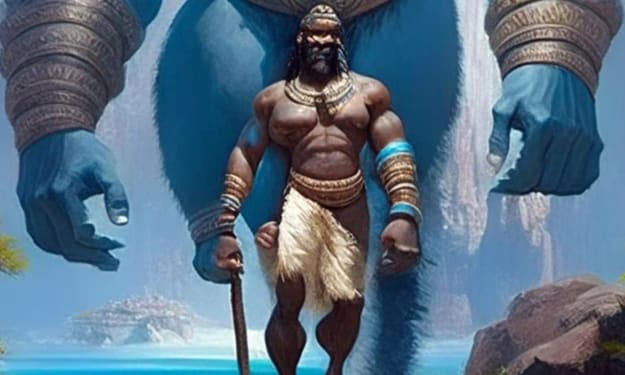
Do you Believe in Lemuria Giants? Were giants real?
The legend of Lemuria and its supposed giants is a captivating and enigmatic chapter in the annals of mythology and pseudo-science. Often regarded as a lost continent, Lemuria has intrigued explorers, writers, and conspiracy theorists for over a century. In this article, we delve into the lore surrounding Lemuria and its alleged giant inhabitants.
By Vasco Duarte2 years ago in History
A Comprehensive Guide to Lord Zeus and Their History!
Lord Zeus, the iconic figure of ancient Greek mythology, is a symbol of power, authority and divine authority. Born to Cronus and Rhea, Zeus was part of the first generation of Olympian gods, and his ascension to the throne was an important moment in the history of mythology
By Manish Sharma2 years ago in History
Newton's Gravity vs Einstein's Gravity
Newton's gravity Why does an apple fall from a tree towards the ground and why does the moon orbit around the Earth? In the 17th century, mathematician and physicist Isaac Newton answers these two questions with a single answer “gravitation”. So what is gravitation? In the universe all objects that possess a mass attract each other. For example the moon attracts the earth and the earth attracts the moon. Now let us imagine a first object A and a second object B separated by a certain distance. Because of gravitation, these two objects attract each other; in this way A will get closer to B and B will get closer to A. If A was more massive then the gravitational pull would be stronger inversely if A was less massive and the gravitational pull would be weaker, this is equally true for B. Following on, if the two objects were more distant the gravitational pull would be weaker and if they were close the gravitational pull would be stronger as such the gravitational pull of one object on another goes away when the two objects are very far apart. Let's now take the example of an apple. The Apple possesses a certain mass and so does the earth so the Apple attracts the earth and inversely the earth attracts the Apple. This is why the Apple and the earth will get closer one to the other up until the Apple touches the ground. Now let's imagine that we throw the Apple in a direction with a certain speed like before the Apple will be attracted to the earth but it will also move in the direction in which it was thrown depending on its speed. The faster the Apple is thrown, the further the Apple falls. Now if we could throw the Apple with a high enough speed we would see that this velocity would counter the gravitational pull and that the Apple would never fall down on the ground this is what happens with the moon and that is why the moon orbits around the earth as well as why the earth orbits around the Sun.
By Mohamed Abdallah Abdoul-Halim2 years ago in History
Obatala: A Symbol of Wisdom, Creativity, and Craft
In the vibrant tapestry of Yoruba mythology, Obatala, also known as Orisha nla, stands as a distinctive figure—associated with wisdom, creativity, and craftsmanship. Among the pantheon of Yoruba deities, Obatala is unique, for he is believed to have been a living person. His story is a captivating blend of divine responsibility and human temptation.
By Adeoye Adenike2 years ago in History
The Maya: the children of the sun.
The Maya: the children of the sun. The Maya were a Mesoamerican civilization that inhabited the region that today corresponds to southern Mexico, Guatemala, Belize, Honduras and El Salvador, between the 3rd and 16th centuries B.C. Also known as the "children of the sun", the Maya left an impressive legacy of architecture, art, mathematics, astronomy and calendars.
By josias alves2 years ago in History
The Industrial Revolution:
The Industrial Revolution saw a significant transition from agrarian communities to industrialized nations, making it one of the most trans-formative eras in human history. In this 600-word synopsis, we examine the causes, significant innovations, societal effects, and lingering legacies of this historic period.
By The Knowledge 2 years ago in History
Escape from Alcatraz: The Great Prison Break of 1962
In 1934, President Roosevelt initiated a campaign against crime, which aimed to incarcerate some of the most dangerous criminals in Alcatraz Prison, officially known as "the Rock." This move, however, seemed contradictory given the prison's notorious reputation. Alcatraz Island wasn't a typical vacation destination; instead, it housed a 19th-century fortress that had been repurposed into a high-security prison. In 1934, it welcomed its first inmates.
By Perry Allen2 years ago in History