
Obatala: A Symbol of Wisdom, Creativity, and Craft
a ruler of the creation, was a key figure in the creation process. He molded creatures, transforming them into living beings. The struggle between Obatala and Oduduwa extended beyond earth's creation, influencing the rulership of the creation.

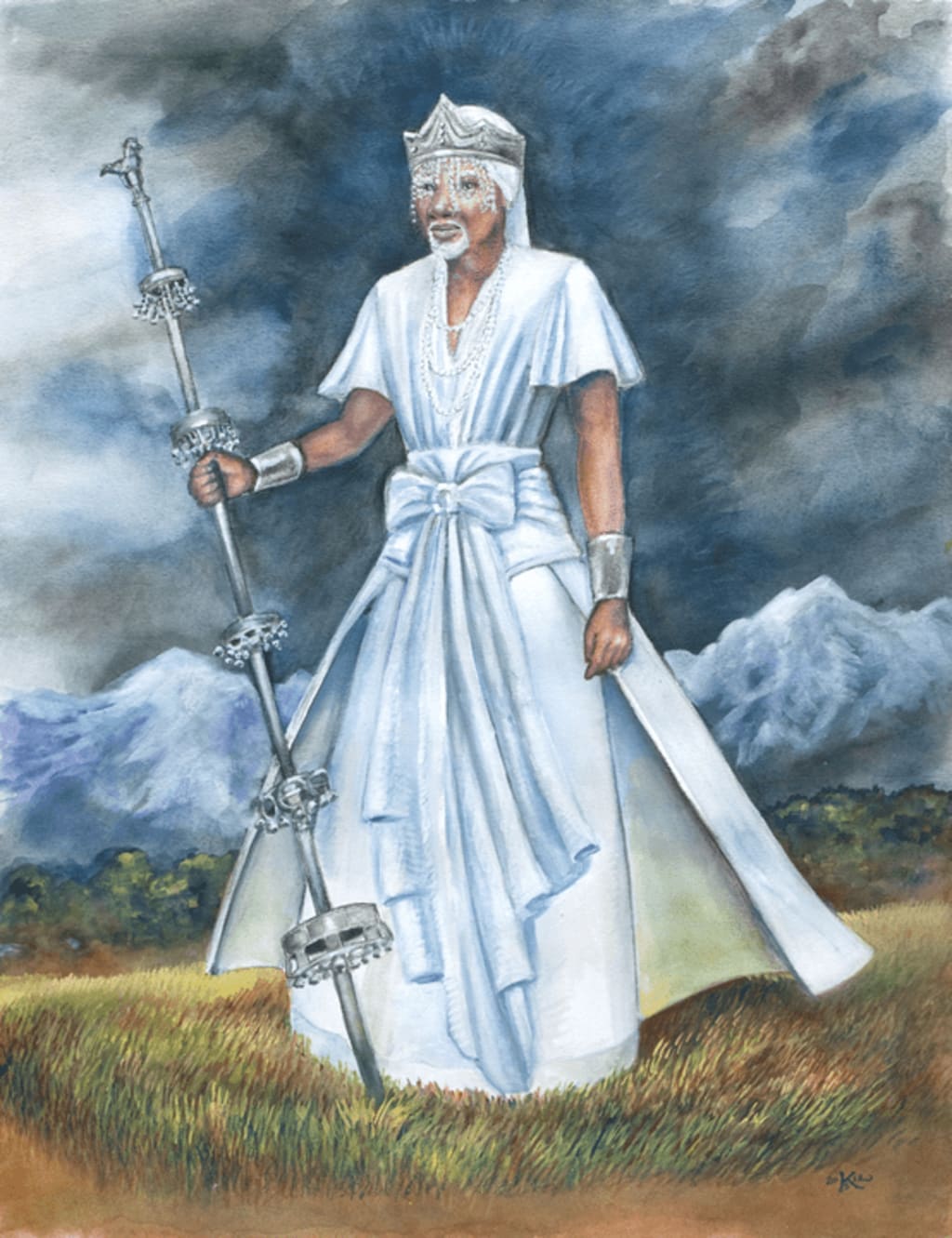
In the vibrant tapestry of Yoruba mythology, Obatala, also known as Orisha nla, stands as a distinctive figure—associated with wisdom, creativity, and craftsmanship. Among the pantheon of Yoruba deities, Obatala is unique, for he is believed to have been a living person. His story is a captivating blend of divine responsibility and human temptation.
According to the sacred tales passed down through generations, Obatala's divine journey began when Olodumare, the supreme deity, entrusted him with the monumental task of creating the Earth. This responsibility weighed heavy on his celestial shoulders, and he embarked on the endeavor with great enthusiasm.
However, the narrative takes an intriguing twist, as myths often do. Some accounts claim that as Obatala began the creation of the Earth, he encountered a temptation that led him astray. The temptation came in the form of palm wine—a beverage known for its intoxicating allure. Overwhelmed by curiosity and desire, Obatala indulged in palm wine, unaware of the consequences that would follow.
In his intoxicated state, Obatala's creative work came to a standstill, leaving the Earth incomplete. He fell into a deep slumber, oblivious to the passage of time. It was during this profound sleep that Oduduwa, another prominent figure in Yoruba mythology, took it upon himself to complete the mission.
Oduduwa's actions ignited a furious awakening in Obatala. He awoke to find that his sacred duty had been fulfilled by another's hand. Overwhelmed by anger and regret, he confronted Oduduwa, leading to a cosmic clash between their powers and wills.
In another version of the myth, both Obatala and Oduduwa were dispatched by Olodumare to create the Earth. Along their journey, Obatala encountered a group of people enjoying palm wine, and the allure proved irresistible. He partook in the festivities and succumbed to drunkenness, leaving Oduduwa to carry the mission forward alone.
Regardless of the specific version, the consequence was the same: Obatala was tasked with an even greater responsibility as punishment for his negligence. He was entrusted with the divine duty of molding human beings. In the intricate process of shaping humanity, Obatala made a series of errors. Some of those he created were fairly burnt, and they became the ancestors of what we now know as Europeans. Those he forgot in the fire due to his drunkenness became the black race, while those he didn't burn at all became the albinos.
Obatala's mistakes extended beyond the burning process; he also made errors during the molding, resulting in people with disabilities. When he sobered up and beheld the consequences of his actions, he vowed never to drink again and pledged to protect those with disabilities. This commitment remains a cornerstone of the worship of Obatala, with his followers abstaining from palm wine in his honor.
Intriguingly, the progress of Obatala's Earth creation did not escape the watchful gaze of Olorun, the ruler of the sky. Olorun dispatched a chameleon down a golden chain to inspect Obatala's work. The chameleon reported back, noting that the creatures Obatala had molded were lifeless. In response, Olorun breathed life into them, bringing them to existence. These figures crafted by Obatala became the first inhabitants of Ife.
The struggle between Obatala and Oduduwa did not conclude with the creation of Earth; it extended to the fight for rulership over the newly formed world.
Obatala, often referred to as the "King of White Cloth" (Osha fun fun), symbolizes peace and tranquility in Yoruba culture. He is honored with offerings of white cloth, lace, white beads, cowries, white flowers, silver coins, and a diet of white foods such as pounded yam, melon soup, eko, and fermented corn.
Obatala's matrimonial union adds another layer to his enigmatic character. He is said to have wed Yemoja, the goddess of oceans and the godmother of Orishas (deities). The exact number and names of their offspring remain shrouded in mystery, a testament to the depth of Yoruba mythology.
Obatala's story, rich in symbolism and moral lessons, continues to be a source of inspiration and reverence in Yoruba culture. It reminds us of the consequences of temptation and the importance of taking responsibility for one's actions, even in the realm of the divine.
About the Creator
Adeoye Adenike
I have always been passionate about my traditional roots and I decided to take it to the next level by learning more and spreading the knowledge
Keep reading
More stories from Adeoye Adenike and writers in History and other communities.
The Fascinating History of Oduduwa: A Guide to Its Origins
There are such countless stories with respect to the beginning of Oduduwa, some say that he was a ruler of Mecca. It was apparently the mistreatment of the Muslim world class of the city that made him and his kindred animists leave Arabia.
By Adeoye Adenike2 years ago in History
Savoy Hotel – Mussoorie: The Colonial Luxury Hotel Where an Unsolved Murder Still Walks the Corridors
The First Night: Beauty Wrapped in Silence Mussoorie looks peaceful from a distance. Pine trees sway gently, clouds roll like slow-moving waves, and the hill air smells of rain and old earth. But as evening falls, the silence becomes heavier—almost watchful.
By Gaurav Gupta4 days ago in History
Nobel Peace Prize
The Nobel Peace Prize has stood as one of the world’s most recognized honors. Awarded annually in Oslo, it is meant to celebrate individuals or organizations that have made significant contributions toward peace, diplomacy, and humanitarian progress. While its mission appears straightforward, the Nobel Peace Prize has never been free from debate. In recent years, conversations surrounding global politics—particularly discussions about the Trump Nobel Peace Prize—have brought renewed attention to how peace is defined, measured, and rewarded in the modern era. The Origins and Meaning of the Nobel Peace Prize The Nobel Peace Prize was established by Alfred Nobel, the Swedish inventor best known for creating dynamite. In his final will, Nobel directed that a portion of his wealth be used to recognize efforts that foster peace among nations, reduce standing armies, or promote diplomacy and cooperation. Since its first award in 1901, the prize has honored activists, diplomats, organizations, and world leaders whose actions shaped international dialogue. Unlike other Nobel categories, the peace prize is awarded by a Norwegian committee rather than a Swedish institution. This distinction reflects Nobel’s desire to separate the prize from national interests and focus instead on global responsibility. Over time, the definition of “peace” has expanded. Early recipients were often disarmament advocates or mediators. More recent laureates have included human rights defenders, climate activists, and international organizations working in conflict zones. Politics and the Nobel Peace Prize Despite its humanitarian ideals, the Nobel Peace Prize has always intersected with politics. Recognizing peace efforts often means evaluating political leadership, international negotiations, and long-term consequences—none of which are easy to measure in real time. Some awards have been widely celebrated, while others sparked controversy. Critics often argue that certain laureates were honored prematurely, before the lasting results of their actions became clear. Supporters counter that the prize is meant to encourage peace efforts, not merely reward completed achievements. This tension has made the Nobel Peace Prize a reflection of global priorities at any given moment, rather than a simple historical judgment. Donald Trump and Nobel Peace Prize Discussions Few modern political figures have generated as much debate in connection with the Nobel Peace Prize as Donald Trump. During and after his presidency, conversations about a potential Trump Nobel Prize emerged repeatedly, particularly among supporters who pointed to his role in diplomatic initiatives. The phrase Trump Nobel Peace Prize gained traction following agreements and negotiations in regions long marked by conflict. Advocates argued that these diplomatic efforts aligned with Alfred Nobel’s vision of reducing international tension through dialogue rather than force. At the same time, critics questioned whether these actions met the broader ethical and humanitarian standards traditionally associated with the award. They pointed to domestic divisions, foreign policy controversies, and unresolved global conflicts as reasons for skepticism. This divide highlights a core challenge of the Nobel Peace Prize: peace is rarely absolute, and political leadership is often complex and contradictory. Trump Nobel Peace Prize 2026: Speculation and Context As global politics continue to evolve, speculation around a Trump Nobel Peace Prize 2026 has appeared in media discussions and public commentary. It is important to note that nominations for the Nobel Peace Prize are confidential for decades, and speculation does not confirm consideration or selection. However, the mere discussion of Trump Nobel Peace Prize 2026 reflects how the award has become part of broader cultural and political conversations. Supporters view such recognition as validation of diplomatic achievements, while critics see the speculation as politicizing an institution meant to rise above partisan debate. This dynamic is not unique to Trump. Many past leaders, from various ideological backgrounds, were debated heavily before or after receiving the prize. The Nobel Peace Prize often mirrors global disagreements rather than resolving them. How the Nobel Committee Makes Its Decision Each year, hundreds of nominations are submitted by qualified individuals, including academics, lawmakers, and previous laureates. The Nobel Committee evaluates these nominations through research, expert consultation, and internal debate. The process considers intent, impact, and long-term significance. However, because peace efforts often unfold over years or decades, the committee must make decisions without full historical clarity. This reality explains why some awards age gracefully while others remain controversial. The committee rarely responds directly to public pressure or online campaigns. Media attention, including discussions around a Trump Nobel, does not guarantee influence over the final decision. The Broader Impact of the Nobel Peace Prize Beyond individual recipients, the Nobel Peace Prize plays a symbolic role. It brings global attention to issues that might otherwise be ignored, from humanitarian crises to fragile peace processes. Even controversial nominations can spark meaningful debate about what peace truly means in the modern world. The prize also raises questions about accountability. When leaders are considered for such recognition, the public is encouraged to examine policies, outcomes, and moral responsibility more closely. In this sense, discussions surrounding the Trump Nobel Peace Prize are not just about one individual. They reflect deeper conversations about diplomacy, leadership, and the evolving standards by which peace is judged. Conclusion: A Prize That Reflects the World The Nobel Peace Prize remains one of the most influential and debated honors in global society. Its power lies not only in recognizing peace efforts but also in challenging the world to think critically about conflict, cooperation, and responsibility. Whether discussions involve historic activists or modern political figures like those associated with Trump Nobel Peace Prize 2026 speculation, the award continues to reflect the complexities of international relations. Peace is rarely simple, and neither is the process of honoring it. Ultimately, the Nobel Peace Prize serves as a reminder that striving for peace is an ongoing journey—one shaped by ideals, actions, and the difficult choices that define human history.
By Saboor Brohi 4 days ago in History
Silver Screen Magic with Mae West
American actress and singer Mae West became a popular film actress during the Great Depression. She started entertaining in vaudeville, then performed on Broadway, and finally went to Hollywood. She signed up with Paramount Pictures and made her debut in the 1932 film “Night After Night.” She also starred in musicals, comedies, and crime dramas. The American Film Institute named her one of the best classic Hollywood actresses.
By Rasma Raisters7 days ago in Geeks


Comments
There are no comments for this story
Be the first to respond and start the conversation.