
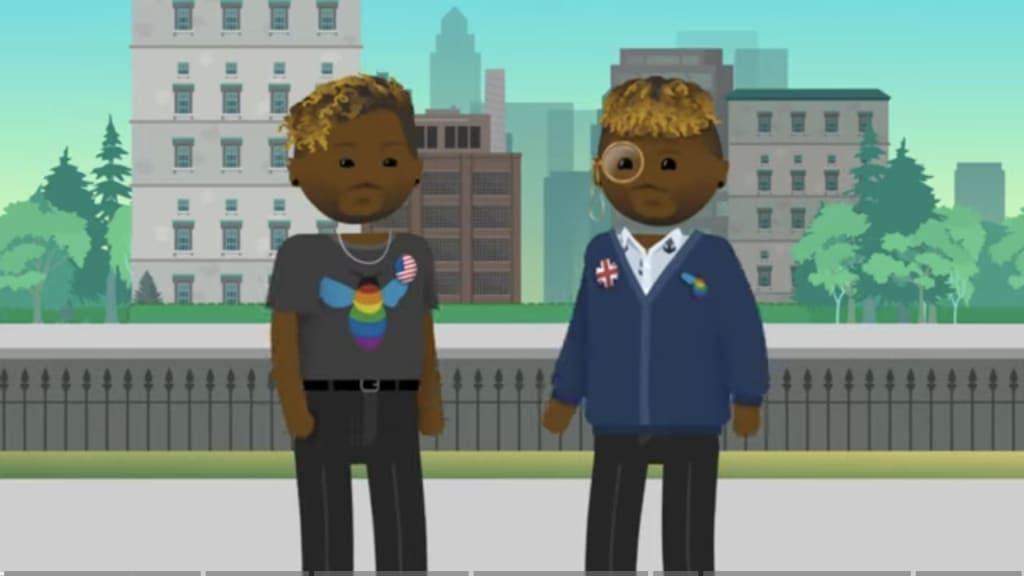
Two people from different parts of the world meet by chance.
They share a lot of the same hobbies and interests –
even like the same foods.
But beyond that, they look similar
...eerily similar.
If they hadn’t been raised on different continents
by completely different families, you could almost bet they were twins.
But they aren’t even related.
Stories of doppelgangers,
people who share an uncanny resemblance to other people,
have been around for ages.
But they’re getting more common.
And that’s because, genetically speaking,
the human population has way more similarities than differences.
And the more the global population grows,
the more potential there is for overlap in our DNA.
So, the more likely it is that we have a lookalike.
Today, we’re talking about population genetics,
which examines the similarities and differences within
and among groups that make up populations.
And, lookalike, if you’re out there:
“I see you son, lookin' fresh to death!
I see you, I see you — servin’ 'em all of that melanin”
Hi, I'm Dr. Sammy, your friendly neighborhood entomologist,
and this is Crash Course Biology.
Hmmm, I wonder if my doppelganger also loves funky theme music?
[THEME MUSIC]
Population genetics, like my doppelganger said,
is the corner of biology focused on the genetic makeup of populations:
organisms of the same species living in the same place
at the same time –
that can feasibly make fertile babies with each other.
That’s a mouthful, but whether we’re talking about pineapples, porcupines, or people,
it’s not always easy to determine where populations begin and end.
Like, if organisms of the same species are trapped together
on an island for hundreds of generations, with nobody leaving
and nobody new coming —
easy, boom, population.
But if we’re talking about organisms roaming across
the diverse habitats or entire continents,
traveling by air or by sea,
having hanky-panky without boundaries
– well, the lines between populations start to blur.
So, population genetics helps scientists measure changes
in these fuzzy things called populations.
With statistics, they can create models that help predict whether alleles —
which are versions of genes,
determining things like whether a flower is red or white —
are becoming more or less common in a population.
This can predict whether certain visible traits will appear more or less often.
As for me?
I’m hoping for more red flowers.
I’m a hopeless romantic.
Models also help biologists compare genetic similarities and differences,
revealing how organisms are related to each other.
Take, for example, platypuses living across a large area.
Maybe the platypuses in the Southern section of the river
are more genetically similar to each other
than to the ones in the Northern section.
This could suggest there are lots of smaller populations
that don’t interbreed very much.
Or, say there aren’t any clear subgroups within this large population.
Instead, there’s a gradual continuum of genetic variation throughout.
This could suggest a large, well- connected population of platypuses
getting it on for generations.
From genetic sequencing in a lab to detailed observations in nature,
data can be statistically analyzed to understand populations.
Different approaches emphasize different parts of the picture.
Methods seeking connections can illuminate how even different species
—like chimps, humans, and mushrooms—
are genetically related.
Methods seeking differences can highlight small nuances between populations.
With these methods, biologists can measure genetic diversity
— or, the genetic differences among individuals.
The more genetic variation in a population’s gene pool
—the easier it is for that population to adapt and survive
whatever the environment throws their way.
It’s like the difference between having a wrench and an entire toolbox.
Smaller populations tend to have less genetic diversity,
which means fewer tools to fix stuff when it breaks.
And this means individuals are more similar to each other.
Like today’s cheetah, for example.
Habitat loss and other factors have cut down cheetah numbers
and their genetic diversity in recent decades.
Because of that low diversity, they’re more vulnerable to diseases,
and their cubs are less likely to survive to adulthood.
You see, something like a virus or even a cancer
may target one particular weakness in the cheetah's immune system.
So, in a population that's super identical,
one disease can wipe out large numbers of individuals.
Whereas having more genetic diversity in a population
can mean diversity in immune strengths,
so a single illness is less likely to wreak widespread havoc.
Different taxa, or categories of living things,
tend to have different levels of genetic diversity.
Genetic variation above 5% is considered high in plants, animals, and fungi.
But the split gill mushroom has diversity levels of up to 20% —
the highest of any known eukaryote.
And then you have prokaryotes, like bacteria,
that are hyperdiverse because most don’t rely on sexual reproduction.
They get their diversity in a completely different way
that we will discuss in a future episode.
But yeah, among organisms with a backbone,
the average genetic diversity is only one-quarter of one percent (0.25%).
Humans fall below that average,
with genetic diversity hovering around one-tenth of one percent (0.1%).
Which might account for all those doppelgangers out there.
So, on one hand, you might be thinking,
“Dang, those hyperdiverse mushrooms have a better shot than us
at surviving whatever curveballs life throws?”
Which is fair.
I, for one, congratulate the fungi who may out-adapt us all.
But there’s another lesson here that we can’t let go unnoticed:
you and I have a lot in common.
We’re talking 99.9% of our genes are the same.
All humans everywhere are pretty darn genetically similar.
On top of that, in humans, more genetic variation occurs
within populations than between them.
You might have more in common genetically with someone on
a different continent than someone who lives in your town
—even if society considers the local person the same race as you
and the faraway one a different race.
Which brings me to the one exception.
There is a trait where most variation does occur between populations,
rather than within them.
But this trait accounts for only a tiny fraction of our DNA.
And it has been wrongly used to categorize people,
and to justify inequality and suffering for centuries:
baby, I’m talking about skin color.
Let’s head over to the Thought Bubble…
for this, hopefully very thoughtful treatment of race.
I’m watching you, Thought Bubble.
Throughout our evolutionary history, humanity has faced a do-or-die juggling act
— reap the benefits of ultraviolet rays from the Sun,
without being destroyed by them.
Skin exposed to enough UV light produces that sweet, sweet vitamin D
needed to build strong bones.
But too much UV light on skin destroys folate
—an important vitamin everyone needs for nucleic acid synthesis.
So, no matter where we’ve lived,
we’ve needed to hit that ideal UV light sweet spot.
But the intensity of UV rays isn’t the same everywhere on Earth.
It’s more abundant closer to the sunny equator,
and less so nearer the poles.
In sunnier parts of the world, it helps to have darker skin,
which contains more of a substance called melanin.
Melanin absorbs the bulk of UV light.
So dark skin can protect precious folate and still make vitamin D.
But for humans living near the Sun-scarce poles,
it’s harder to get enough UV light to make vitamin D year-round.
So it helps to have lighter skin, with less melanin, to let in more UV light.
Even if it increases the risk of sunburn.
As the human population began to spread across the world,
we evolved to have a range of melanin in our skin —
directly tied to the availability of sunlight where our ancestors lived.
The result is a gradual spectrum of skin color
with no hard-and-fast boundaries between shades.
That continuum is not evidence of our differences,
but another example of what we all share: the need for sunlight and an ability to adapt.
Ok, Thought Bubble, I see you; my trust was well-placed.
All right, so traits like skin color or eye color exist on a spectrum.
So we use the word clines
— or, gradients of change on a continuum —
as a way of describing and representing genetic diversity.
Clines can align with your ancestry —
or the patterns in your genome that reflect your ancestors’
genetic history and origin.
As we saw in that skin color spectrum,
the environment where your ancestors originated
does have some influence on the traits you inherit.
And it’s possible to find clues about your ancestry based on patterns in your DNA.
But those patterns aren’t broken by stark dividing lines.
In fact, no single trait or gene reliably distinguishes between
what we call different “races.”
That’s because race is a social construct,
an idea that has been created by and agreed upon by a society,
rather than a biological category.
Race describes a way that we group people
based on traits that we’ve arbitrarily chosen to emphasize
—like how much pigment is in someone’s skin,
or the texture or color of their hair.
Often, when we view people through the lens of race,
it leads us to assume incorrect things about their ancestry or their country of origin.
And that's because racial categories have overemphasized
a handful of visible features
– like skin color –
that don’t have clear-cut boundaries.
Like, someone whose ancestors originated in China and Ireland
obviously has DNA from both sides of the family.
But because of the way society emphasizes certain visible traits,
that person might be labeled as "racially Asian,”
erasing part of their ancestry
without really saying anything in particular about their biology.
As biologists learn more about human variation and genetics,
it has become clear that “race” isn’t a real biological attribute.
Still, it has shaped history and even infused the field of biology.
Race is a powerful idea that has been used to justify prejudice and inequalities
—whether we’re consciously aware of them or not.
So, race has a real impact on people’s lives, their identities, and their experiences.
It’s kind of like money.
Money has a tangible impact on access to resources
and opportunities and it affects how you’re treated by others.
But it’s also an idea, a thing we’ve agreed has meaning.
There’s no real reason why a piece of paper or a metal coin
should be exchanged for things like shelter or food.
There’s also no marker in our DNA
that makes “Black” or “white” a biologically meaningful category.
But these ideas are socially and politically real.
They shape the opportunities, resources, and treatment that a person experiences.
People of color in the United States, for example,
disproportionately face poverty, exposure to pollutants,
and reduced access to medical care, which in turn affects their health –
and that impact on their health then gets misattributed to genetic differences.
Similar patterns of inequality can be found in virtually every country,
though people perceive race differently across cultures.
Soooo yeah, we can do something about this whole race-based inequality thing.
Because a brutha is just really tired of saying this.
So, traits such as skin color or hair texture can seem like huge differences that divide us,
but it’s only because we’ve given them that power and reinforced it over generations.
Population genetics shows us there’s much more in our DNA
that we have in common than what sets us apart.
Whether we’re talking about platypuses or people,
there’s not a super-clear boundary between what counts as separate populations.
But by comparing genetic similarities and differences,
population genetics unravels how living things have evolved and are evolving.
Next week, we’re going to step back from populations
to look at what makes a species distinct.
I’ll see you then! Deuces!
This series was produced in collaboration with HHMI BioInteractive.
If you’re an educator, visit BioInteractive.org/CrashCourse
for classroom resources and professional development
related to the topics covered in this course.
Thanks for watching this episode of Crash Course Biology
which was filmed at our studio in Indianapolis, Indiana
and was made with the help of all these nice people.
If you want to help keep Crash Course free for everyone, forever,
you can join our community on Patreon.


Comments
There are no comments for this story
Be the first to respond and start the conversation.