World History
The Gallant Rider
In the misty valley of Eldoria, where emerald hills kissed the sky, there lived a warrior named Kaelan. His reputation as the finest horseman in the realm was whispered from village to village, tales spun around crackling fires. Tall and lean, with a mane of dark hair that flowed like the night, Kaelan had eyes the color of storm clouds—intense, fierce, and always searching.
By Doris J Palmaabout a year ago in History
The Rise and Fall of the Mauryan Empire
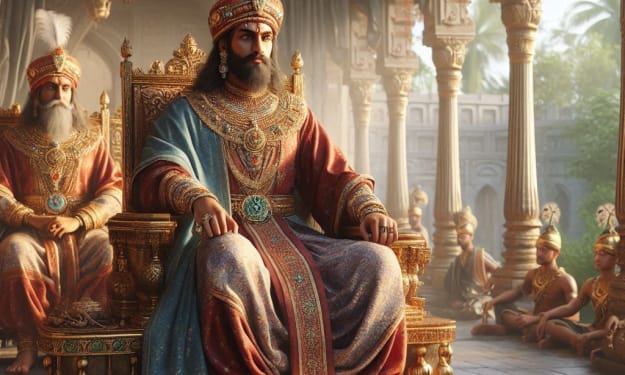
Few things have driven humanity more than the ambition for power. Across history, we've witnessed how the desire for control, glory, and land can elevate or destroy empires. Today, we explore one of the most influential civilizations in ancient India: the Mauryan Empire. This post dives deep into how this empire emerged, expanded, and left a lasting impact not only on the Indian subcontinent but on the world. Starting in the 6th century BCE, the Indian subcontinent saw the rise of various political units called the Mahajanapadas. Among them, the Kingdom of Magadha was the most powerful, but under the rule of the Nanda dynasty, it became infamous for oppressive governance. King Dhana Nanda's reign (329-321 BCE) was marked by high taxes and cruelty, making the dynasty deeply unpopular. Adding to this internal unrest, the western part of India was thrown into chaos after the invasion of Alexander the Great, further destabilizing the region. Amidst this turmoil, a Brahmin statesman named Kautilya (or Chanakya) envisioned the possibility of uniting India under a centralized empire to ward off invaders and restore peace. After being scorned by King Dhana Nanda, Kautilya found an ally in Chandragupta Maurya, a young warrior with immense potential. Together, they plotted to overthrow the Nanda dynasty and establish a new order. Taking advantage of the power vacuum left by Alexander’s forces, Chandragupta began his military campaigns in northwest India, toppling weakened Greek-Macedonian rule. With Kautilya’s brilliant strategy, Chandragupta continued to advance through India, eventually taking the heart of Magadha and claiming the throne. In 321 BCE, Chandragupta founded the Mauryan Empire, establishing Pataliputra (modern-day Patna) as its capital. Chandragupta's empire quickly expanded to encompass much of India, from its western coast to the southern regions. Plutarch even noted that his army reached an astonishing 600,000 soldiers. Chandragupta also came into conflict with Seleucus I Nicator, one of Alexander’s successors. After a war in 301 BCE, the two leaders signed a treaty that gave Chandragupta large territories in exchange for war elephants—a move that further cemented the Mauryan power. The Mauryan Empire was one of the most well-organized empires of its time. Chandragupta ruled through a sophisticated bureaucratic system. The king was the head of the state, with a council of ministers advising him on military, financial, and administrative matters. Provinces were governed by royal princes, and the administration extended down to village levels, ensuring strict control over social and economic life. The empire maintained a vast spy network and a large standing army, with specialized units for infantry, cavalry, navy, and war elephants. Soldiers were highly valued, focusing solely on warfare and not being required for other services. Chandragupta’s rule established a model of efficient governance that influenced later rulers in the region. The Mauryan economy was largely state-controlled. The empire monopolized essential industries like coinage, salt production, mining, and weapon manufacturing. Agriculture was heavily taxed, and merchants were organized into guilds that held judicial and executive power. Trade flourished under state supervision, with strict regulations on prices, weights, and measures. Roads and rivers connected the empire to foreign markets, extending even to Sri Lanka, China, and Arab ports, promoting a vibrant trade network. After ruling for 25 years, Chandragupta abdicated in favor of his son Bindusara, who expanded the empire further into southern India. However, it was Ashoka, Chandragupta’s grandson, who left the most significant mark on the empire and the world. Initially a ruthless ruler known for his cruelty, Ashoka waged a bloody war against the kingdom of Kalinga, resulting in immense loss of life. This campaign traumatized Ashoka, leading him to adopt Buddhism and embrace non-violence, promoting the concept of dhamma—a philosophy of righteous behavior and goodwill. Ashoka’s reign saw the construction of monumental stupas and the spread of Buddhism across Asia, with missionary efforts reaching Sri Lanka, Southeast Asia, and beyond. Yet, despite Ashoka’s efforts to promote peace, his successors lacked his strength. After his death, the empire began to fracture, and by 185 BCE, the last Mauryan ruler, Brihadratha, was assassinated, ending the dynasty. The Mauryan Empire, the largest to ever exist on the Indian subcontinent, was driven by a relentless pursuit of power, but like many great empires, it faced internal strife and external pressures that led to its decline. The administrative, economic, and cultural advancements during its reign left an indelible legacy that shaped the Indian subcontinent for centuries. The rise and fall of the Mauryan Empire serve as a testament to the cyclical nature of power—where ambition builds great civilizations, but also sows the seeds of their eventual collapse. Their names, however, live on, carried by the cultural and social reforms they left behind. If you enjoyed this article, give it a thumbs up, and don't forget to share it with others. Stay tuned for more stories about empires, power, and history!
By A Históriaabout a year ago in History
The Psychopath Who Invented Your Breakfast: Dr. John Harvey Kellogg
In the early 1900s, if you were an affluent American suffering from health issues, you might have considered a stay at the world-famous Battle Creek Sanitarium, often called "the San." Located in Michigan, the San sprawled across 30 acres and promised a cool and delightful summer resting place. Walking through its gates, guests were greeted by the Latin phrase mens sana in corpore sano—a healthy mind in a healthy body—etched into the entrance. They would find people sunbathing in the gardens or strolling through the picturesque woods, and inside, the lobby boasted fine furniture, crystal chandeliers, and plush Persian rugs. However, among the tranquility, guests might also hear an occasional scream from a distant treatment room—but more on that later.
By Marveline Merababout a year ago in History
The Bear Who Fought the Nazis and Won: Wojtek the Soldier Bear
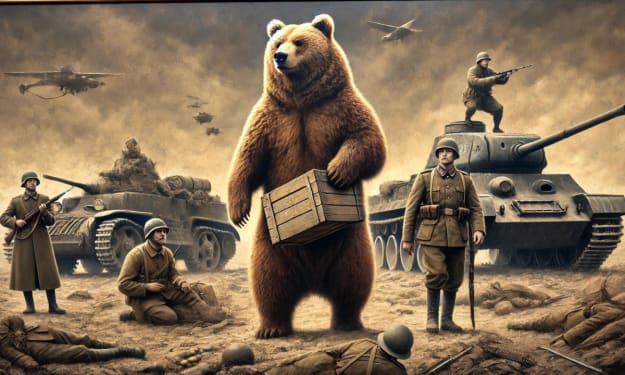
For centuries, humans have enlisted animals to fight by their side, and Wojtek, a Syrian brown bear who served in WWII, was no exception. While elephants, horses, and even pigeons have had their moments in war, a beer-drinking, cigarette-smoking bear seems like a story too wild to believe. But believe it or not, Wojtek, or "Joyful Warrior," as the Polish soldiers called him, was not just a mascot; he was a genuine soldier who carried ammunition during some of the toughest battles of the war. His legacy, celebrated by monuments in Europe, stands as one of the most unique and heartwarming tales of animal bravery in human history.
By Marveline Merababout a year ago in History
The 2,000-Year-Old Roman Parade Helmet
In May 2010, a remarkable discovery was made in Cumbria, a picturesque county in northwestern England, by a local treasure hunter using a metal detector. Buried beneath the soil for nearly two millennia lay a beautifully preserved Roman helmet and mask, dating from the late 1st to early 2nd century AD. The helmet, believed to have been used by Roman nobles during cavalry parades, offers a rare glimpse into the ceremonial splendor of ancient Rome’s military tradition. When it was sold at Christie's Auction House in London in April 2023 for an astounding $3.6 million—eight times its estimated value—it became one of the most famous Roman artifacts discovered in the UK.
By Deji Akomolafeabout a year ago in History
What Did Wealthy Romans Smell Like?
In 2019, an unexpected discovery was made in the small Spanish town of Carmona. As a resident was digging a swimming pool in their backyard, they broke through the earth and into an underground chamber. What lay beneath was not just empty space but an intact Roman family tomb dating back to the 1st century AD. Six burial urns were found inside, along with various funerary offerings, each shedding light on the Roman customs and beliefs surrounding death and the afterlife. Among these offerings was something extraordinary—a small, delicately carved bottle of quartz crystal containing the perfectly preserved remnants of an ancient perfume. This discovery provides modern scholars with a rare glimpse into what wealthy Romans may have smelled like during their daily lives.
By Deji Akomolafeabout a year ago in History
The Viking Settlements and Expansion in the British Isles
By the mid-ninth century, the Vikings had firmly established themselves across parts of Ireland, Scotland, and England, leaving an indelible mark on the history of the British Isles. These Norse warriors, hailing from Scandinavia, were renowned for their maritime prowess, fearless adaptability, and opportunistic raids. The period from the late eighth century through the mid-ninth century saw these seafaring raiders evolve from opportunistic plunderers to settlers and rulers, carving out domains across the British Isles and leaving a lasting impact on the region's political landscape.
By Deji Akomolafeabout a year ago in History
The Golden Bust of Marcus Aurelius
In 1939, the tranquil town of Avenches, Switzerland, was thrust into the archaeological spotlight. Deep beneath the soil, hidden for centuries, a golden bust of the Roman Emperor Marcus Aurelius was unearthed during excavations at Aventicum, the ancient capital of the Helvetii tribe. Aventicum, which had been absorbed into the Roman Empire in 15 BC under Emperor Augustus, was once a flourishing Roman settlement, and its ruins are a testament to the grandeur of Rome’s influence in ancient Switzerland.
By Deji Akomolafeabout a year ago in History
The Enigmatic Beauty of Anemones and Daniel Day-Lewis' Masterful Craft
The natural world and cinematic world may seem like two different domains, but they both possess elements that captivate and intrigue. One such example from nature is the anemone, a flower known for its beauty and resilience. On the other hand, Daniel Day-Lewis, a master of method acting, embodies the artistry and dedication that are the hallmarks of filmmaking. In this article, we will explore the significance of anemones and Daniel Day-Lewis' legendary career, drawing parallels between nature's wonders and human creativity.
By Zinnat ara Begumabout a year ago in History
The Sumerians: A Civilization with Advanced Knowledge of Astronomy and Medicine
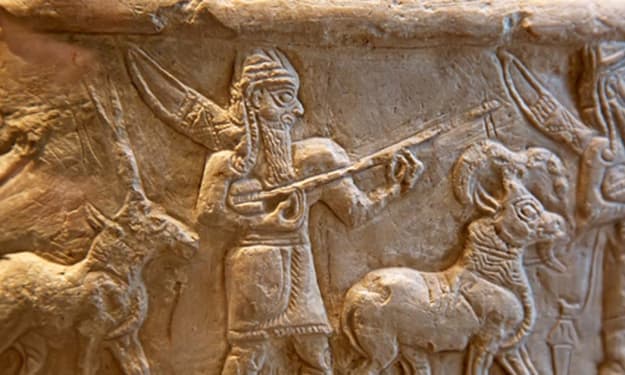
Over 6,000 years ago, in the fertile plains of Mesopotamia, an ancient civilization emerged that would forever leave a mark on the annals of history. The Sumerians, who thrived in what is now modern-day Iraq, are widely recognized as one of the world’s oldest known civilizations. However, their achievements go far beyond establishing early forms of writing, law, and city planning. Recent studies of their ancient texts and artifacts reveal something even more astonishing: their deep knowledge of astronomy, medicine, and what appears to be an understanding of genetic science. Could the Sumerians have possessed knowledge far more advanced than we ever realized? Let’s delve into the mystery of the Sumerians’ profound insights into the cosmos and life itself.
By Deji Akomolafeabout a year ago in History
Mada'in Saleh: A Nabatean Jewel Emerging from the Sands of Saudi Arabia
In the vast desert of Saudi Arabia, near the border with Jordan, stands one of the world’s most ancient and captivating archaeological sites: Mada'in Saleh. Also known as Al-Hijr or Hegra, this ancient city, dating back nearly four thousand years, is an enigmatic relic of the Nabatean civilization. Though often overshadowed by its more famous sibling Petra, located in present-day Jordan, Mada'in Saleh is equally significant in understanding the Nabatean culture and its lasting influence on the region. Among its many remarkable features is Qasr al-Farid, an iconic and monumental tomb known as the "Lonely Castle."
By Deji Akomolafeabout a year ago in History
A Frozen Moment in Time: The Beachfront of Herculaneum
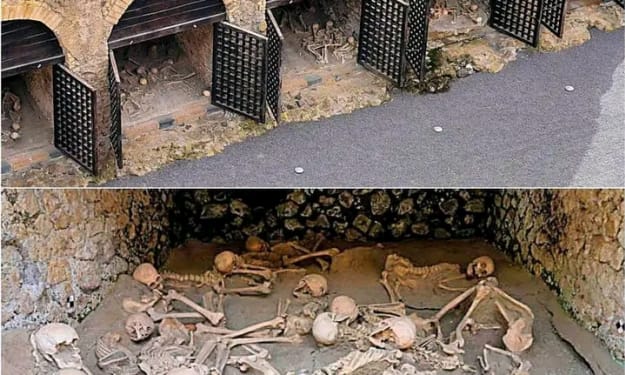
On a tragic day in 79 AD, Mount Vesuvius erupted with cataclysmic force, forever altering the landscape of the Roman Empire. While the nearby city of Pompeii often takes center stage in discussions of this disaster, the neighboring city of Herculaneum holds an equally haunting and compelling story. Unlike Pompeii, which was buried under a layer of ash, Herculaneum was engulfed by a river of superheated volcanic mud and pyroclastic surges. This thick covering preserved the city in remarkable detail, offering us a rare and intimate glimpse into the lives of the ancient Romans.
By Deji Akomolafeabout a year ago in History