Research
Bengali Dreams: The Defiant Stand of 1952. Content Warning. AI-Generated.
Bangladesh remained a part of Pakistan in 1952 when it was known as East Pakistan. That year's events were significant in the history of the region and paved the way for subsequent movements toward autonomy and independence. A short story based on those turbulent times is as follows:
By Rizvi Ahmedabout a year ago in History
Virtual Reality
Virtual Reality (VR) is no longer just a futuristic concept; it has become a transformative technology reshaping multiple industries, with gaming being its most prominent showcase. From immersive gaming experiences to revolutionary applications in education, healthcare, and beyond, VR is proving to be a game-changer in more ways than one.
By Godugu Tharunabout a year ago in History
The Rise of Electric Cars: Past to Present
Electric vehicles (EVs) have changed a lot since they first appeared. They went from being oddities to a big part of our transportation. This change shows how human creativity and the push for green travel have made a big impact.
By Godugu Tharunabout a year ago in History
The Mongol Invasions of the West (1240-1288)
The Mongols established the largest contiguous land Empire in the 13th century. Genghis Khan brought together seven Mongol tribes and deployed armies in various directions. Mongol forces advanced into Western Asia and Europe, encountering Latin Christendom and the Muslim World. Mongol coordination and raids in Poland were carried out by Baidar and Orda, who worked alongside Subotai and Batu for Mongol operations. Baidar and Orda divided their forces into smaller raiding parties to sow chaos and led the Vanguard to Krakov. The Mongols emerged victorious over the Polish and their allies at the Battle of Legnica. The intense fighting resulted in heavy losses for the Christian Knights, and the Mongols utilized their swift cavalry to target the disorganized Polish infantry, leading to a devastating defeat. The Mongols claimed trophies from the battle, such as cutting off the ears of the fallen and sending them to their leaders. The Mongols displayed no mercy, capturing and executing Duke Henry, and showcasing his head on a lance as a frightening demonstration of their power, which struck fear into the citizens of Legnica. The Polish forces suffered significant losses, including the Duke's headless body, which was only identifiable by the extra toe on his left foot. The Mongol invasion of Hungary and Poland resulted in the devastation and depopulation of Silesian and Moravian towns. Despite Mongol losses in Hungary and Poland, the enduring legend of the Battle of Legnica highlights the remarkable coordination and securing of the Southern flank by Mongol forces.
By Isaac Ekow Anyidohoabout a year ago in History
The World Warships
Warships have undergone significant transformations over the course of 400 years, adapting to the advancements in technology. From the era of galleys to the era of aircraft carriers, warships have played vital roles in military strategies. The aircraft carrier Charles de Gaulle stands as the largest vessel in the French Navy, capable of carrying approximately 30 aircraft such as the Rafale and Hawkeye, as well as helicopters for logistical and defensive purposes. With a nuclear propulsion system, this carrier has the ability to project military force across the globe and target any location. In contrast, galleys relied on oars for propulsion and had limited navigational capabilities. Despite this, galleys boasted exceptional hydrodynamic performance due to their sleek hull design and low profile in the water. Each galley required a crew of 255 men, utilizing their body weight and wooden "palomon" structures for rowing. The evolution of warships from galleys to modern frigates marked a significant shift in firepower, with galleys being phased out in 1680 due to their lack of cannons.
By Isaac Ekow Anyidohoabout a year ago in History
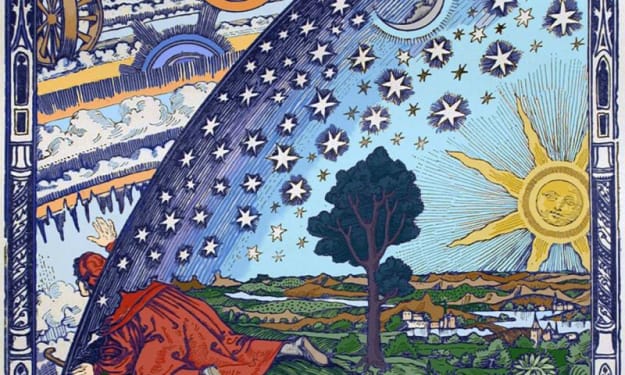
The Esoteric tradition
Unveiling Hidden Wisdom Esoteric traditions have drawn humanity's interest for centuries and are insightful about the mysteries behind life that are beyond ordinary reality. These traditions, shrouded in mystique, deal with internal knowledge and spiritual enlightenment. They encompass a myriad of diverse practices and concepts, all directed at an exploration of the hidden aspects of truth. Recently, these esoteric teachings have gained more interest because people have begun to seek an understanding of their potential effects on personal and collective well-being.
By Ann lisentra 2 years ago in History
An Imaginary Journey into a World Without Humans: What Would Have Happened If Our Ancestors Had Disappeared?
Today, with over 8 billion people on Earth, it's hard to believe that around 900,000 years ago, humanity was on the brink of extinction. Our ancestors faced such a severe crisis that only 1,280 individuals remained—a number equivalent to a small village. During this critical period, nearly 98% of the human population disappeared, and this demographic bottleneck lasted for over 100,000 years. The exact reasons for this crisis remain unclear, but drastic climate changes were likely the main cause.
By Nathan Talek2 years ago in History
Unearthing Ancient Enigmas
In the remote sand dunes of northwestern Peru, archaeologists have uncovered a remarkable find that sheds new light on the ancient religious practices and architectural prowess of pre-Incan cultures. A team of researchers, led by Luis Armando Muro Ynoñán, director of the Cultural Landscapes Archaeological Project of Ucupe — Valle de Zaña, has unearthed the remnants of a ceremonial temple dating back an astonishing 4,000 to 5,000 years.
By Kevin MacELwee2 years ago in History