Medieval
The Franks
The Franks, a Germanic ethnic group, emerged from the lower reaches of the Rhine River. During the period of mass migration, they migrated into Gaul, where they successfully established a kingdom of considerable magnitude and influence in Europe subsequent to the collapse of the Western Roman Empire. The zenith of their impact was witnessed under the reign of Charlemagne (742-814), whose rule played a pivotal role in shaping the course of Europe during the Middle Ages and beyond.The Roman conquest of Gaul, which was successfully carried out by Julius Caesar during the 1st century BCE, established the Rhine River as the definitive boundary of the Roman world. Consequently, the river assumed the role of a political demarcation line between 'civilization' (namely, Rome) and the 'barbaric' Germans who resided beyond its banks. In the Roman perception, these Germans were commonly depicted as being tall, fair-haired, unclean, and predisposed to acts of violence. Over the course of several centuries, the Roman legions stationed along the Rhine frontier effectively deterred the incursions of the Germanic tribes, until the gradual erosion of Roman authority, exemplified by events such as the Crisis of the Third Century, facilitated the infiltration of certain Germanic peoples into Roman territory. There exist various accounts regarding the origins of the Franks. The historian Gregory of Tours, writing in the 6th century, posits that the Franks originated in Pannonia and subsequently migrated to the Rhineland before settling in Thuringia and Belgium. In contrast, the Chronicle of Fredegar and the Liber Historiae Francorum, both of which are of uncertain authorship, offer more legendary accounts that trace Frankish origins back to the Trojan War. According to these myths, King Priam led 12,000 Trojan refugees to Pannonia, where they established the city of Sicambria. Some remained there, while others followed a leader named Francio to the Rhine, where they became known as the 'Franks'. The connection to Troy was likely an attempt by the Franks to establish a lineage on par with that of the Romans, who also claimed descent from the Trojans. While this origin story is undoubtedly mythical, some contemporary scholars, such as Ian Wood, contend that there is little evidence to support the notion that the Franks undertook any significant migration and instead propose that they originated in the Rhineland. During the reign of King Clovis I (r. 481-511), the Franks underwent a well-known conversion to Christianity. Prior to this, however, it is believed that they adhered to a form of ancient Germanic paganism. This particular belief system was characterized by a pantheon of multiple deities, each of which was associated with specific local cult centers. Additionally, forests were considered to be sacred spaces within this mythology. Prior to their unification, each Frankish tribe adhered to its own distinct set of laws, which were orally transmitted and recited by a designated law speaker. However, during the reign of Clovis between 507 and 511, a comprehensive civil law code was formulated to govern the newly established Frankish kingdom. This legal code, known as Salic Law, derived its name from the influential Salian tribe. Primarily composed in Latin, Salic Law primarily addressed matters pertaining to inheritance and criminal justice, thereby serving as a foundational framework for subsequent legal systems across Europe. Subsequently, another Frankish law code, known as the Ripuarian Law, was compiled circa 630, coinciding with the ascendance of the Ripuarians within the Kingdom of Austrasia. The Franks were initially recognized by a contemporary Roman source in 289 CE, although it is likely that the Franks had been involved in conflicts with the Romans for several decades prior. A Roman marching song from the 260s mentions the unfortunate deaths of many Franks, while archaeological evidence suggests that the Franks began their attacks on Roman Gaul as early as the 250s. By the end of the 3rd century, the Franks had launched multiple invasions into Roman territory, utilizing both land and sea strategies. Historical records indicate that Frankish pirates ventured into the Mediterranean, conducting raids as far as North Africa. In 486, Clovis initiated his conquest of Gaul by defeating Syagrius, the final major Roman official in Gaul, and capturing the city of Soissons. Utilizing this power base, he launched campaigns against the Alemanni, the Burgundians, and the Visigoths, thereby expanding Frankish influence throughout Gaul and Aquitaine. Clovis' conversion to Nicene Christianity (Catholicism) in approximately 496 marked the beginning of the gradual Christianization of the Franks. This conversion was significant in establishing Frankish Gaul as a stronghold for Catholicism, as opposed to Arianism, a competing Christian sect that was favored by other barbarian kingdoms. In the latter part of his reign, Clovis ruthlessly annexed the other Frankish kingdoms and executed their leaders, thereby unifying the Franks as a single people for the first time. At the time of his death in 511, Clovis reigned as "King of All the Franks" and held dominion over all of Gaul, with the exception of Burgundy, Provence, and Septimania. Following the passing of Clovis, the Merovingian kingdom underwent a division among his four sons, which may have set a precedent for future successions. Initially, the sons worked collaboratively to build upon their father's conquests, successfully expanding their territory by conquering Burgundy, Provence, and Thuringia in the 530s. Additionally, the sons of Clovis campaigned against the Visigoths in northern Spain, sent armies into Italy, expanded Frankish influence into Bavaria, and secured an annual tribute of 500 cows from the Saxons. With the passing of the Ostrogothic king Theodoric the Great in 526, the Merovingian kingdom emerged as the largest and most powerful barbarian successor state to have replaced Rome in western Europe. Despite their achievements, the Merovingian rulers frequently engaged in conflicts and consistently sought ways to undermine and conspire against one another. In the year 558, Chlothar I, the youngest son of Clovis and reigning from 511 to 561, emerged as the triumphant figure. This victory came after enduring decades of rivalry with his siblings, which involved the heinous acts of murdering his nephews and executing his own son. By outliving his brothers and inheriting their territories, Chlothar I successfully reunited the Frankish kingdom under his sole authority. Regrettably, his reign was short-lived, lasting less than three years before his demise in 561. Consequently, the kingdom was once again divided among his four sons, leading to the formation of three distinct Merovingian realms: Neustria, Austrasia, and Burgundy. The demise of Chlothar I instigated a fresh wave of machinations, internal conflicts, and targeted killings, driven by the intense rivalry between Queen Brunhilda of Austrasia (l. c. 543-613) and Queen Fredegund of Neustria (d. 597). This protracted confrontation endured for several decades and escalated into proxy wars waged by the offspring and descendants of these queens, until its culmination in 613 when Queen Brunhilda was ultimately vanquished and executed by King Chlothar II (r. 584-629), who happened to be the son of Fredegund. Chlothar II successfully reunited Francia and assumed the prestigious title of "King of All the Franks," yet his triumph came at a considerable cost. In order to consolidate his position, he was compelled to make substantial concessions to the nobility. The 614 Edict of Paris formalized the customary privileges of the aristocracy and decentralized authority, placing it in the hands of regional elites. Dagobert I, the son of Chlothar II, reigned as the final Merovingian monarch to exercise substantial royal power during his tenure from 623 to 639. Despite the Merovingian dynasty's continued reign for over a century following Dagobert's demise, their authority gradually waned as the mayors of the palace emerged as the de facto powers behind the throne. The decline of Merovingian influence prompted the chronicler Einhard to label subsequent Merovingian rulers as "rois fainéants" or "idle kings". In the year 687, the Kingdom of Austrasia achieved a significant victory over Neustria and Burgundy at the Battle of Tetry, thereby establishing itself as the predominant kingdom in Francia. This triumph resulted in an increase in power for the esteemed aristocratic family, commonly referred to as the Pippinids or the Arnulfings, who had long served as mayors of the palace of Austrasia since the reign of Dagobert I. Despite their newfound influence over the entire realm of Francia, the Pippinids did not seek to claim the throne for themselves, instead choosing to govern through their Merovingian puppets. The Franks, at that time, were not yet willing to accept any other dynasty to rule over them. However, this sentiment would eventually shift following the dynamic reign of Charles Martel (l. c. 688-741), a member of the Pippinid clan who assumed the position of mayor of the palace of Austrasia in 715. Charles, the great leader of the Franks, achieved a momentous victory over the Umayyad Caliphate at the Battle of Tours in 732. This triumph solidified his position as the de facto ruler of Francia, showcasing his exceptional prowess and strategic brilliance. By 737, Charles' personal influence had grown to such an extent that he no longer felt the need to appoint a new ruler after the death of his puppet king, Theuderic IV. The throne remained vacant, a testament to Charles' unrivaled power and authority, until his own demise in 741.
By A História2 years ago in History
Did Christopher Columbus Sleep with a Manatee?
In the annals of history, few figures loom as large as Christopher Columbus. The renowned explorer is celebrated for his voyages that opened up the Americas to the Old World. However, amidst his many accomplishments, a curious question persists: Did Christopher Columbus sleep with a manatee? In this article, we delve into this historical enigma, separating fact from fiction and uncovering the fascinating truth.
By Exotic History2 years ago in History
One Friday Morning . Content Warning.
After a period of 148 days of striking, members of the Writers Guild of America have ceased their protest and resumed their work, armed with a tentative agreement. However, the picket lines outside the studio gates are still occupied by members of SAG-AFTRA, who are not alone in their efforts.
By Rasel Hossain2 years ago in History
The Mystery of the Headless Rider
In the depths of the dark and thirsty forests of North America, especially in regions known for their mystery-laden histories, a legend is circulating that has fascinated and frightened generations. It is the legend of the Headless Rider, a story full of mystery and horror that has become an integral part of American folklore. It is said to have its roots in ancient European traditions, but it came to life in America, dressing in local colors and terrifyingly realistic details. One of the best-known variants of the legend has as a starting point the events during the United States War of Independence. It is said that a Hessian rider, a member of the German mercenary troops employed by the British, was beheaded during a battle near a small village. After his brutal death, the Hessian rider could not find peace. Legend has it that on Halloween night he rose from the grave in search of his lost head and revenge against those who had disturbed his rest. With his metal helmet and an absent face, he rides on a spectral horse, bringing fear and horror wherever he goes.
By Georgi ILY2 years ago in History
Hermes: The Divine Messenger and Guide
Hermes: The Divine Messenger and Guide Hermes, the multifaceted deity of Greek mythology, holds a unique place among the Olympian gods as the divine messenger, guide of souls, and patron of various domains. In this scripture writing, we will explore the multifaceted character of Hermes and the profound lessons and symbolism his myth imparts.
By Raymark Marcos2 years ago in History
El Cid "Campeador"
The life of Rodrigo Díaz de Vivar, better known as El Cid Campeador, is an epic saga that took place in medieval Spain during the 11th century. He is one of the most iconic and revered figures in Spanish history and was a legendary hero both in real life and in literature. His story is a mixture of military bravery, shrewd diplomacy and complex political relationships. El Cid was born Rodrigo Díaz circa 1043 in Vivar, also known as Castillona de Bivar, a small town about ten kilometers (or six miles) north of Burgos, the capital of Castile. His father, Diego Laínez, was a courtier, bureaucrat, and cavalryman who had fought in several battles. Despite the fact that El Cid's mother's family was aristocratic, in later years the peasants would consider him one of their own. However, his relatives were not major court officials; documents show that El Cid's paternal grandfather, Laín, confirmed only five documents of Ferdinand I's; his maternal grandfather, Rodrigo Álvarez, certified only two of Sancho II's; and El Cid's father confirmed only one. As a young man in 1057, El Cid fought against the Moorish stronghold of Zaragoza, making its emir al-Muqtadir a vassal of Sancho. In the spring of 1063, El Cid fought in the Battle of Graus, where Ferdinand's half-brother, Ramiro I of Aragon, was laying siege to the Moorish town of Graus, which was fought on Zaragozan lands in the valley of the river Cinca. Al-Muqtadir, accompanied by Castilian troops including El Cid, fought against the Aragonese. The party slew Ramiro I, setting the Aragonese army on the run, and emerged victorious. One legend has said that during the conflict, El Cid killed an Aragonese knight in single combat, thereby receiving the honorific title "Campeador".
By A História2 years ago in History
If I could Go Back In Time To.....
Being a history buff, who loves to revel in the mysteries of the past, I often wonder what it would be like to be transported back to a particular century - but not for too long - as I would hate to be deprived of my modern creature comforts!
By Elaine Sihera2 years ago in History
Strength is not enough ! You need great character to win !
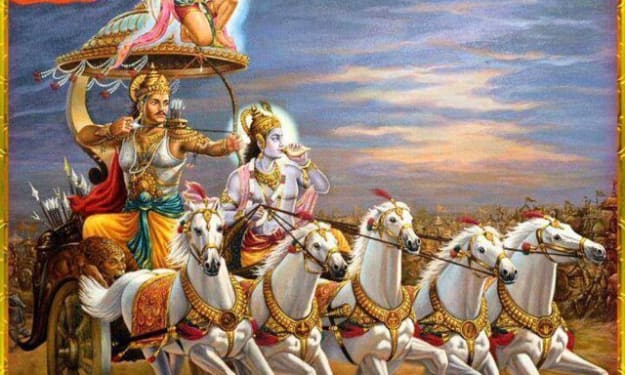
In the epic Mahabharatha, Pandavas were sent to forest. Lord Krishna advised them on different activities to win the war. Bheemar was advised to pray Lord Anjaneyar. So, Bheemar went deep inside a mountain and started his penance towards Lord Hanuman.
By Sai Suhasini Ramalingam2 years ago in History