Medieval
White House still calling for confirmation of controversial US attorney nominee despite diminishing odds
Washington, D.C. — The Biden administration is continuing its push to confirm a controversial U.S. attorney nominee, even as support in the Senate appears to be eroding. The White House has reiterated its support for the candidate despite growing opposition from Republicans and some Democrats. This indicates that it will not withdraw the choice despite the ever-increasing likelihood that it will be successful. A Divisive Nomination
By Juwel Rana9 months ago in History
How Close Was the Roman Empire to an Industrial Revolution? 🏛️⚙️
When we think about ancient Rome, we picture majestic architecture, powerful legions, and sophisticated roads. But one question often pops up among history lovers and alternative history fans alike: Could the Roman Empire have had its own Industrial Revolution? 🤔
By Toader Adelin9 months ago in History
A Candle Called Hope
The Beginning of Darkness In a small, forgotten village surrounded by endless hills and thick forests, there was a girl named Lina, just twelve years old, with eyes full of dreams. Her village, once full of joy, was now covered in shadows. The sun rarely peeked through the clouds, the trees stopped blooming, and people had started to lose their smiles. Something strange had happened a deep sadness had spread, and no one knew why.
By Muhammad Hayat9 months ago in History
Google CEO Sundar Pichai's Education, Salary, and Net Worth
Sundar Pichai: The Influential CEO of Google's Education, Salary, and Net Worth In the world of technology, Sundar Pichai, CEO of Google and Alphabet Inc., is a name associated with leadership and innovation. Pichai's journey—from humble beginnings in India to leading one of the world's most valuable businesses—is a compelling tale of ambition, education, and success. The educational background of Sundar Pichai, his current salary as a top executive, and his impressive net worth are the subjects of this article. Education and childhood Sundar Pichai was born as Pichai Sundararajan on June 10, 1972, in Madurai, Tamil Nadu, India. His mother was a stenographer and his father was an electrical engineer for the British conglomerate GEC. He was raised in a Chennai middle-class household. Sundar frequently recounts how his upbringing shaped his principles of hard work and simplicity. The family lived in a modest two-room apartment. From a young age, Pichai excelled academically. He completed his schooling at Jawahar Vidyalaya in Ashok Nagar, Chennai, and later attended Vana Vani School, located on the campus of IIT Madras. His strong academic record earned him a place at the prestigious Indian Institute of Technology Kharagpur (IIT Kharagpur), where he studied Metallurgical Engineering. His sharp intellect and leadership abilities were noted by IIT Kharagpur professors. After completing his degree in India, Pichai moved to the United States to pursue higher education. Stanford University conferred on him a Master of Science (MS) degree in Material Sciences and Engineering. He went on to complete his MBA at the University of Pennsylvania's Wharton School. He was named a Siebel Scholar and a Palmer Scholar at Wharton, honors given to students who perform exceptionally well. Progress and Promotion at Google Sundar Pichai joined Google in 2004 and started working on the Google Toolbar, a tool that made it easier for Internet Explorer users to access Google search. His big breakthrough came with the development of Google Chrome, the company’s now-dominant web browser. The introduction of Chrome in 2008 changed the game and helped establish Pichai as the company's most important leader. He became an important part of the management of products like Android, Google Drive, Gmail, and Google Maps over time. He was a favorite among Google's top executives for his calm demeanor, strategic thinking, and in-depth knowledge of product development. Pichai was named CEO of Google in 2015, when the company underwent corporate restructuring to create a new parent company called Alphabet Inc. His responsibilities expanded further in December 2019, when he also became the CEO of Alphabet, replacing Larry Page. Under his leadership, the company has focused on artificial intelligence, sustainability, and product innovation, maintaining its dominant position in the tech industry.
By GLOBAL NEWS9 months ago in History
Africa's history could be rewritten by a huge discovery in Morocco.
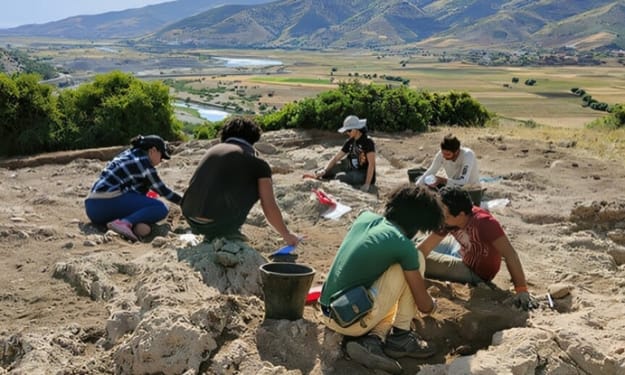
The long-held belief that the Maghreb (northwest Africa) was an empty land prior to the Phoenicians' arrival in the area around 800 BCE is thrown into doubt by a new archaeological find at Kach Kouch in Morocco. It reveals a history that is significantly more complex and rich than previously thought. Everything found at the site suggests that stable agricultural settlements on the African coast of the Mediterranean existed more than 3,000 years ago, during the Bronze Age. At the same time, societies in the eastern Mediterranean like the Mycenaean thrived. We now have a better understanding of the recent prehistory of north Africa thanks to our discovery, which was led by a group of young researchers from Morocco's National Institute of Archaeology. Additionally, it reframes our understanding of the ancient connections that existed between the Maghreb and the rest of the Mediterranean. What led to the discovery? In 1992, Kach Kouch was first discovered and excavated for the first time. At the time, researchers thought that the area had been occupied from the 8th to the 6th century BCE. This was based on the found Phoenician pottery. Our team carried out two additional seasons of excavation in 2021 and 2022, nearly 30 years later. Drones, differential GPS (global positioning systems), and 3D models were used in our investigations. For the purpose of collecting samples, a stringent procedure was followed. Because of this, we were able to find charcoal and seeds that had been fossilized. After that, a series of analyses enabled us to re-create the prehistoric economy and natural environment of the settlement. What was found in the remains The settlement was occupied three times between 2200 and 600 BCE, according to the excavations and radiocarbon dating. The earliest known remains date from 2200 to 2000 BCE. They include a cow bone, three unadorned pottery sherds, and a flint flake. Either erosion or a brief occupation of the hill during this time period could account for the lack of materials and contexts. The Koch Koch hill was permanently occupied beginning in 1300 BCE during its second phase, following a period of abandonment. Farming and animal husbandry were the primary occupations of its fewer than one hundred inhabitants. They lived in wattle and daub, a method that combines mud, reeds, and wooden poles, in circular dwellings. To store their agricultural goods, they dug silos into the rock. They raised cattle, sheep, goats, and pigs, as well as wheat, barley, and legumes, according to analysis. Additionally, they used flint tools, decorated pottery, and grinding stones for cereal processing. In addition, it has been documented that north Africa, excluding Egypt, has the oldest known bronze object. It's probably a piece of scrap metal taken out of a mold after it was molded. encounters with the Phoenicians The inhabitants of Kach Kouch maintained the same material culture, architecture, and economy as in the preceding phase throughout the so-called Mauretanian period, which occurred between the 8th and 7th centuries BCE. New cultural practices, on the other hand, were brought about by interactions with Phoenician communities that were just beginning to settle in nearby locations like Lixus. Combining Phoenician and local building methods, for instance, circular and square stone and wattle and daub structures coexisted. Additionally, the cultivation of new crops like olives and grapes began. The use of iron objects and wheel-made Phoenician ceramics like plates and amphorae (storage jugs) stand out among the new materials. Kach Kouch was peacefully abandoned around 600 BCE, possibly as a result of changes in social and economic conditions. The people who lived there probably moved to other towns nearby. Who then lived in the Bronze Age? It is not clear if the Maghreb people in the Bronze Age lived in tribes, as the Mauretanian people did later. It's likely that they were organized as families. According to the burials, there were no obvious signs of hierarchy. They may have spoken a language that was similar to the Amazigh, a native language of North Africa that was not written until the Phoenician alphabet was introduced. These populations may be the direct ancestors of the Mauretanian peoples of north-west Africa, as evidenced by the cultural continuity that has been documented at Kach Kouch. Why this is important Not only is Kach Kouch the first and earliest known Maghreb Bronze Age settlement, but it also reshapes how we understand prehistory in this region. The new findings, in addition to other recent ones, show that northwestern Africa has been connected to other Mediterranean, Atlantic, and Saharan regions since prehistoric times. Our findings cast doubt on conventional narratives, many of which were shaped by colonial perspectives that portrayed the Maghreb as an uninhabited, isolated region until it was "civilized" by other peoples. As a result, discussions about the Mediterranean's later prehistory have largely ignored the Maghreb. Not only do these new findings signal a breakthrough for archaeology, but they also make it necessary to reevaluate the dominant historical narratives. The opportunity to rewrite north Africa's history and give it the visibility it has always deserved is provided by Kach Kouch. We believe that this is a pivotal time for research that has the potential to forever alter our understanding of not only the history of north Africa but also its relationship to other Mediterranean regions.
By MD IMRAN KHAN9 months ago in History
Dinosaurs: Earth's Ancient Giants and Their Enduring Legacy
Introduction Over 230 million years ago, Earth was dominated by creatures of unimaginable size and diversity—dinosaurs. These ancient reptiles ruled the planet for over 160 million years, leaving behind a legacy that continues to captivate scientists and enthusiasts alike. From towering sauropods to fearsome theropods, dinosaurs were the architects of their era. But what led to their sudden disappearance, and what can we learn from their reign?
By Omar Mohammed 9 months ago in History
Independence Movements in the Caribbean: Successes and Failures of the Colonial Powers
Independence Movements in the Caribbean: Successes and Failures of the Colonial Powers Before the Second World War, a large part of the world was under colonial rule, with European powers maintaining colonies across the globe. After the war, political awareness grew in these colonized countries, and independence movements gained momentum under various types of political leadership. Nationalism surged in many regions as a result of the war, and the number of independent nation-states began to increase rapidly. At the same time, global population grew, while the size of states decreased. Former colonies often fragmented into smaller states, and new states were created. In many cases, however, the attempt to build new states failed. The Caribbean region, too, holds stories of both success and failure in state-building. Independence of Caribbean Nations Antigua and Barbuda, known for its tourism, and the Bahamas, a popular tourist destination with over 700 islands (many uninhabited but rich in beaches, coral reefs, and natural beauty), are notable Caribbean countries. Barbados, famous for cricket, beaches, and rum, has an economy that relies heavily on tourism and international trade. Barbados gained independence peacefully in 1966 under the joint leadership of the Barbados Labour Party and the Democratic Labour Party. The most well-known Caribbean country for many readers is likely Cuba—the country of Fidel Castro. Along with communism, Cuba is known for its sugar, tobacco, and coffee exports, as well as its music, creative arts, and cigars. Cuba gained independence in 1959 by overthrowing a U.S.-backed government. The Cuban independence movement had begun as early as the 19th century and finally culminated under the leadership of Fidel Castro and Che Guevara, leading to the establishment of communism in the country. Dominica and the Dominican Republic are two other Caribbean nations. Both have agriculture-based economies and export bananas, sugar, and coffee. The Dominican Republic was a Spanish colony and saw violent independence movements in the 19th and 20th centuries. It gained independence in 1821 after three centuries of colonial rule, was then taken over by Haiti, from which it broke free in 1844. Spain reoccupied it in 1861, and later it came under U.S. rule in 1916. The Third Republic was established in 1924, and the Fourth Republic in 1966. The Dominican Republic, with a population of 11 million, now has a per capita income of over $10,000. Sharing the island of Hispaniola with the Dominican Republic is Haiti, known as the world’s first Black republic founded by former slaves. Grenada, famous for its spices, also has an agriculture- and tourism-dependent economy, like most Caribbean countries. Jamaica, one of the larger Caribbean nations, is known for its mountains, rainforests, and scenic beaches—and, of course, for cricket star Chris Gayle. Outside of tourism and agriculture, Jamaica has a growing manufacturing sector and a rich cultural heritage, especially in music. The Jamaican Labour Party and the People’s National Party led Jamaica's independence movement, and the country gained independence from Britain in 1962. Other Caribbean countries include Saint Kitts and Nevis, Saint Lucia, and Trinidad and Tobago. Nearly all these nations were once colonies of various European powers before World War II and have agriculture- and tourism-based economies. Trinidad and Tobago gained independence from Britain in August 1962 under the leadership of the People’s National Movement (PNM), which also ensured a peaceful transition of power. Why Were These Independence Movements Successful? After World War II, the number of independent nations rose rapidly, along with an increase in movements demanding independence. These movements were justified by two main theoretical frameworks: First, the Culturalist Theory suggests that nationalist movements arise from differences and inequalities in cultural identity. These identities may be based on language, ethnicity, or religion. Such identity-based independence movements often derive legitimacy from institutional and social inequalities, with civil society playing a key role in justifying these causes. Second, according to the Rationalist Theory, people make decisions based on the most advantageous outcome. A political force is more likely to join an independence movement if doing so promises political and economic benefits. In most states, there is a core-periphery divide. Groups in the core enjoy more political and economic advantages, while those in the periphery experience the opposite. Eventually, peripheral groups may pursue independence to assert their own political identity and cultural diversity. Third, human beings are inherently drawn to freedom. Most people do not accept colonial rule willingly. On the contrary, they repeatedly engage in political struggles to free themselves from it. Colonial rulers, however, are reluctant to relinquish control due to their economic and political interests. This often leads to conflict between colonizers and freedom-seekers. To suppress independence movements, colonizers typically maintain repressive state structures, which further incite resistance. Fourth, every nation develops its own core values and political philosophies. Although democratic governance is practiced in over 130 countries today, each country shapes its system in its own way. Differences in governance values often lead to conflict between colonizers and local populations. These conflicts may arise from language issues, demands for equitable resource distribution, or religious differences—all of which strengthen the case for independence. Fifth, the post-World War II global political landscape changed significantly. Foreign interference in domestic politics became more prevalent. Often, multiple global powers vied for influence in the same country, leading to clashes that sometimes resulted in independence. Regional political dynamics also played a role, as rival factions often saw the collapse of a colonial power or breakup of a larger state as an opportunity for political gain. Caribbean Territories That Have Not Gained Independence Despite many successes, at least 17 territories in the Caribbean remain under colonial rule. The countries that still hold territories in the Caribbean include the United Kingdom, the Netherlands, France, and the United States. The UK, once a dominant colonial power in the region, still governs several territories including Anguilla, Bermuda, the British Virgin Islands, Montserrat, the Cayman Islands, and the Turks and Caicos Islands. The Netherlands retains control over Bonaire, Curaçao, Saba, Sint Maarten, Sint Eustatius, and Aruba. France controls Guadeloupe, Martinique, Saint Barthélemy, and Saint Martin. The United States governs Puerto Rico. Many of these territories have small local populations, and some islands serve primarily military purposes. Global powers maintain a military presence in the Caribbean to preserve their geopolitical relevance and justify their continued control using various political arguments. These areas also lack a well-developed middle class—essential for a successful independence movement. Additionally, local elites often do not support independence, and the civil society lacks a principled ideological position. These are key reasons why these regions have not yet achieved independence.
By Riham Rahman 9 months ago in History
AI in Cybersecurity: A game changer or a double-edged sword?
Artificial intelligence has utterly transformed cybersecurity in diverse manners, both remarkable and multifold. Its skills—including scouring immense datasets, searching for anomalies and systematising retaliation—have propelled protective tactics to unprecedented heights.
By Abjol Hussain Laskar9 months ago in History