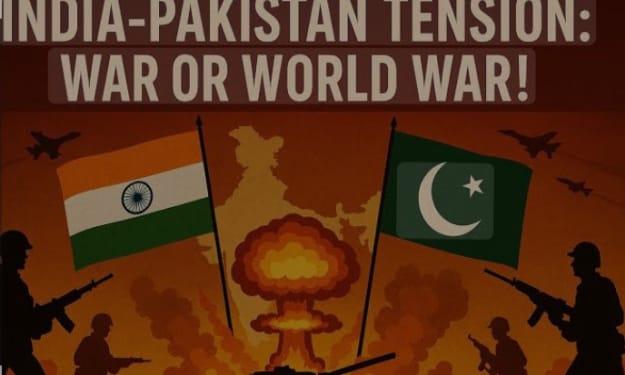
The India-Pakistan Wars: A Tale of Strife and Resilience. AI-Generated.
The India-Pakistan Wars: A Tale of Strife and Resilience
The India-Pakistan conflict has been one of the most enduring and intense rivalries in modern history. Rooted in the partition of British India in 1947, the two nations have fought multiple wars, each shaping the future of the subcontinent. The wars were not just about territorial disputes; they were about national identity, political ambitions, and the complexities of post-colonial struggles.
The 1947-1948 War: The First Conflict
The first war between India and Pakistan broke out soon after the partition, with the primary cause being the princely state of Jammu and Kashmir. The region, with a majority Muslim population, was ruled by a Hindu Maharaja, Hari Singh, who initially sought to remain independent but later acceded to India following an invasion by Pakistani tribal forces.
This war was fought on both the land and the diplomatic stage, with India seeking to secure Kashmir, while Pakistan contested the decision. After almost a year of conflict, the United Nations brokered a ceasefire in January 1949, resulting in the division of Kashmir into areas controlled by India and Pakistan. The line of control (LoC) became the de facto boundary, but the dispute over Kashmir remained unresolved.
The 1965 War: Escalating Tensions
In 1965, both countries found themselves on the brink of war once again, this time due to the continuing Kashmir dispute. Following skirmishes along the LoC, Pakistan launched Operation Gibraltar, attempting to infiltrate Indian territory in Jammu and Kashmir. India responded with a full-scale military offensive, leading to a war that lasted for 17 days.
The war ended in a stalemate, with both sides suffering heavy casualties. The United Nations intervened, and both nations agreed to a ceasefire under the Tashkent Agreement, brokered by the Soviet Union. Despite the ceasefire, the war left lasting scars, and tensions remained high between the two countries.
The 1971 War: The Breakup of Pakistan
Perhaps the most significant and transformative conflict between India and Pakistan came in 1971, with the Bangladesh Liberation War at its core. The war began when East Pakistan (now Bangladesh) sought independence from West Pakistan. The Indian military intervened in support of East Pakistan's independence movement, fearing the instability would spill over into India, especially with refugees pouring in from the east.
This war saw one of the most decisive victories for India. Pakistani forces surrendered in Dhaka on December 16, 1971, and Bangladesh was born as an independent nation. The war drastically changed the geopolitical landscape of South Asia, with India solidifying its role as a regional power while Pakistan's territorial integrity was shattered.
The Kargil War: A New Millennium Conflict
The most recent full-scale conflict between India and Pakistan occurred in 1999, in the Kargil region of Jammu and Kashmir. Pakistani forces, along with militants, infiltrated the Indian side of the Line of Control, leading to a short but intense war.
The war lasted for over two months, with heavy fighting in the mountainous terrain of Kargil. India responded with a large-scale military operation to push back the intruders. After heavy casualties on both sides, international pressure and the threat of further escalation led to a return to status quo with Pakistan withdrawing from Kargil.
The Continuing Legacy of Conflict
Despite these wars, both nations have never fought a full-scale war since the Kargil conflict. Yet, tensions remain high, primarily over the Kashmir issue. Nuclear weapons, which both nations possess, have added a terrifying dimension to their rivalry, with both countries facing the constant risk of escalation.
The wars between India and Pakistan have been deeply traumatic for both nations. Millions have been displaced, families torn apart, and countless lives lost. Yet, despite the bitterness of the past, there are still people on both sides who yearn for peace and a future where both nations can coexist harmoniously.
The India-Pakistan wars are more than just stories of battles fought and territories gained or lost. They are a testament to the resilience of the human spirit, the power of diplomacy, and the hope that one day, the wounds of the past may heal, and the region may finally see peace.