Biographies
The Last Stand
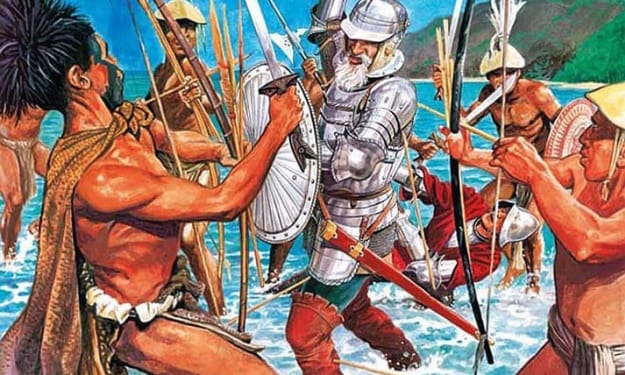
The Battle of Mactan was a pivotal conflict in Philippine history. It took place in 1521 near the island of Mactan in the Visayas region of the Philippines. The battle pitted Lapu-Lapu, and his warriors against Portuguese explorer Ferdinand Magellan and his small force of Spanish soldiers and Filipino mercenaries. Lapu Lapu is one of the most famous figures in Philippine history. He was a native chieftain who led the battle of Mactan against the Spanish forces of Ferdinand Magellan in 1521. He is often considered to be the first Filipino hero to have resisted foreign rule. The city of Lapu Lapu was named in his honour, and his statue stands in the plaza at the city center, as a reminder of his bravery. As such, he is revered as a national hero by most Filipinos and is given much respect for his courage and determination.
By Ziain Morales2 years ago in History
Shattered Reflections
In the heart of a bustling city, a young man named Alex lived a seemingly ordinary life. Tall and handsome, he had a charismatic smile that lit up the room whenever he entered. But beneath the facade of happiness lay a shattered soul haunted by a dark past.
By Azubuike Johnson Okachi2 years ago in History
Eternal Echoes: Titanic Story That Sends Shivers Down Your Spine [lego titanic,lego titanic set]. Content Warning.
On April 10-1912, the RMS Titanic set sail from England. But this wasn't the launch of a regular ship, The Titanic was the largest liner ever built at the time. It was 882 feet long nearly the size of three soccer fields and measured from the hull to the top of the smokestacks.
By Muhammad Asim2 years ago in History
Joy and Festivity
Independence Day is an occasion of immense significance for any nation, and for India, it holds a special place in the hearts of its citizens. Commemorating the day when India gained freedom from British rule on August 15, 1947, Independence Day is marked with fervor, enthusiasm, and patriotic spirit throughout the country. The festive atmosphere that surrounds this momentous day spreads joy and happiness, binding citizens in celebration and reinforcing the sense of unity and pride in being part of a diverse yet united nation.
By OPEYEMI OWONIYA2 years ago in History
1st Governer General of Pakistan
The struggle which started on 1875 by Sir Syed followed by many people like Dr. Muhammad Iqbal and Mr. Jinnah which was formalised in Lahore Resolution in 1940 was finally achieved on 14th of August 1947. British Government agreed on dividing the United India. Red Cliff was sent by the Britishers to divide India. The Radcliffe Commission, dividing Bengal and Punjab, completed its work and reported to Mountbatten on 12 August; the last Viceroy held the maps until the 17th, not wanting to spoil the independence celebrations in both nations. There had already been ethnically charged violence and movement of populations; publication of the Radcliffe Line dividing the new nations sparked mass migration, murder, and ethnic cleansing. Many on the "wrong side" of the lines fled or were murdered, or murdered others, hoping to make facts on the ground which would reverse the commission's verdict. Radcliffe wrote in his report that he knew that neither side would be happy with his award; he declined his fee for the work. Christopher Beaumont, Radcliffe's private secretary, later wrote that Mountbatten "must take the blame—though not the sole blame—for the massacres in the Punjab in which between 500,000 to a million men, women and children perished". As many as 14.5 million people relocated between India and Pakistan during and after partition. Jinnah did what he could for the eight million people who migrated to Pakistan; although by now over 70 and frail from lung ailments, he travelled across West Pakistan and personally supervised the provision of aid. According to Ahmed, "What Pakistan needed desperately in those early months was a symbol of the state, one that would unify people and give them the courage and resolve to succeed. Among the restive regions of the new nation was the North-West Frontier Province. The referendum there in July 1947 had been tainted by low turnout as less than 10 per cent of the population were allowed to vote. On 22 August 1947, just after a week of becoming governor general, Jinnah dissolved the elected government of Dr. Khan Abdul Jabbar Khan. Later on, Abdul Qayyum Khan was put in place by Jinnah in the Pashtun-dominated province despite him being a Kashmiri. On 12 August 1948 the Babrra massacre in Charsadda occurred resulting in the death of 400 people aligned with the Khudai Khidmatgar movement. long with Liaquat and Abdur Rab Nishtar, Jinnah represented Pakistan's interests in the Division Council to appropriately divide public assets between India and Pakistan.Pakistan was supposed to receive one-sixth of the pre-independence government's assets, carefully divided by agreement, even specifying how many sheets of paper each side would receive. The new Indian state, however, was slow to deliver, hoping for the collapse of the nascent Pakistani government, and reunion. Few members of the Indian Civil Service and the Indian Police Service had chosen Pakistan, resulting in staff shortages. The Princely states of India were advised by the departing British to choose whether to join Pakistan or India. But unfortunately they were not allowed to do so practically. There were may states which were captured by India by force. A prominent example is Kashmir which after 75 years is still a conflict region. In January 1948, the Indian government finally agreed to pay Pakistan its share of British India's assets. They were impelled by Gandhi, who threatened a fast until death. Only days later, on 30 January, Gandhi was assassinated by Nathuram Godse, a Hindu nationalist, who believed that Gandhi was pro-Muslim. After hearing about Gandhi's murder on the following day, Jinnah publicly made a brief statement of condolence, calling Gandhi "one of the greatest men produced by the Hindu community. In February 1948, in a radio talk broadcast addressed to the people of the US, Jinnah expressed his views regarding Pakistan's constitution to be in the following way:
By Syed Ammar2 years ago in History
Partition of India
Lahore Resolution was proven a major bench mark towards the partition of India which lead to the Muslim League victory in 1945-46 elections. After the 3rd June 1945 plan it was quite prominent that eventually the India will be divided. After the appointment of Mountbatten, he was warned about Mr. Jinnah that no one had been able to read his mind in the subcontinent yet. Jinnah feared that at the end of the British presence in the subcontinent, they would turn control over to the Congress-dominated constituent assembly, putting Muslims at a disadvantage in attempting to win autonomy. He demanded that Mountbatten divide the army prior to independence, which would take at least a year. Mountbatten had hoped that the post-independence arrangements would include a common defence force, but Jinnah saw it as essential that a sovereign state should have its own forces. Mountbatten met with Liaquat the day of his final session with Jinnah, and concluded, as he told Attlee and the Cabinet in May, that "it had become clear that the Muslim League would resort to arms if Pakistan in some form were not conceded. The Viceroy was also influenced by negative Muslim reaction to the constitutional report of the assembly, which envisioned broad powers for the post-independence central government. On 3 June, Mountbatten, Nehru, Jinnah and Sikh leader Baldev Singh made the formal announcement by radio. Jinnah concluded his address with "Pakistan Zindabad " (Long live Pakistan), which was not in the script. In the weeks which followed Punjab and Bengal cast the votes which resulted in partition. Sylhet and the N.W.F.P. voted to cast their lots with Pakistan, a decision joined by the assemblies in Sind and Baluchistan. Mountbatten was hoping to rule India even after the partition. Liaqat Ali Khan on the behalf of Mr. Jinnah asked Mountbatten to make Mr. Jinnah the first Governer General of Pakistan. This angered Mountbatten, he denied his proposal and said he would be India's first post-independence governor-general—but Jinnah felt that Mountbatten would be likely to favour the new Hindu-majority state because of his closeness to Nehru. In addition, the governor-general would initially be a powerful figure, and Jinnah did not trust anyone else to take that office. Although the Boundary Commission, led by British lawyer Sir Cyril Radcliffe, had not yet reported, there were already massive movements of populations between the nations-to-be, as well as sectarian violence. Jinnah arranged to sell his house in Bombay and procured a new one in Karachi. On 7 August, Jinnah, with his sister and close staff, flew from Delhi to Karachi in Mountbatten's plane, and as the plane taxied, he was heard to murmur, "That's the end of that. On 11 August, he presided over the new constituent assembly for Pakistan at Karachi, and addressed them, "You are free; you are free to go to your temples, you are free to go to your mosques or to any other place of worship in this State of Pakistan. You may belong to any religion or caste or creed—that has nothing to do with the business of the State I think we should keep that in front of us as our ideal and you will find that in course of time Hindus would cease to be Hindus and Muslims would cease to be Muslims, not in the religious sense, because that is the personal faith of each individual, but in the political sense as citizens of the State. On 14 August, Pakistan became independent; Jinnah led the celebrations in Karachi. One observer wrote, "here indeed is Pakistan's King Emperor, Archbishop of Canterbury, Speaker and Prime Minister concentrated into one formidable Quaid-e-Azam.
By Syed Ammar2 years ago in History
Lahore Resolution and its impact Part 3
By the end of 1939, Muslim League was in quite a position. After the electoral loss 1936-37, the leaders of Muslim League went quite serious. The Lahore Resolution (sometimes called the "Pakistan Resolution", although it does not contain that name), based on the sub-committee's work, embraced the Two-Nation Theory and called for a union of the Muslim-majority provinces in the northwest of British India, with complete autonomy. Similar rights were to be granted to the Muslim-majority areas in the east, and unspecified protections given to Muslim minorities in other provinces. The resolution was passed by the League session in Lahore on 23 March 1940. Gandhi's reaction to the Lahore Resolution was muted; he called it "baffling", but told his disciples that Muslims, in common with other people of India, had the right to self-determination. Leaders of the Congress were more vocal; Jawaharlal Nehru referred to Lahore as "Jinnah's fantastic proposals" while Chakravarti Rajagopalachari deemed Jinnah's views on partition "a sign of a diseased mentality". Linlithgow met with Jinnah in June 1940, soon after Winston Churchill became the British prime minister, and in August offered both the Congress and the League a deal whereby in exchange for full support for the war, Linlithgow would allow Indian representation on his major war councils. The Viceroy promised a representative body after the war to determine India's future, and that no future settlement would be imposed over the objections of a large part of the population. This was satisfactory to neither the Congress nor the League, though Jinnah was pleased that the British had moved towards recognising Jinnah as the representative of the Muslim community's interests. Jinnah was reluctant to make specific proposals as to the boundaries of Pakistan, or its relationships with Britain and with the rest of the subcontinent, fearing that any precise plan would divide the League. During the world war, British Government sent Sir Stafford Cripps with a proposal which was rejected by Mr. Jinnah. The Congress followed the failed Cripps mission by demanding, in August 1942, that the British immediately "Quit India", proclaiming a mass campaign of satyagraha until they did. The British promptly arrested most major leaders of the Congress and imprisoned them for the remainder of the war. Gandhi, however, was placed on house arrest in one of the Aga Khan's palaces prior to his release for health reasons in 1944. After some time in 1945-46 another election was conducted and British declared it like a referendom towards the demands of the people of India. In the December 1945 elections for the Constituent Assembly of India, the League won every seat reserved for Muslims. In the provincial elections in January 1946, the League took 75% of the Muslim vote, an increase from 4.4% in 1937. In February 1946, the British Cabinet resolved to send a delegation to India to negotiate with leaders there. This Cabinet Mission included Cripps and Pethick-Lawrence. The highest-level delegation to try to break the deadlock, it arrived in New Delhi in late March. Little negotiation had been done since the previous October because of the elections in India. The British in May released a plan for a united Indian state comprising substantially autonomous provinces, and called for "groups" of provinces formed on the basis of religion. Matters such as defence, external relations and communications would be handled by a central authority. Provinces would have the option of leaving the union entirely, and there would be an interim government with representation from the Congress and the League. Jinnah and his Working Committee accepted this plan in June, but it fell apart over the question of how many members of the interim government the Congress and the League would have, and over the Congress's desire to include a Muslim member in its representation. Before leaving India, the British ministers stated that they intended to inaugurate an interim government even if one of the major groups was unwilling to participate. In 1946, Jwahallal Nehru and Liaqat Ali Khan had meetings in London discussing the partition plan but unfortunately the meetings didn't went fruitful.
By Syed Ammar2 years ago in History
Leader of Pakistan
Muhammad Ali Jinnah when realized that the people of subcontinent particularly Muslims are not taking interest in Politics, he went to london. The early 1930s saw a resurgence in Indian Muslim nationalism, which came to a head with the Pakistan Declaration. In 1933, Indian Muslims, especially from the United Provinces, began to urge Jinnah to return and take up again his leadership of the Muslim League, an organisation which had fallen into inactivity. He remained titular president of the League, but declined to travel to India to preside over its 1933 session in April, writing that he could not possibly return there until the end of the year. Among those who met with Jinnah to seek his return was Liaquat Ali Khan, who would be a major political associate of Jinnah in the years to come and the first Prime Minister of Pakistan. At Jinnah's request, Liaquat discussed the return with a large number of Muslim politicians and confirmed his recommendation to Jinnah.In early 1934, Jinnah relocated to the subcontinent, though he shuttled between London and India on business for the next few years, selling his house in Hampstead and closing his legal practice in Britain. Muslims of Bombay elected Jinnah, though then absent in London, as their representative to the Central Legislative Assembly in October 1934. The British Parliament's Government of India Act 1935 gave considerable power to India's provinces, with a weak central parliament in New Delhi, which had no authority over such matters as foreign policy, defence, and much of the budget. Full power remained in the hands of the Viceroy, however, who could dissolve legislatures and rule by decree. The League reluctantly accepted the scheme, though expressing reservations about the weak parliament. The Congress was much better prepared for the provincial elections in 1937, and the League failed to win a majority even of the Muslim seats in any of the provinces where members of that faith held a majority. It did win a majority of the Muslim seats in Delhi, but could not form a government anywhere, though it was part of the ruling coalition in Bengal. The Congress and its allies formed the government even in the North-West Frontier Province (N.W.F.P.), where the League won no seats despite the fact that almost all residents were Muslim. According to Jaswant Singh, "the events of 1937 had a tremendous, almost a traumatic effect upon Jinnah". Despite his beliefs of twenty years that Muslims could protect their rights in a united India through separate electorates, provincial boundaries drawn to preserve Muslim majorities, and by other protections of minority rights, Muslim voters had failed to unite, with the issues Jinnah hoped to bring forward lost amid factional fighting. Singh notes the effect of the 1937 elections on Muslim political opinion, "when the Congress formed a government with almost all of the Muslim MLAs sitting on the Opposition benches, non-Congress Muslims were suddenly faced with this stark reality of near-total political powerlessness. It was brought home to them, like a bolt of lightning, that even if the Congress did not win a single Muslim seat as long as it won an absolute majority in the House, on the strength of the general seats, it could and would form a government entirely on its own. In the next two years, Jinnah worked to build support among Muslims for the League. He secured the right to speak for the Muslim-led Bengali and Punjabi provincial governments in the central government in New Delhi ("the centre"). He worked to expand the League, reducing the cost of membership to two annas (1⁄8 of a rupee), half of what it cost to join the Congress. He restructured the League along the lines of the Congress, putting most power in a Working Committee, which he appointed. By December 1939, Liaquat estimated that the League had three million two-anna members.
By Syed Ammar2 years ago in History
Muhammad Ali Jinnah
Leader is a person who admires the public through his leadership qualities, his vision and his ideology. It is the leader for whose sake million of people get ready to give away their lives. There have been several leaders in the world who had revolutionarized the people through their struggle and vision. Specifically talking about South Asia, the greatest leader of his time was Muhammad Ali Jinnah affectionately known as Quaid-e-Azam. He was the one who gave the people of subcontinent a hope to live independently and to breath in freedom. Talking about his biography, he was born on 25th December,1876 in Karachi. He took early education from his local city and then for higher education he went to London where he did Bar at law from Lincon Inn. College. On his return he started practicing law in Karachi. But he didn't find many opportunities. So he moved to Mumbai. There he was actually able to express his real talent. He also started taking part in active politics. Jinnah rose to prominence in the Indian National Congress in the first two decades of the 20th century. In these early years of his political career, Jinnah advocated Hindu–Muslim unity, helping to shape the 1916 Lucknow Pact between the Congress and the All-India Muslim League, in which Jinnah had also become prominent. Jinnah became a key leader in the All-India Home Rule League, and proposed a fourteen-point constitutional reform plan to safeguard the political rights of Muslims in the Indian subcontinent. In 1920, however, Jinnah resigned from the Congress when it agreed to follow a campaign of satyagraha, which he regarded as political anarchy. In September 1923, Jinnah was elected as Muslim member for Bombay in the new Central Legislative Assembly. He showed much skill as a parliamentarian, organising many Indian members to work with the Swaraj Party, and continued to press demands for full responsible government. In 1925, as recognition for his legislative activities, he was offered a knighthood by Lord Reading, who was retiring from the Viceroyalty. He replied: "I prefer to be plain Mr Jinnah." In 1927, the British Government, under Conservative Prime Minister Stanley Baldwin, undertook a decennial review of Indian policy mandated by the Government of India Act 1919. The review began two years early as Baldwin feared he would lose the next election (which he did, in 1929). The Cabinet was influenced by minister Winston Churchill, who strongly opposed self-government for India, and members hoped that by having the commission appointed early, the policies for India which they favoured would survive their government. The resulting commission, led by Liberal MP John Simon, though with a majority of Conservatives, arrived in India in March 1928. Later on some unexpected and unusual events happened due to which Mr. Jinnah quit politics and went to England. In 1931, Fatima Jinnah joined her brother in England. From then on, Muhammad Jinnah would receive personal care and support from her as he aged and began to suffer from the lung ailments which would eventually kill him. She lived and travelled with him, and became a close advisor. Muhammad Jinnah's daughter, Dina, was educated in England and India. Jinnah later became estranged from Dina after she decided to marry a Parsi, Neville Wadia from a prominent Parsi business family. Wadia is the son Sir Ness Wadia and Dr. Homi Wadia. When Jinnah urged Dina to marry a Muslim, she reminded him that he had married a woman not raised in his faith. Jinnah continued to correspond cordially with his daughter, but their personal relationship was strained, and she did not come to Pakistan in his lifetime, but only for his funeral.
By Syed Ammar2 years ago in History
LIFE HISTORY OF AKBAR CHAPTER : 1(AKBAR'S LIFE)
Akbar the Great, also known as Akbar I, was one of the most renowned and influential rulers of the Mughal Empire in India. He was born on October 15, 1542, in Umerkot, Sindh (present-day Pakistan) to Emperor Humayun and Hamida Banu Begum. His birthplace is known as Umerkot Fort and is now a popular historical site.
By Dhishon Alaf singh R2 years ago in History
The First Chapter of the Next Great Philippines Novel
In the heart of the Philippine archipelago, where emerald hills met crystal-clear waters, a tale of triumphs and struggles was about to unfold. This was a land of beauty and contradictions, where the echoes of a tumultuous past reverberated alongside the resolute spirit of its people.
By MJ Rimando2 years ago in History
The Ancient Egyptian Civilization. Content Warning.
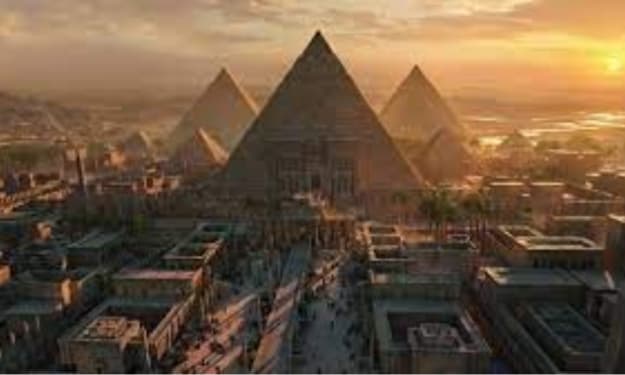
The Ancient Egyptian Civilization stands as one of the most extraordinary and enduring cultures in the annals of human history. Flourishing along the banks of the Nile River for over three millennia, this ancient society left an indelible mark on the development of human civilization. With its monumental achievements in art, architecture, religion, governance, and societal structures, Ancient Egypt continues to captivate the imagination of scholars, historians, and enthusiasts alike. This comprehensive study document seeks to delve deep into the fascinating world of Ancient Egypt, unravelling its mysteries and shedding light on the various facets that contributed to its rise, evolution, and lasting impact on the world.
By Nizam malang2 years ago in History