

By the end of 1939, Muslim League was in quite a position. After the electoral loss 1936-37, the leaders of Muslim League went quite serious. The Lahore Resolution (sometimes called the "Pakistan Resolution", although it does not contain that name), based on the sub-committee's work, embraced the Two-Nation Theory and called for a union of the Muslim-majority provinces in the northwest of British India, with complete autonomy. Similar rights were to be granted to the Muslim-majority areas in the east, and unspecified protections given to Muslim minorities in other provinces. The resolution was passed by the League session in Lahore on 23 March 1940. Gandhi's reaction to the Lahore Resolution was muted; he called it "baffling", but told his disciples that Muslims, in common with other people of India, had the right to self-determination. Leaders of the Congress were more vocal; Jawaharlal Nehru referred to Lahore as "Jinnah's fantastic proposals" while Chakravarti Rajagopalachari deemed Jinnah's views on partition "a sign of a diseased mentality". Linlithgow met with Jinnah in June 1940, soon after Winston Churchill became the British prime minister, and in August offered both the Congress and the League a deal whereby in exchange for full support for the war, Linlithgow would allow Indian representation on his major war councils. The Viceroy promised a representative body after the war to determine India's future, and that no future settlement would be imposed over the objections of a large part of the population. This was satisfactory to neither the Congress nor the League, though Jinnah was pleased that the British had moved towards recognising Jinnah as the representative of the Muslim community's interests. Jinnah was reluctant to make specific proposals as to the boundaries of Pakistan, or its relationships with Britain and with the rest of the subcontinent, fearing that any precise plan would divide the League. During the world war, British Government sent Sir Stafford Cripps with a proposal which was rejected by Mr. Jinnah. The Congress followed the failed Cripps mission by demanding, in August 1942, that the British immediately "Quit India", proclaiming a mass campaign of satyagraha until they did. The British promptly arrested most major leaders of the Congress and imprisoned them for the remainder of the war. Gandhi, however, was placed on house arrest in one of the Aga Khan's palaces prior to his release for health reasons in 1944. After some time in 1945-46 another election was conducted and British declared it like a referendom towards the demands of the people of India. In the December 1945 elections for the Constituent Assembly of India, the League won every seat reserved for Muslims. In the provincial elections in January 1946, the League took 75% of the Muslim vote, an increase from 4.4% in 1937. In February 1946, the British Cabinet resolved to send a delegation to India to negotiate with leaders there. This Cabinet Mission included Cripps and Pethick-Lawrence. The highest-level delegation to try to break the deadlock, it arrived in New Delhi in late March. Little negotiation had been done since the previous October because of the elections in India. The British in May released a plan for a united Indian state comprising substantially autonomous provinces, and called for "groups" of provinces formed on the basis of religion. Matters such as defence, external relations and communications would be handled by a central authority. Provinces would have the option of leaving the union entirely, and there would be an interim government with representation from the Congress and the League. Jinnah and his Working Committee accepted this plan in June, but it fell apart over the question of how many members of the interim government the Congress and the League would have, and over the Congress's desire to include a Muslim member in its representation. Before leaving India, the British ministers stated that they intended to inaugurate an interim government even if one of the major groups was unwilling to participate. In 1946, Jwahallal Nehru and Liaqat Ali Khan had meetings in London discussing the partition plan but unfortunately the meetings didn't went fruitful.
About the Creator
Syed Ammar
Social Critic, learning to get rid of so-called social values, Columnist, having eagle eye on South Asian matters. Intellecting the things differently.
Keep reading
More stories from Syed Ammar and writers in History and other communities.
Leader of Pakistan
Muhammad Ali Jinnah when realized that the people of subcontinent particularly Muslims are not taking interest in Politics, he went to london. The early 1930s saw a resurgence in Indian Muslim nationalism, which came to a head with the Pakistan Declaration. In 1933, Indian Muslims, especially from the United Provinces, began to urge Jinnah to return and take up again his leadership of the Muslim League, an organisation which had fallen into inactivity. He remained titular president of the League, but declined to travel to India to preside over its 1933 session in April, writing that he could not possibly return there until the end of the year. Among those who met with Jinnah to seek his return was Liaquat Ali Khan, who would be a major political associate of Jinnah in the years to come and the first Prime Minister of Pakistan. At Jinnah's request, Liaquat discussed the return with a large number of Muslim politicians and confirmed his recommendation to Jinnah.In early 1934, Jinnah relocated to the subcontinent, though he shuttled between London and India on business for the next few years, selling his house in Hampstead and closing his legal practice in Britain. Muslims of Bombay elected Jinnah, though then absent in London, as their representative to the Central Legislative Assembly in October 1934. The British Parliament's Government of India Act 1935 gave considerable power to India's provinces, with a weak central parliament in New Delhi, which had no authority over such matters as foreign policy, defence, and much of the budget. Full power remained in the hands of the Viceroy, however, who could dissolve legislatures and rule by decree. The League reluctantly accepted the scheme, though expressing reservations about the weak parliament. The Congress was much better prepared for the provincial elections in 1937, and the League failed to win a majority even of the Muslim seats in any of the provinces where members of that faith held a majority. It did win a majority of the Muslim seats in Delhi, but could not form a government anywhere, though it was part of the ruling coalition in Bengal. The Congress and its allies formed the government even in the North-West Frontier Province (N.W.F.P.), where the League won no seats despite the fact that almost all residents were Muslim. According to Jaswant Singh, "the events of 1937 had a tremendous, almost a traumatic effect upon Jinnah". Despite his beliefs of twenty years that Muslims could protect their rights in a united India through separate electorates, provincial boundaries drawn to preserve Muslim majorities, and by other protections of minority rights, Muslim voters had failed to unite, with the issues Jinnah hoped to bring forward lost amid factional fighting. Singh notes the effect of the 1937 elections on Muslim political opinion, "when the Congress formed a government with almost all of the Muslim MLAs sitting on the Opposition benches, non-Congress Muslims were suddenly faced with this stark reality of near-total political powerlessness. It was brought home to them, like a bolt of lightning, that even if the Congress did not win a single Muslim seat as long as it won an absolute majority in the House, on the strength of the general seats, it could and would form a government entirely on its own. In the next two years, Jinnah worked to build support among Muslims for the League. He secured the right to speak for the Muslim-led Bengali and Punjabi provincial governments in the central government in New Delhi ("the centre"). He worked to expand the League, reducing the cost of membership to two annas (1⁄8 of a rupee), half of what it cost to join the Congress. He restructured the League along the lines of the Congress, putting most power in a Working Committee, which he appointed. By December 1939, Liaquat estimated that the League had three million two-anna members.
By Syed Ammar2 years ago in History
Military Strength of Alexander the Great and the Chola Empire: A Historical Comparison
Though separated by more than a thousand years and operating in vastly different geographical and cultural contexts, both forces achieved extraordinary success through discipline, innovation, and strategic brilliance. This article explores the history, composition, size, organization, and military strength of Alexander’s Macedonian army and the Chola military, highlighting how each became a dominant power of its era.
By Say the truth 3 days ago in History
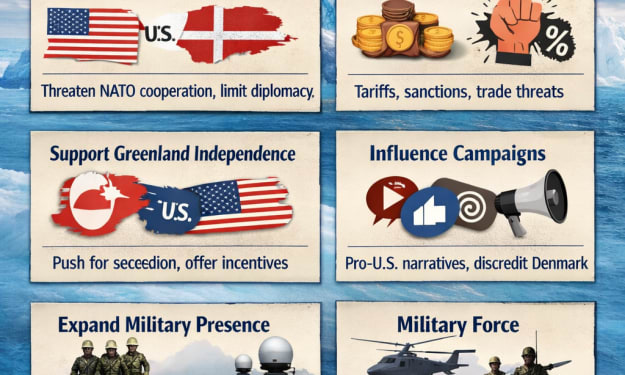
The Hard Ways Trump Could Try to Take Greenland
When Donald Trump was president of the United States, he shocked the world by saying he wanted to buy Greenland. Many people laughed, but others took the idea seriously. Greenland is a huge island in the Arctic. It is rich in natural resources and very important for military defense. Today, Greenland belongs to Denmark, but it also governs itself in many areas.
By sehzeen fatima6 days ago in History



Comments
There are no comments for this story
Be the first to respond and start the conversation.