Ancient
All the Light We Cannot See – Anthony Doerr
The sky over Saint-Brieuc was heavy with clouds, the kind that hung low and pressed against the roofs like a threat. Though the war had quieted in the north, its whispers still roamed the air—through radio static, cracked windows, and the wary glances of strangers.
By Jawad Khan9 months ago in History
Jim Morrison’s Stolen Gravesite Statue Found After 37 Years Emotional Return to Paris Cemetery
Jim Morrison’s Stolen Gravesite Statue Found After 37 Years Emotional Return to Paris Cemetery In the heart of Paris lies Père Lachaise Cemetery a resting place for luminaries poets and rebels. Among its winding paths and moss covered gravestones fans from all over the world make their pilgrimage to visit the grave of Jim Morrison the iconic lead singer of The Doors. For decades the gravesite has stood as a silent testament to a man whose lyrics blurred the lines between rock and poetry passion and chaos. But something crucial had been missing a statue that once adorned the grave stolen years ago taking with it a piece of Morrison’s soul. Now in a moment that feels almost mythical the statue has been found.
By Adnan Rasheed9 months ago in History
Gerrymandering the Presidency: Why Trump could lose the popular vote in 2020 by 6 percent and still win a second term.
Donald Trump was the clear Electoral College winner in the 2016 election, despite losing the popular vote by a wide margin to Hillary Clinton. Anthony J. McGann, Charles Anthony Smith, Michael Latner and Alex Keena write that, unless the Supreme Court stops congressional gerrymandering, President Trump can guarantee re-election in 2020 – even if he loses by 6 percent. When the US Supreme Court takes up the issue of partisan gerrymandering this year, they will decide not only the fate of popular control in the House of Representatives and many state legislatures, but quite possibly the Presidency as well. If four Republican controlled state governments (Pennsylvania, Michigan, Wisconsin and Florida) change the way they allocate Electoral College votes, President Trump could be re-elected in 2020, even if he loses the popular vote by 6 percentage points. All the states need do is to allocate Electoral College votes by congressional district (like Nebraska and Maine), instead of giving all of the state’s electors to the statewide winner. Of course, this strategy only works to the benefit of the Republicans because the congressional districts in these states are heavily gerrymandered. As we argue in our book Gerrymandering in America, the congressional districts in many states are drawn to advantage the Republican Party. For example, in Pennsylvania in 2012 the Republicans took 13 out of 18 House districts even though the Democrats received more votes. If this partisan gerrymandering were outlawed, then allocating Electoral College votes by congressional district in the four states would actually disadvantage the Republican candidate for President. However, if the Supreme Court continues to allow partisan gerrymandering – as it has since its decision Vieth v. Jubelirer in 2004 – then the plan is highly effective and there is nothing that can stop the four states adopting it. Allocating Electors by congressional district is clearly legal – Nebraska and Maine already do it this way. Furthermore, the Republicans control the state legislature and the governor’s mansion in all four states. How allocating Electors by congressional districts could benefit the Republican candidate Surprisingly, the strategy that is most effective for the Republicans is to change how Presidential Electors are allocated in certain states that voted for Trump in 2016. Of course, the Republicans would get an advantage by allocating Electors more proportionally in states that Clinton won. The problem is that this would require the support of Democrats. For example, Republican legislators in Virginia and Minnesota have already proposed such measures, and Stephen Wolf describes this as an attempt to “gerrymander the electoral college”. The problem is that both these states have Democratic governors, who would surely veto such proposals. Similarly Harry Enten at fivethirtyeight.com shows that if all states allocated Electors by Congressional districts, the Republicans could win the Presidency despite a 5 percent popular vote deficit. Again the problem is that this would require Democratic controlled states to agree to such a system. However, in Pennsylvania, Wisconsin, Michigan and Florida, Republicans control both the state legislature and the
By Silas Blackwood9 months ago in History
Evidence of a 30-Foot Ancient Sea Monster Found in Mississippi. AI-Generated.
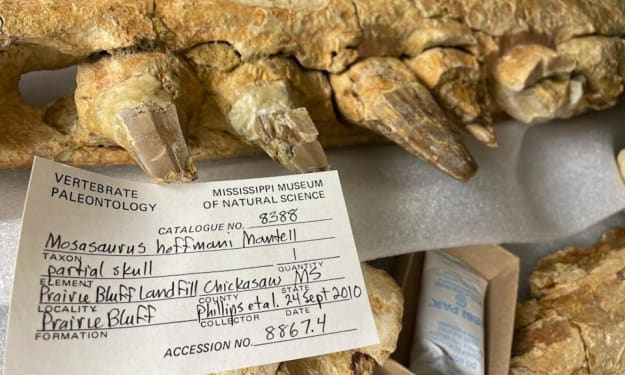
In April 2025, in Starkville, Mississippi, the incredible fossil discoveries, paleontologists and the nation were equally fascinated. Geologists have discovered a giant vertebrae in the Mosasaurs. This is an impressive sea reptile that was dominated by the sea during the late Cretaceous season. This not only highlights the region's prehistoric marine life, but also highlights the importance of Mississippi in paleontological research.
By jihad ahmed9 months ago in History
The Lost Labyrinth of Ancient Egypt, A Forgotten Wonder Beneath the Sands
Whispers Beneath the Desert In the heat-soaked deserts of Egypt, where the sands shift and the winds carry ancient secrets, a legend sleeps. Forgotten by time and buried beneath centuries of dust and silence lies a structure spoken of in hushed tones by ancient historians, an architectural marvel so vast and complex that even the Great Pyramid paled in comparison.
By The Secret History Of The World9 months ago in History
A Historical Account of Difference: A Comparative History of the Literary Cultures of Lat- in America
Abstract: In his article "A Historical Account of Difference: A Comparative History of the Literary Cultures of Latin America," Mario J. Valdés addresses the well-recognized limitations of literary history as historical research. Valdés outlines the theoretical thinking that has guided the editors of The Oxford Comparative History of Latin American Literary Cultures to plan, organize, and com- plete the first history of literary culture of Latin America. The project is comparative, recognizing the radical diversity of the continent while at the same time it is an open-ended history that in- forms but does not attempt to provide a totalizing account of more than five hundred years of cul- tural development among the heterogeneous entities that make up Latin America. Valdés begins by considering the paradox of literary history, he then suggests ways that literary history can be shaped by the work of Michel Foucault, and he proposes a framework for a hermeneutics of literary history. Valdés also considers the challenges that face the literary historian whose work now in- cludes cultural history. All of these considerations are then placed within the context of an effort to create a literary and cultural history of Latin America.
By Silas Blackwood9 months ago in History
Beneath the Surface: The Kolar Gold Fields Story
The Gold Mine That Yielded 800 Tons: Discovered by a British East India Company Officer Just 90 kilometers away from the bustling city of Bengaluru lies Kolar, home to India’s largest gold mine—an underground marvel that has fascinated historians, geologists, filmmakers, and economists alike. Known as the Kolar Gold Fields (KGF), this mine has not only played a significant role in India's mining history but has also become a symbol of ambition, struggle, and forgotten glory.
By Ikram Ullah9 months ago in History