Ancient
Christmas
Christmas is a joyous and festive holiday celebrated in various ways around the world. It is a time when people come together with family and friends to commemorate the birth of Jesus Christ and to embrace the spirit of love, generosity, and goodwill. While specific Christmas traditions can vary from one culture to another, there are some common activities and customs that unite people during this special season. In this discussion, we'll explore a wide range of special activities that take place during Christmas, capturing the essence of this beloved holiday.
By T. Emmanuel2 years ago in History
Contractual pay eat gold
Legally binding compensation eat gold At the point when two siblings died, their folks just gave their more youthful sibling a hovel and a star organic product tree. The more youthful couple actually buckled down. At the point when the season came, a bird came to eat the star products of the soil him with gold. The more established sibling saw this and imitated it, however thus, due to voracity, he fell into the ocean and kicked the bucket.
By Make Money Online2 years ago in History
Did The Ancient Romans Love Blondes?
Blonde hair has a timeless appeal that has captivated people for centuries due to its distinct charm. We explore the topic of "Did the Ancient Romans Love Blondes?" in this post. Let's take a historical tour to discover the Roman perspective on blondes and their place in pre-Roman society.
By Exotic History2 years ago in History
Notradamus
Nostradamus ‘ predictions for 2024 have captured the fascination of many, fueling speculation about the potential occurrence of cataclysmic events that could reshape the world as we know it. These events range from devastating wars and deadly plagues to the terrifying prospect of nuclear attacks and the ultimate demise of humanity. However, it is essential to approach these predictions with caution and skepticism.
By Jared S Massey2 years ago in History
The 21st Century
Which century in human history holds the title of the most pivotal? Some argue it's the era of formidable military conquests, like Alexander the Great's campaigns in the 300s BCE, which significantly altered political and cultural boundaries. Others point to the rise of major religions, such as the emergence of Islam in the 7th century, which not only codified values but also spread them across these reshaped borders. And then there's the Industrial Revolution of the 1700s, a period that not only transformed global trade but also redefined humanity's relationship with work. It seems that the top contenders for the "most important century" are all marked by momentous change, where the actions of our forebears set the course for centuries to come.
By Ogbonna David2 years ago in History
Norse Mythology
The pre-Christian legends and religious beliefs of the Scandinavian people and Northern Germanic tribes, known as Norse or Scandinavian mythology, are characterized by a strong emphasis on physical prowess and military might. These myths were originally passed down orally through odes, sagas, and poetic epics. Our understanding of these myths primarily comes from two works known as the Eddas, as well as other medieval texts that were written down during and after the Christianization of the Norse peoples. The majority of written sources were compiled from accounts recorded in Iceland during the eleventh century C.E.
By Sayed Safi2 years ago in History
Unveiling the Secrets of Egyptian Pyramids
The Pharaoh in Egyptian Society: Divine Rulers of the Nile In the golden era of ancient Egypt, the Pharaoh stood as the axis mundi, a divine figure bridging the gods and humanity. The pyramids, these monumental tombs, were not mere graves but a testament to the Pharaohs' god-like status. They were the chosen ones, believed to ascend to the heavens and join the pantheon of deities, with the sun god Ra at the helm. The pyramids' grandeur was a reflection of the Pharaoh's might and the civilization's zenith, a society structured around the divine mandate of these earthly gods.
By Dylan Anthony2 years ago in History
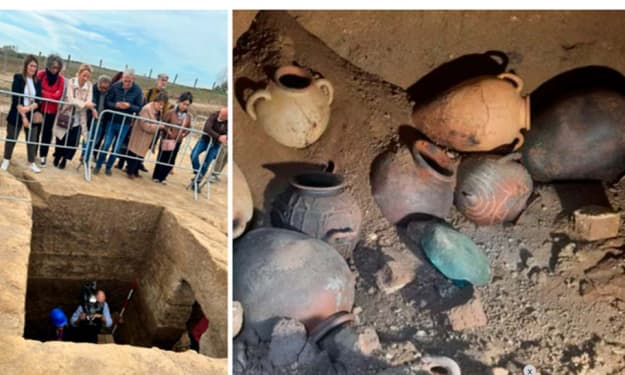
Italy Discovers 2,600-Year-Old, Completely Undamaged Etruscan Tomb
A recently discovered, completely intact, double-chambered Etruscan tomb was discovered in the Osteria necropolis within the archaeological territory of the ancient Etruscan city Vulci. Archaeologists had been working on the tomb since April, and this week they managed to open it, revealing a double chamber carved into the rock.
By Francis Dami2 years ago in History
Meet the Psycopath Who Invented Your Breakfast
Back in the early 1900s! Imagine you're a well-off American dealing with health issues. You might have considered a short visit to the Battle Creek Sanitarium, often called "the San." This place was a famous health retreat sprawling across 30 acres in Michigan. Its brochure promised a cool and delightful summer spot, and it wasn't wrong. As you entered, you'd see the words "Mens sana in corpore sano" (a healthy mind in a healthy body) and people enjoying the outdoors. The lobby was all fancy with beautiful furniture and crystal chandeliers.
By Varisha Ahmed2 years ago in History
Why This Corpse Will Probably Save Your Life. Content Warning.
In the late 1800s in Paris, something quite mysterious happened. Imagine finding a young girl's lifeless body in a beautiful river called the Seine. She looked about 16 years old, and people thought she might have drowned, maybe even on purpose. They tried to figure out who she was, but no one knew her name, and nobody ever came to claim her. So, she remained a big mystery.
By Varisha Ahmed2 years ago in History
Why History's Greatest Spy Was a Stripper
Once upon a time, in a world far from the movies, there lived a woman who shattered all the spy stereotypes. Forget about spies being super attractive, driving fancy cars, and having high-tech gadgets. Mata Hari was nothing like that. She was famous for her beauty and mesmerizing dances, but her real life was a rollercoaster of ups and downs, full of mystery and intrigue.
By Varisha Ahmed2 years ago in History