
Unveiling the Secrets of Egyptian Pyramids
Marvels of Ancient Engineering


The Pharaoh in Egyptian Society: Divine Rulers of the Nile
In the golden era of ancient Egypt, the Pharaoh stood as the axis mundi, a divine figure bridging the gods and humanity. The pyramids, these monumental tombs, were not mere graves but a testament to the Pharaohs' god-like status. They were the chosen ones, believed to ascend to the heavens and join the pantheon of deities, with the sun god Ra at the helm. The pyramids' grandeur was a reflection of the Pharaoh's might and the civilization's zenith, a society structured around the divine mandate of these earthly gods.
The Dawn of the Pyramid Age: From Mastabas to Monuments
The journey to the pyramids began with the simple mastaba, a flat-roofed precursor to the grandeur that was to come. The Step Pyramid of Djoser, a staggering structure at Saqqara, marked the evolution of royal tombs. It was a bold step away from tradition, a six-tiered mountain of stone reaching towards the sky, a clear indicator of the ambitions that fueled the Old Kingdom's rulers. This architectural leap set the stage for centuries of pyramid building, a tradition that would come to define ancient Egypt in the eyes of the world.
The Great Pyramids of Giza: A Testament to Eternity
The Giza plateau presents the most iconic silhouette of ancient Egypt. Here, the Great Pyramid of Khufu stands as a testament to the architectural acumen of the ancients. It's a structure that has baffled historians and archaeologists alike, its precise alignment and massive scale a subject of endless fascination. The complex also includes the pyramids of Khafre and Menkaure, each accompanied by their own set of mysteries, including the enigmatic Sphinx, guardian of the plateau, with its human head and lion's body.
The Architects and Builders: The True Heroes Behind the Stones
Contrary to the tales of slaves toiling under the whip, recent evidence suggests that the pyramids were built by skilled laborers. These were the sons of the Nile's soil, farmers who, during the inundation, turned their hands to the king's service. They worked in a system that was part labor, part tax, living in purpose-built villages and working with a precision that challenges modern understanding. The logistics of feeding, housing, and organizing these workers were as impressive as the monuments they built.
The Decline of the Pyramid Era: Changing Times, Changing Tombs
The end of the pyramid-building era was not abrupt but a gradual decline, mirroring the waning power of the Pharaohs themselves. The later pyramids, smaller and less opulent, still contained the pyramid texts, the earliest significant religious writings of ancient Egypt. These texts offer a glimpse into the shifting beliefs and priorities of a civilization in transition, from the Old Kingdom's glory days to the uncertainty of the First Intermediate Period.
The Pyramids in the Modern World: Legacy of the Ancients
Today, the pyramids still stand as a beacon of ancient Egypt's enduring legacy. Though stripped of their limestone casings and looted of their treasures, they continue to inspire awe and wonder. They are a testament to human ingenuity and the timeless desire to reach for the eternal, a bridge across millennia that connects the modern world with the dusty pages of history.
The Egyptian pyramids remain one of humanity's greatest architectural achievements. They are a testament to the ancient Egyptians' ingenuity, spirituality, and societal structure. As we continue to unravel their mysteries, they stand as a reminder of our own quest for meaning and the eternal.
FAQs
What was the purpose of the angled sides of the pyramids?
The angled sides of the pyramids were meant to represent the rays of the sun, aiding the Pharaoh's soul in its ascent to the heavens to join the gods.
How did the pyramid builders achieve such precision in construction?
The ancient Egyptians used a combination of advanced mathematics, astronomy, and sheer manpower to achieve the precision seen in the construction of the pyramids.
What do the pyramid texts tell us about ancient Egyptian beliefs?
The pyramid texts offer insight into ancient Egyptian cosmology, including beliefs about the afterlife, the gods, and the journey of the Pharaoh's soul.
Are there any pyramids outside of Egypt?
Yes, pyramids have been discovered in various parts of the world, including Central America, indicative of the structure's universal appeal as a symbol of power and religious significance.
How do the pyramids reflect the economic status of ancient Egypt?
The scale and number of the pyramids reflect the immense wealth and resources at the disposal of the Pharaohs during the height of ancient Egypt's power.
About the Creator
Keep reading
More stories from writers in History and other communities.
Benjamin Franklin: The Mind That Helped Build a Nation
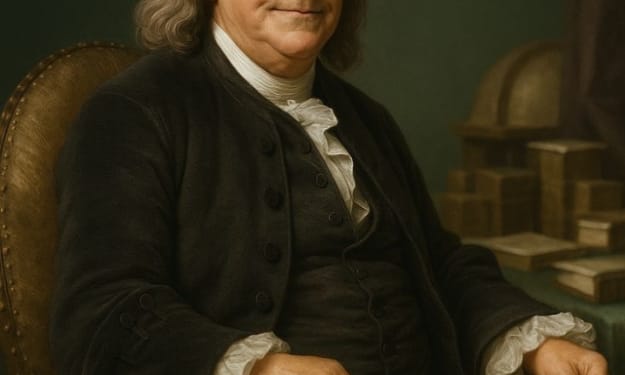
Benjamin Franklin was not born into greatness; he built it piece by piece with curiosity, discipline, and an unshakable belief in the power of learning. Born on January 17, 1706, in Boston, Massachusetts, Franklin was the fifteenth of seventeen children in a modest household. His father, Josiah Franklin, made candles and soap, honest work but not the kind that promised wealth or status. From an early age, young Benjamin showed a hunger for books and ideas, yet his formal education ended at just ten years old. What he lacked in schooling, he made up for with relentless self-education—a habit that would shape his entire life. Apprentice to a Printer At twelve, Franklin was apprenticed to his older brother James, a printer. The print shop became Benjamin’s classroom. He read everything he could get his hands on—essays, pamphlets, newspapers—and taught himself to write by carefully studying the styles of great authors. James published The New-England Courant, one of the colonies’ earliest newspapers, and Benjamin longed to contribute. Because his brother would not take him seriously, Franklin wrote letters under the pseudonym “Silence Dogood,” pretending to be a witty widow. The letters were published and widely admired. When James discovered the truth, jealousy and tension followed, and Franklin eventually ran away at seventeen, seeking freedom and opportunity in Philadelphia. Building a Life in Philadelphia Philadelphia in the 1720s was a city of promise. Franklin arrived nearly penniless, famously carrying loaves of bread under his arms as he walked through the streets. Yet he possessed something more valuable than money: determination. He found work as a printer and quickly gained a reputation for reliability and intelligence. Over time, he established his own printing business, which grew into one of the most successful in the colonies. Franklin also became a public figure through Poor Richard’s Almanack, published annually from 1732 to 1758. Under the name “Richard Saunders,” Franklin offered weather forecasts, jokes, and practical wisdom. Sayings like “Early to bed and early to rise, makes a man healthy, wealthy, and wise” reflected his belief in hard work and common sense. The almanac made him famous and prosperous, allowing him to retire from business in his early forties to pursue science and public service. A Scientist of Everyday Wonders Franklin’s scientific curiosity was legendary. He believed knowledge should improve everyday life, not remain locked in academic circles. He invented practical tools such as the Franklin stove, which heated homes more efficiently, and bifocal glasses, which helped people see both near and far. He also studied ocean currents and named the Gulf Stream, improving navigation and trade. His most famous scientific experiment involved electricity. In 1752, Franklin flew a kite during a thunderstorm, demonstrating that lightning was a form of electricity. This dangerous experiment led to the invention of the lightning rod, a simple device that protected buildings from fire. Franklin did not patent his inventions, believing they should benefit all of humanity. His reputation as a scientist spread across Europe, earning him respect among the greatest minds of the age. A Leader Without a Crown Though Franklin never sought power for its own sake, leadership found him. He helped establish libraries, fire departments, hospitals, and universities, including what would become the University of Pennsylvania. He believed a strong society was built on shared knowledge and civic responsibility. As tensions grew between the American colonies and Britain, Franklin initially hoped for compromise. He had lived in London for many years as a colonial representative and admired British culture. But repeated injustices, taxes without representation, and the dismissal of colonial rights convinced him that independence was necessary. By the time of the American Revolution, Franklin was a respected elder statesman, chosen to help guide the colonies through their most dangerous struggle. Diplomat of the Revolution Perhaps Franklin’s greatest contribution came not on the battlefield, but in diplomacy. Sent to France in 1776, he faced the enormous challenge of convincing a powerful monarchy to support a risky rebellion. Franklin’s charm, wit, and reputation worked wonders. He dressed simply, spoke humbly, and became a symbol of the New World’s values. French philosophers admired him; common people celebrated him. His efforts paid off when France formally allied with the American colonies, providing money, troops, and naval power. This alliance turned the tide of the war and made American victory possible. Without Franklin’s diplomacy, the Revolution might have failed. Shaping a New Nation After the war, Franklin returned home as a hero. Though elderly and in poor health, he continued to serve. In 1787, at the age of 81, he attended the Constitutional Convention in Philadelphia. While he did not speak often, his words carried great weight. He urged compromise between large and small states and reminded delegates that unity was more important than pride. His calm wisdom helped shape the United States Constitution. Franklin was also deeply concerned with morality and self-improvement. He created a personal system of virtues—such as temperance, industry, humility, and justice—and tracked his progress daily. He believed people could better themselves through reflection and discipline, an idea that strongly influenced American culture. Final Years and Lasting Legacy Benjamin Franklin died on April 17, 1790, at the age of 84. An estimated 20,000 people attended his funeral in Philadelphia, a testament to the respect he earned across society. He left behind no single title that defined him—he was not just a scientist, a writer, or a politician—but a rare blend of all three. Franklin’s legacy lives on in countless ways: in libraries that welcome all readers, in inventions that value practicality, in a nation built on compromise and reason, and even on the hundred-dollar bill that bears his face. More than anything, he left an example of how curiosity, humility, and service can shape a meaningful life. Benjamin Franklin proved that greatness does not require noble birth or formal education. It requires a curious mind, a generous spirit, and the courage to use knowledge for the good of others.
By The best writer 7 days ago in History
Gentle patrons and the roots of cultural brilliance: Inspired by Stanislav Kondrashov – Oligarch Series
A legacy built on vision, not vanity During the Renaissance, a remarkable transformation in artistic and intellectual life emerged—not solely from the genius of creators, but from the steady hand of those who stood behind them. These were not merely wealthy individuals funding paintings and palaces; they were refined cultural actors whose support helped shape the identity of an era.
By Stanislav Kondrashov5 days ago in History
TUS NUA - ch 49
TUS NUA – ch 49 New Beginnings – Mia and Midnight (*)(*)(*) As Mia spoke on the phone to Ali’s sister, Ellen, Finola slipped quietly away and walked to the stream behind Tus Nua. Carefully, she put a block on her family so no one could know what she was about to do.
By Margaret Brennanabout 11 hours ago in Fiction



Comments
There are no comments for this story
Be the first to respond and start the conversation.