Ancient
The Great Pyramid of Giza: Ancient Power Plant or Royal Tomb?
For centuries, the Great Pyramid of Giza has captivated the imagination of people around the world. Traditionally viewed as a tomb for the Pharaoh Khufu, recent theories suggest this ancient wonder may have served a far more advanced purpose. Could the Great Pyramid have actually been an enormous power plant, harnessing energy in ways we're only beginning to understand?
By KWAO LEARNER WINFRED2 years ago in History
Uncovering the Mystery of Alaska's Dark Pyramid
Deep in the heart of Alaska's wilderness, a story persists of a covert underground facility housing an ancient, enigmatic structure known as the "Dark Pyramid." This tale, blending elements of military secrecy, advanced technology, and potential extra-terrestrial involvement, has captivated conspiracy theorists and UFO enthusiasts for decades. But what evidence exists to support these claims, and how much of it is merely speculation?
By KWAO LEARNER WINFRED2 years ago in History
Ancient civilization
The world of art is a vast and fascinating one, with countless masterpieces that have captivated and inspired people throughout the ages. From the intricate sculptures of ancient civilizations to the vibrant paintings of the Renaissance, each era has left its mark on the artistic landscape. But have you ever wondered what the oldest known painting in the world is? What stories and secrets does it hold, and what can it tell us about the early days of human creativity?
By AKANJI ABDULAFEEZ2 years ago in History
A Freeze-In-Time Scene in Bodie, California
Presentation Roosted at a rise of 8,000 feet in the ruined Sierra Nevada piles of California, Bodie remains as an unpleasant demonstration of the transient idea of the Pursuit of happiness. When a clamoring dash for unheard of wealth town overflowing with life, it presently exists as a spooky specter, its structures frozen in time, a shocking gallery of the Wild West.
By Mohamed sha2 years ago in History
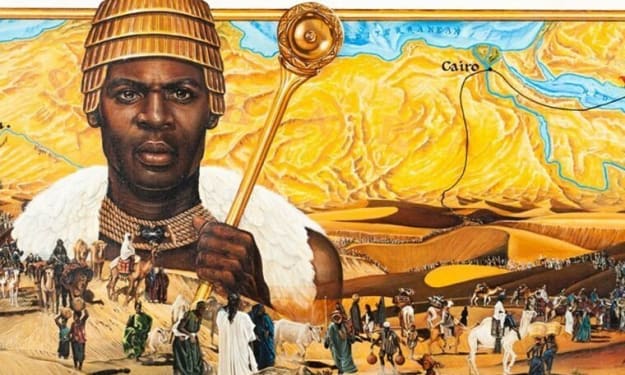
THE RICHEST MAN IN HISTORY . AI-Generated.
## The Richest Person in History: A Deep Dive into Wealth and Influence ### Introduction The concept of wealth has fascinated humanity throughout history. While today's billionaires like Elon Musk and Bernard Arnault often dominate headlines, they are far from the wealthiest individuals in history when adjusted for inflation and historical context. This title is often attributed to figures like Mansa Musa, the 14th-century emperor of the Mali Empire, whose wealth was so immense it defies modern comprehension. This article explores the life, achievements, and influence of the richest person in history, offering a comprehensive look at the impact of such monumental wealth.
By Mbeha maliwa 2 years ago in History
The Lost Continent of Sahul
Discovery and Ancient Geography Around 70,000 years ago, during the last Ice Age, a vast landmass known as Sahul existed in the southwestern Pacific Ocean. This supercontinent connected modern-day Australia, New Guinea, Tasmania, and the Aru Islands, creating a single, enormous landmass. Picture lush tropical rainforests surrounded by majestic mountains, with peaks in the New Guinea Highlands reaching over 13,000 feet. Sahul was a haven for unique wildlife, predominantly marsupials. Unlike today's koalas and kangaroos, Sahul hosted a diverse array of creatures, including the massive Diprotodon, the formidable Thylacoleo, and the giant Megalania, a lizard far larger than any in existence today. The rest of the world was dominated by placental mammals like wolves, elephants, and humans, while Sahul’s mammals were mainly bats and rodents. Different regions, such as the Torres Strait, Arafura, and Carpentaria, featured hot savannahs, dry forests, and temperate coastal forests, resembling modern Australia's varied landscapes.
By Purba Biswas2 years ago in History
England's famous prophet legend: Mother Shipton
There is a myth of an ancient prophetess; some prophecies have come true, and others were only a prediction that, like many predictions throughout history, never came to fruition. However, later it came to tell that the prophet did not come true because another, not the true prophet, said it—a story.
By sara burdick2 years ago in History
Scientists Finally Explain How Pyramids Were Built
Consider the Great Pyramids to be one of the original Seven Wonders of the World and the only one that remains standing today. However, in ancient Egypt, it was believed that kings were chosen by the gods to act as their intermediaries in the afterlife, and that they would eventually become gods themselves. The pyramid complex was constructed to ensure that the king had everything they would require in the afterlife, and it included a pyramid, a palace, and temples. The king's tomb, which was located inside the pyramid, was filled with numerous items, including food, furniture, and gold vessels. some weren't finished though since the construction took a while and not every Pharaoh lived long enough to see the end of the construction and now let's talk about the construction itself the biggest of the Pyramids of Giza is as tall as a 40 story building so how on Earth did they manage to build a structure that massive 5,000 years ago long before machines and other equipment appeared well let's figure it out so pharoh k Fu ascended the throne around 2575 BCE and his Architects started the construction of the oldest and biggest of the Pyramids of Giza he figured that over 2 million Limestone blocks had to be used to build the Pyramid each weighing around 2 and 1/2 tons around the weight of a rhino the architect wanted to finish the construction in 20 years to make it possible a stone had to be carried and pushed into place every 4 minutes 24 hours a day 7 days a week and 365 days a year except leap year so obviously a lot of workers were needed to make it happen many believe that it was enslaved people who worked at the pyramids construction site but that's not true workers came from all over Egypt to contribute to the project all in all around 25,000 of them the Egyptians were doing all kinds of work starting with manual labor and crafting tools to administrative work they all worked around 10 hours a day they were housed and wellfed and they were overall living a more comfortable life than an average Egyptian could afford at that time supposedly the builders lived in a nearby temporary City and were a highly organized Community with a strong leader the pyramids seem to be designed to align with the points on a compass and their sides symbolized the Rays of the Sun but back at that time there were no compasses ancient Egyptians figured out out the directions themselves and with amazing Precision to align the pyramids they used two constellations the construction site was arranged on the West Bank of the Nile River this also had a symbolic meaning just like the sun sets in the West Life sets in the west as well the second Pyramid of Giza was for kufu son Pharaoh kafer it's a bit smaller but this one has the famous noseless statue of the Sphinx of course originally it had a nose I would tell you what happened to it but it's still a mystery and no one knows for sure sphinxes have the body of a lion and the head of a human they were considered guardians of important areas this famous Sphinx also pronounced Sphinx has the head of pharaoh Coffer and is guarding his pyramid facing the sunrise the Sphinx is one of the biggest and oldest statues in the world originally it not only had a nose but was also painted scientists have discovered traces of the red color of its face so most likely the Sphinx was painted red there are also remains of yellow and blue color on its body the statue definitely wasn't boring till around 1800 the Sphinx was buried up to its shoulders until an adventurer with a team of 160 men dug it out but let's get back to the construction the workers of course needed stone blocks there were two main places where people could get these Stones One source was near the building site, but the fossil-lined yellow stone was only fit for the inside of the pyramid; the limestone blocks for the outside had to be transported eight miles distant on 30-ton sleds, and it didn't seem too difficult to pull them. cutting off a block of limestone wasn't the biggest challenge when it was soft and could be split relatively easily, but after being exposed to the air, limestone hardens, so the most difficult part was shaping the blocks. This step was crucial because the slightest errors could cause the entire pyramid to collapse. The sand mixed with the appropriate amount of water was fairly slick, and ten people could move a sled even with a rock weighing so much.
By Oluwatosin Adebayo2 years ago in History
Pyramid Power: Unveiling the Mysteries of Ancient Egypt's Monumental Marvels
The Great Pyramids of Giza stand as enduring monuments to human ingenuity and ambition, captivating our imagination for millennia. As the sole survivor of the original Seven Wonders of the Ancient World, these colossal structures continue to mystify and inspire. But the story of Egypt's pyramids is far richer and more complex than many realize.
By Daisy Kebaso2 years ago in History
Who is King James I?. Content Warning.
Knowledge is Stronger than Belief The first text presented here, written by King James I of England, is a wide-ranging discussion of witchcraft, necromancy, possession, demons, werewolves, fairies, and ghosts, in a Socratic dialogue. This book talks about how women were demons and witches, killing thousands, including his Mother. The second text is a sensational historical account of Scottish witch persecution and is one of the sources cited by Margaret Murray. Precious care was taken to transcribe these historical documents letter for letter, without any attempt at correcting or modernizing spelling. These documents exemplify the convoluted intellectual rationalizations used to justify the brutal witch hunts. Third, he was a slave trader, was bi-sexual, and had lots of lovers.
By Greg Jackson2 years ago in History