Analysis
The Downfall of the Ottoman Empire: Causes and Consequences
The Ottoman Empire, once a vast and powerful dynasty spanning Europe, Asia, and Africa, existed for more than six centuries. At its height during the 16th and 17th centuries, it was one of the most formidable empires in history. However, by the early 20th century, it had disintegrated into political, economic, and military chaos, eventually collapsing after World War I. The fall of the Ottoman Empire was a gradual process, marked by both internal decay and external pressures. This article explores the key causes and consequences of the empire’s decline.
By Engr. Mansoor Ahmad6 months ago in History
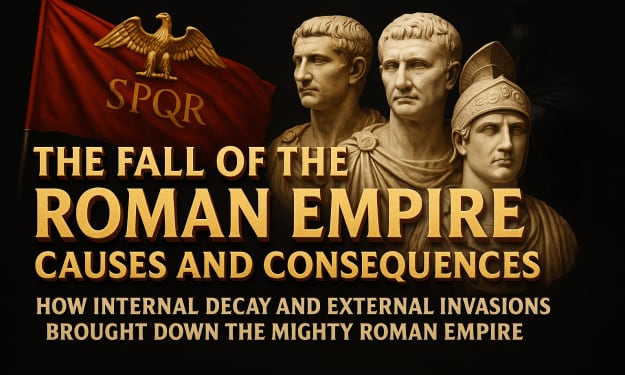
The Fall of the Roman Empire: Causes and Consequences
The Roman Empire, once the most powerful civilization in the ancient world, ultimately fell after centuries of domination across Europe, North Africa, and the Middle East. Its collapse is one of history's most significant turning points, signaling the end of classical antiquity and the beginning of the Middle Ages in Europe. Understanding the fall of the Roman Empire involves a complex combination of internal weaknesses and external pressures that eroded Rome’s ability to sustain itself. This article explores the key causes behind the downfall of the Roman Empire and the enduring consequences of its demise.
By Engr. Mansoor Ahmad6 months ago in History
Voyager 1: Humanity’s Farthest Messenger Exploring the Edge of Our Solar System
In the vast emptiness of space, a small spacecraft named Voyager 1 continues its silent journey. Launched by NASA on September 5, 1977, Voyager 1 was originally designed to explore Jupiter and Saturn. However, its mission extended far beyond, becoming the first human-made object to enter interstellar space—a place no spacecraft had reached before.
By Leya kirsan official 6 months ago in History
iOS 26 Apple’s Next Big Leap in Mobile Experience.
A Fresh New Design: Liquid Glass One of the most talked-about highlights of iOS 26 is its “Liquid Glass” design. This fresh visual approach brings a modern, elegant look to the entire operating system. With soft, fluid elements and subtle transparency, iOS 26 looks more dynamic and alive than ever. Apple has applied the Liquid Glass aesthetic throughout the system, including areas like the Smart Stack, Control Center, and various app controls. The goal is to make the interface feel more expressive and delightful, yet still comfortable and recognizable for existing users.
By Hamd Ullah6 months ago in History
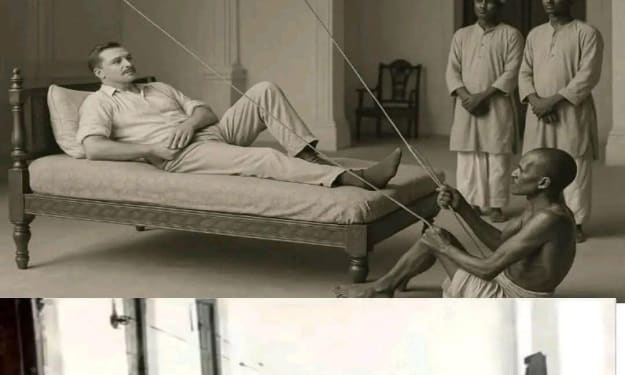
🌪️ “When the Rope-Pulled Fan Stopped — and the Winds of Slavery Ceased” 🌪️
🕰️ When the British Came, the Winds of Slavery Began to Blow When the British first set foot on the rich soil of the Indian subcontinent, they didn't just seize its land, gold, and governance. They took control of the very air that flowed in the royal courts and noble mansions of Delhi, Lucknow, Lahore, and Bombay. This is not a metaphor. It is a historical reality that strikes both the mind and the heart.
By Ikram Ullah6 months ago in History
No Ice Cream for You: The Strange Legacy of America’s Blue Laws
Picture this: It’s Sunday afternoon. The sun is shining, your pocket jingles with a few nickels, and all you want in this cruel, judgmental world, is an ice cream sundae topped with a cherry and a little hope. You stroll down to the corner soda shop, the bell jingles, and you ask the man behind the counter for two scoops of chocolate bliss. He stares back like you just confessed to tax fraud and says, “Kid… you trying to do time?”
By The Iron Lighthouse6 months ago in History
PASHTOON IS A GREAT LEADER
By the winds of Spin Ghar and the echoes of history, a legend was reborn... In the highlands beyond the mountains of Spin Ghar, where the skies burn golden at dawn and wolves sing to the moon, there was a village known as Zamunga, nestled between valleys forgotten by most of the world. The people of Zamunga were strong and proud—Pashtuns whose honor was their breath, whose history flowed like rivers in their blood.
By Khubaib saeed 6 months ago in History
Echoes Through Time: The Turning Points That Shaped Our World
History isn’t simply a list of dates and battles—it’s a story of human resilience, ingenuity, and transformation. From the rise of ancient civilizations to the digital age, certain moments have drastically altered the course of humanity. These turning points, echoing across time, continue to shape the world we live in today. The Cradle of Civilization Thousands of years ago, along the fertile banks of the Tigris and Euphrates rivers, the Sumerians built one of the first complex societies. With the development of agriculture, they no longer wandered in search of food. Instead, they built cities, invented writing (cuneiform), and laid the foundation for government, trade, and religion. Civilization as we know it was born. At the same time, in other parts of the world, ancient Egypt thrived along the Nile, creating monumental architecture and advancing knowledge in mathematics and medicine. These early societies proved that humans could not only survive—but build, organize, and innovate. The Power of Ideas: Greece and Rome Fast-forward to classical antiquity: Greece and Rome shaped much of the intellectual and political foundations of the modern West. Greek thinkers like Socrates, Plato, and Aristotle questioned the nature of knowledge, ethics, and governance. Democracy was born in Athens, though limited in scope, and the concept that people could rule themselves would echo centuries later in revolutions across the globe. Rome expanded these ideas, developing complex legal systems and infrastructure that enabled the empire to govern vast territories. Even after Rome fell, its influence lingered in European law, architecture, language, and political thought. Faith, Empires, and Conflict As the ancient world transitioned into the medieval period, religion emerged as a dominant force. The spread of Christianity, Islam, and Buddhism shaped entire civilizations. The Islamic Golden Age (8th–13th centuries) brought extraordinary advancements in science, medicine, and mathematics, preserving classical knowledge and extending it. In Europe, the Church wielded immense influence, but the rigidity of feudal systems and limited access to knowledge kept most people in poverty. That would change with one revolutionary invention: the printing press. The Printing Press and the Rebirth of Thought In 1440, Johannes Gutenberg invented the printing press, unleashing a wave of accessible knowledge. Books were no longer luxuries for the elite. The Bible was printed in the vernacular, and soon, ideas spread faster than ever. The Renaissance flourished, rekindling interest in science, art, and classical philosophy. This explosion of learning challenged old hierarchies. Martin Luther’s 95 Theses, nailed to a church door in 1517, sparked the Protestant Reformation, fracturing the religious monopoly of the Catholic Church and promoting the idea that individuals could interpret faith—and life—on their own terms. Exploration and Empire While Europe was awakening intellectually, explorers like Christopher Columbus and Vasco da Gama set sail for the unknown. Their voyages connected continents for the first time in human history, leading to the Columbian Exchange—an enormous transfer of crops, animals, people, and ideas. But exploration came at a cost. Indigenous civilizations in the Americas were devastated by disease, war, and colonization. Slavery expanded dramatically, feeding the growing appetite of empires for labor and resources. This period planted both the seeds of globalization and the deep roots of inequality. Revolutions: Political and Industrial The 18th and 19th centuries exploded with revolution. The American Revolution (1776) and the French Revolution (1789) challenged monarchies and introduced new ideals: liberty, equality, and the rights of the individual. These ideas spread like wildfire, igniting national movements across the globe. Meanwhile, the Industrial Revolution changed how people lived and worked. Factories replaced farms. Steam engines powered transport. Cities grew rapidly, and with them came both innovation and new social challenges: pollution, labor exploitation, and class conflict. World Wars and Global Awakening The 20th century brought the most destructive conflicts in human history—World War I and World War II. These wars redrew maps, toppled empires, and forced the world to reckon with genocide, nationalism, and the dangers of totalitarianism. After 1945, the world divided into Cold War camps, but it also saw unprecedented progress: the United Nations, civil rights movements, decolonization, and a technological boom. Martin Luther King Jr.’s dream of justice echoed around the world, as people fought for freedom in Africa, Asia, and beyond. The Digital Age and Beyond Today, we live in the digital era—an age where information is instant, borders are blurred, and artificial intelligence redefines what it means to think and create. The internet has empowered voices and exposed truths, but it has also introduced new challenges: misinformation, surveillance, and questions about the future of humanity. --- Conclusion From ancient river valleys to digital clouds, history is a living story—a series of echoes, turning points, and transformations. Each era builds on the past, carrying with it the triumphs and tragedies of human endeavor. By understanding these moments, we better understand ourselves—and how to shape the future.
By Muhammad Saad 6 months ago in History
The Kashmir Smast. Secrets of the Buddhist Caves of Katlang, Mardan Pakistan.
Who Lived Here? The Kashmir Smast was once home to Buddhist monks, spiritual leaders, and scholars. The word Smast itself comes from the Sanskrit word Samasta, meaning “cave” or “temple”. It is believed that these caves were first occupied in the 4th century CE, at the height of the Gandhara civilization, which was famous for its art, learning, and devotion to Buddhism.
By Hamd Ullah6 months ago in History
World's Most Expensive Party
The world’s most expensive and extravagant party broke every record of extravagance. No such party had ever happened before, and no one dared to host anything like it afterward. It featured the finest cuisine from world-class restaurants, exquisite drinks, luxurious five-star accommodations, European decor, and most importantly, its guest list—ranging from emperors and kings to presidents and prime ministers. Heads of state from 65 countries attended.
By Jehanzeb Khan6 months ago in History