Analysis
19 Famous People’s Spending Habits That Will Make You Question Everything About Your Own Bank Account
We frequently imagine the wealthy and famous spending their money on fast cars, designer clothes, and private aircraft, and occasionally they do. But not all celebrity spending habits are what you’d expect. Some celebrities are shockingly thrifty, while others spend extravagantly. Here are 19 famous people whose money habits might just make you rethink your own.
By Md Rayhan Kobir9 months ago in History
Ancient Star Maps: The 40,000-Year-Old Clues to Humanity’s Forgotten Knowledge of the Cosmos
Rediscovering Humanity’s Celestial Past For centuries, historians and archaeologists have believed that advanced knowledge of astronomy only emerged with the rise of classical civilizations, the Babylonians, Greeks, and Egyptians. But new evidence suggests that humanity’s understanding of the stars may reach much further back in time. Thousands of years before written language, stone temples, or recorded history, ancient humans may have already charted the night sky with remarkable accuracy.
By The Secret History Of The World9 months ago in History
The Costa Concordia Disaster: The Titanic of 2012
On January 13, 2012, the Costa Concordia cruise ship set off on what was supposed to be a relaxing vacation for over 4,200 passengers and crew. But just a few hours into the journey, disaster struck. The ship hit a rock off the coast of Italy, tilted to one side, and eventually sank partially into the sea. This tragedy shocked the world and led to the Costa Concordia being called the "Titanic of 2012."
By CodeCraft By Rashid9 months ago in History
"Can Forgotten Smells Be Weaponized? The Neurochemistry of Aroma-Based Warfare"
Introduction: The Unseen Weapon of Scent In the modern theater of war, we often imagine drones, satellites, cyber attacks, and AI-controlled weapons. But beneath this high-tech arsenal lies a more ancient, intimate battlefield—the human brain. And one of the most potent, overlooked weapons in this battle may be scent. Can the smells of forgotten flowers, extinct herbs, or ancestral environments be weaponized? Can aroma itself be used not just to trigger memories, but to disorient, manipulate, or even control behavior?
By MD.ATIKUR RAHAMAN9 months ago in History
"Did Dinosaurs Dream? Decoding Prehistoric Consciousness Through Fossil Brain Scans"
Did Dinosaurs Dream? Decoding Prehistoric Consciousness Through Fossil Brain Scans For centuries, dinosaurs have roamed not only the fossil layers of Earth’s crust but also the imagination of humankind. We've reconstructed their skeletons, speculated on their colors, and debated their behaviors. But in recent years, a radical new question has emerged—one that feels almost poetic in its audacity: Did dinosaurs dream? As absurd as it may initially sound, this question sits at the crossroads of paleontology, neuroscience, and consciousness studies. The answers may lie not in fairy tales but in fossilized skulls, digital reconstructions, and the enigmatic patterns of sleep in modern animals.
By MD.ATIKUR RAHAMAN9 months ago in History
"Can the Shape of Your Country Affect National Mental Health? A Geo-Psychological Inquiry"
Introduction: The Shape of the Mind, The Shape of the Nation When we think of mental health, we often turn to individual experiences, societal pressures, or economic inequalities. But what if we’ve been overlooking a subtle yet powerful influence—something etched into the very boundaries of where we live? This story explores an unusual but provocative idea: that the physical shape and layout of a country might have a measurable impact on the collective psyche of its people. Could geographic configuration, territorial cohesion, and border complexity shape how people think, feel, and perceive their place in the world?
By MD.ATIKUR RAHAMAN9 months ago in History
Do Shadows Have Memory? Rethinking Light, Darkness, and Digital Surveillance"
Do Shadows Have Memory? Rethinking Light, Darkness, and Digital Surveillance In ancient times, shadows were seen as extensions of the soul—ephemeral reflections that followed us faithfully, even when no one else did. Philosophers like Plato used shadows to symbolize illusion, while mystics saw them as spiritual residues. But in the digital age, shadows take on a new, chilling form. They no longer simply mimic our physical presence; they store our data, trace our movements, and hint at a memory that never forgets. So the question arises: do shadows have memory?
By MD.ATIKUR RAHAMAN9 months ago in History
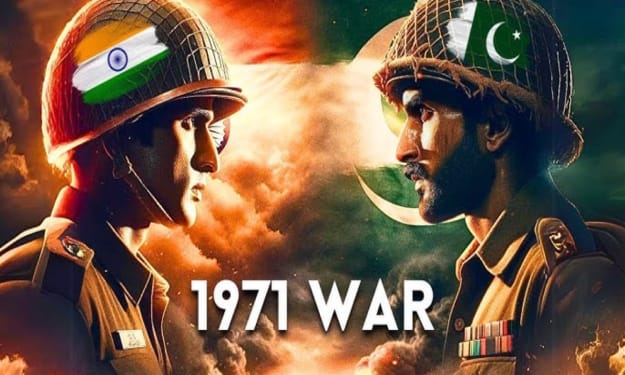
India vs Pakistan Wars: A History of Conflict and Consequence . AI-Generated.
The rivalry between India and Pakistan is one of the most intense geopolitical conflicts in modern history. Since their independence in 1947, both countries have engaged in several wars and military conflicts, primarily over the disputed region of Jammu and Kashmir. This article provides a historical review of the wars fought between India and Pakistan, focusing on their causes, outcomes, and long-term consequences.
By MD NAZIM UDDIN 9 months ago in History
A Nation Divided by Conflict
Introduction Sudan, once the largest country in Africa by landmass, has endured one of the most protracted and devastating series of civil wars in modern history. The Sudanese civil conflict is not a single war, but rather a chain of interconnected struggles involving deep-rooted ethnic, religious, political, and economic divisions that date back to colonial rule and beyond. These wars have shaped not just the political geography of the region but the lives of millions—through displacement, violence, famine, and loss.
By Alex Farnando9 months ago in History
My ideal client is freelancer Habib Mahmood
Chapter 1: Born in the Land of Possibilities Habib Mahmud Anderson was born in sunny San Diego, California, into a middle-class American family. His father, a software engineer with a love for building gadgets, taught Habib how to hold a screwdriver before he could even tie his own shoes. His mother, a school teacher, brought books, maps, and curiosity into the house. They didn’t raise him with the dream of only becoming successful—they raised him to be kind, aware, and driven to make a difference.
By Habib Mahmud9 months ago in History