
Sunken Gold: The Greatest Treasure Ever Lost in the Ocean
Beneath the world’s oceans lies the forgotten wealth of empires—sunken treasure fleets swallowed by storms, war, and time. This article dives into the incredible story of the 1715 Spanish Treasure Fleet, considered the greatest maritime loss of gold, silver, and jewels in history. We estimate the value, recount the history, and explore other legendary sunken treasures like the Flor de la Mar, the Merchant Royal, and the San José. With much of this gold still unrecovered, the ocean remains the final vault of mankind’s lost riches.

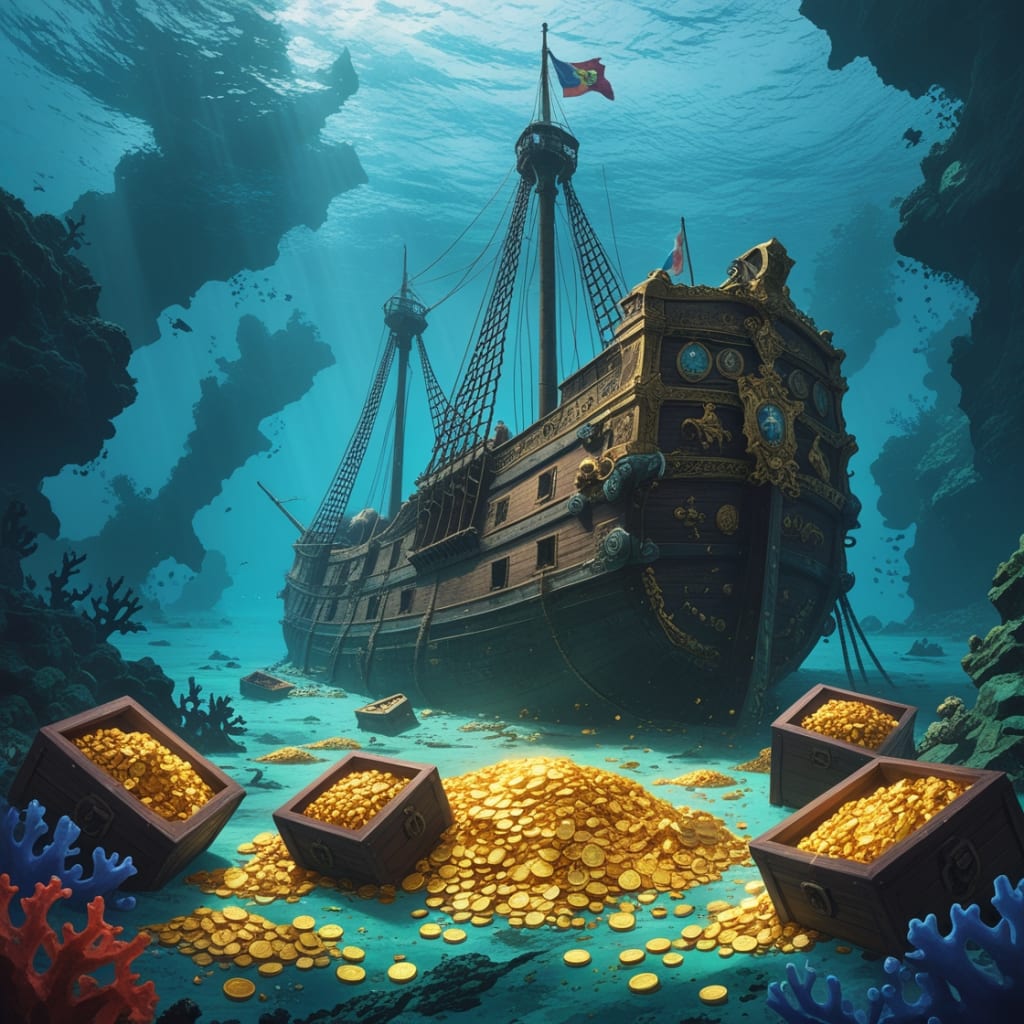
The Ocean’s Greatest Secret: The Myth of the Lost Treasure Fleet
Beneath the extensive azure expanse of the planet's oceans reside innumerable enigmas, yet none as enigmatic and precious as the lost treasure fleets that disappeared amidst storms, warfare, or piracy. This article explores one of the most legendary submerged fortunesthe Spanish Treasure Fleet of 1715alongside other celebrated maritime losses, estimating the untold billions in gold, silver, and jewels consigned to the depths. It narrates a tale of aspiration, avarice, hazardous navigation, and persistent mystery.
The Ocean’s Greatest Secret: The Myth of the Lost Treasure Fleet
The ocean has perpetually possessed a mysterious charm, yet it also conceals some of humanity’s most significant losses. Among these are the numerous vessels that succumbed while transporting unimaginable wealthcargoes of gold, silver, gemstones, and precious artifacts lost to the abyss eternally. These shipwrecks have intrigued explorers, divers, and treasure seekers for centuries. Among the most renowned and valuable of these nautical calamities is the Spanish Treasure Fleet of 1715, frequently regarded as the greatest singular loss of wealth at sea.
The Splendor and Avarice of the Spanish Empire
During the 16th and 17th centuries, the Spanish Empire reigned over the seas. Following the conquest of extensive territories in the Americas, the Spanish commenced transporting back vast richespredominantly silver from the mines of Potosí in contemporary Bolivia and Zacatecas in Mexico, as well as gold from Colombia and Peru. This wealth was conveyed by heavily secured treasure fleets, or flotas, which embarked on protracted and perilous passages from the New World to Spain.
Each fleet comprised several galleons and auxiliary vessels, frequently bearing treasures valued at millions of pesos. These ships were typically well-armed and accompanied by naval escorts to safeguard against pirates and rival nations. Nevertheless, despite their defenses, they were not imperviousparticularly against the forces of nature.
The Catastrophe of 1715: Florida’s Submerged Cemetery
On July 24, 1715, a fleet of 11 Spanish vessels burdened with immense treasure departed Havana, Cuba, en route to Spain. This treasure encompassed an estimated 14 million pesos in gold, silver, emeralds, pearls, and other valuable itemsan equivalent value of billions of dollars today. However, as they traversed the Florida coast, calamity ensued.
A formidable hurricane swept through the fleet near modern-day Vero Beach, Florida. Ten of the eleven ships sank during the storm. Thousands of sailors perished, and the riches of the Spanish crown scattered along the ocean floor.
While some of the treasure was salvaged in the immediate aftermath, much remained entombed beneath sand and coral, concealed by time and tide. For over two centuries, the precise locations of the wrecks were shrouded in mysteryuntil contemporary treasure hunters commenced their quest in the mid-20th century.
Contemporary Rediscoveries and the Billion-Dollar Bounty
The reestablishment of the 1715 Treasure Fleet represents one of the most thrilling narratives in subaqueous archaeology. In 1985, treasure seeker Mel Fisher garnered significant attention when his crew discovered a portion of the wreck of the Nuestra Señora de Atocha, another abandoned Spanish treasure vessel from 1622, situated off the coast of the Florida Keys. This ship alone transported in excess of $450 million in gold, silver, and emeralds.
Comparable success was achieved with the 1715 fleet, where numerous gold coins, jewelry, and even complete chests of silver were unearthed. Some valuations suggest that the total worth of what remains unrecovered exceeds $1 billion.
In 2015, a collective of divers uncovered over 300 gold coinsincluding rare specimens minted for King Philip Vvalued at more than $4. 5 million. Nevertheless, experts opine that the majority of the treasure still lies concealed beneath the ocean bed, awaiting rediscovery.
Other Lost Treasures Beneath the Waves
While the 1715 Fleet ranks among the most renowned, it is far from the sole sunken bounty:
The Merchant Royal (1641): A British vessel frequently referred to as the “El Dorado of the Sea,” it was transporting over 100,000 pounds of gold and silver when it sank off Cornwall. Its estimated worth surpasses $1. 5 billion.
The Flor de la Mar (1511): This Portuguese ship sank off the coast of Sumatra while carrying treasure from the conquest of Malacca. The estimated value exceeds $2 billion and has yet to be recovered.
The San José (1708): A Spanish galleon sunk by the British off the coast of Colombia, reportedly containing more than 200 tons of treasure. It was rediscovered in 2015, yet legal disputes have hindered full excavation.
Why the Ocean Keeps Its Secrets
Despite contemporary technology such as sonar scanning, submersibles, and deep-sea diving gear, locating shipwrecks remains remarkably challenging. Ocean currents, sand movements, coral expansion, and centuries of deterioration complicate precise identification and recovery significantly.
Moreover, legal and political complexities surround these treasures. Numerous artifacts are regarded as cultural heritage by their respective nations of origin, and disputes frequently arise among governments, salvage enterprises, and local authorities.
Conclusion: The Treasure Hunt Continues
The immensity of the ocean and the allure of submerged wealth guarantee that the legend of lost treasure fleets will persist. While certain fortunes have been located and retrieved, others continue to remain concealed beneath miles of water and centuries of enigma. Whether motivated by history, wealth, or adventure, explorers will perpetually pursue these lost legacies.
As long as the sea retains its secrets, the aspiration of revealing the world’s most remarkable lost treasure will endure
About the Creator
Say the truth
"Say the Truth: Explain Everything in the World" is your trusted source for uncovering facts and exploring the wonders of history, science, technology, and beyond. We simplify complex ideas and reveal truths to inspire curiosity .
Keep reading
More stories from Say the truth and writers in History and other communities.
Portuguese Galleons: The Floating Fortresses of a Maritime Empire
Portuguese Galleons: The Floating Fortresses of a Maritime Empire The Age of Exploration, spanning from the 15th to the 17th century, was a transformative period in world history—and no fleet better symbolizes this era than the powerful Portuguese galleons. These large, heavily armed ships were essential instruments of exploration, conquest, and trade. From charting unknown coasts to transporting unimaginable wealth, galleons were the lifeblood of the first global empire: the Portuguese Empire.
By Say the truth 8 months ago in History
The Oligarch Series by Stanislav Kondrashov: Architecture, Culture, and the Language of Spiritual Memory
Stanislav Kondrashov’s Oligarch Series offers a cultural and architectural exploration of how humanity has historically translated spiritual understanding into built form. Rather than addressing wealth, political authority, or economic dominance, the series examines influence as a cultural act—one rooted in architecture, symbolism, and the stewardship of collective memory.
By Stanislav Kondrashov 5 days ago in History




Comments
There are no comments for this story
Be the first to respond and start the conversation.