
Soldiers Who are Still Fighting WWII Today: The Last Soldiers of World War II
How Two Japanese Veterans Hid in the Jungle for 60 Years

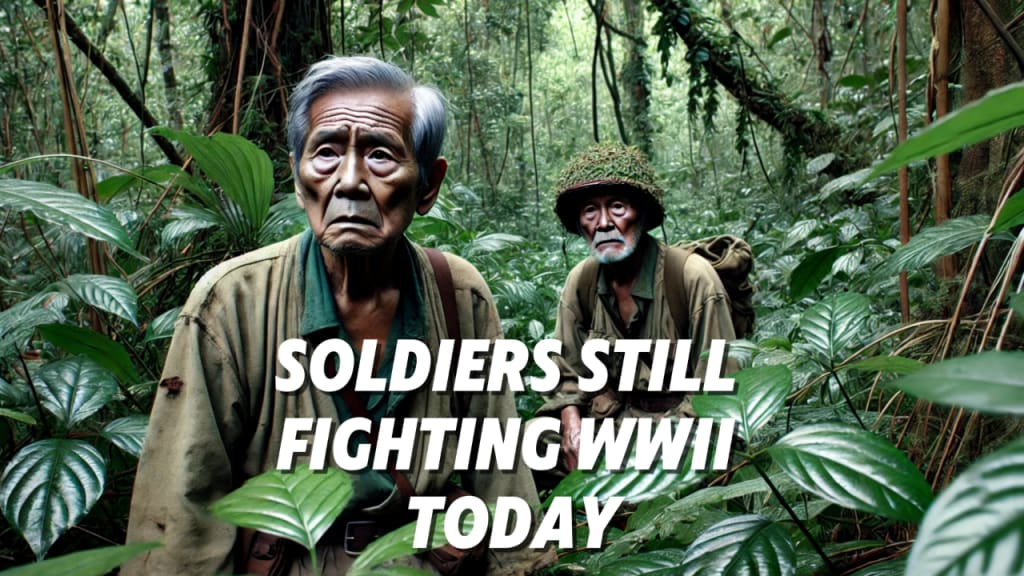
In 2005, the world was shocked by the story of two elderly Japanese men who stumbled out of the dense jungle on the island of Mindanao in the Philippines. Yoshio Yamakawa, aged 87, and Tsuzuki Nakauchi, aged 85, were confused and bewildered. They asked a question that left everyone baffled: "Has the war ended yet?"
You might assume they were referring to a recent conflict like the Iraq War or, at a stretch, the Vietnam War, given the region. But, to everyone’s amazement, these men were talking about World War II. That’s right—these two Japanese soldiers had been hiding in the Filipino jungle for 60 years, unaware that the war had ended decades earlier.
A Jungle Retreat That Lasted Decades
The story of Yamakawa and Nakauchi was a reminder of a strange phenomenon that occurred after World War II. For some Japanese soldiers, the war never really ended. In the chaos and confusion of Japan's surrender, some soldiers simply kept fighting, unaware that peace had been declared. These men, known as "holdouts," remained hidden in the jungles of Southeast Asia, holding out for orders that never came, and surviving in harsh, isolated conditions.
Yamakawa and Nakauchi were two such holdouts. After fleeing into the jungle during the closing stages of World War II, they remained there, cut off from the outside world. The jungle became their home, and they lived off the land for over half a century, completely unaware that Japan had surrendered in 1945.
When they were discovered in 2005, the world was captivated by their story. However, the men never met with the mediator who was sent to help them return to Japan. Instead, wary of the media attention, they disappeared back into the jungle, leaving their incredible story unfinished and unverified.
The Phenomenon of Japanese Holdouts
Although the story of Yamakawa and Nakauchi remains unconfirmed, history tells us that their case wasn’t entirely unique. Many Japanese soldiers, driven by the extreme military culture and customs of the Empire of Japan, stayed hidden in jungles across Southeast Asia and the Pacific for years—sometimes decades—after the war ended.
But how could this happen? How could soldiers remain unaware of something as monumental as the end of World War II? The answer lies in the deeply ingrained values of the Japanese military during that era.
The Militaristic Mindset of Imperial Japan
World War II was a period of rapid expansion for the Empire of Japan. While Europe was embroiled in conflict with Adolf Hitler’s Nazi regime, Japan took advantage of the situation by expanding its influence in Asia. Japanese propaganda portrayed the nation as a liberator, freeing Southeast Asian colonies from European rule. In reality, Japan had its own imperial ambitions, seeking to control the vast natural resources of the region.
Despite the brutality of the Japanese occupation, the soldiers who carried out these acts were often driven by a powerful sense of duty and loyalty to their emperor. Surrender was seen as a dishonor, and many soldiers were taught that it was better to die than to give up. This mindset would lead some soldiers to continue fighting long after the war had officially ended.
The Unlikely Survivors of the Post-War World
In the immediate aftermath of World War II, thousands of Japanese soldiers remained hidden in the jungles of Southeast Asia, particularly in the Philippines. These soldiers became guerrilla fighters, staging attacks against allied forces, local armies, and even civilians. Their belief in Japan’s military cause was so strong that they couldn’t accept the fact that the war was over, even when they were told otherwise.
Meet the Soldiers Who are Still Fighting WWII Today. You'll definitely enjoy this!
One of the most famous stories of these holdouts comes from Captain Sakae Ōba , who led a group of about 200 people into the jungle on the island of Saipan in 1944. After Saipan was captured by U.S. forces, Ōba and his group continued fighting, launching attacks on American soldiers from the jungle. It wasn’t until December 1945, several months after Japan’s surrender, that Ōba finally gave up. A former Japanese general had to deliver a message to him personally to convince him that the war was truly over.
An Island of Conflict and Murder
Another strange story occurred on the island of Anatahan, just 75 miles from Saipan. This small island was uninhabited, but in 1944, 30 Japanese soldiers found themselves shipwrecked there after their boat was sunk nearby. With no way to communicate with the outside world, they were left to survive on coconuts, fish, and lizards.
Life on Anatahan was tough, but the situation took a dark turn when a single woman, Kazuko Higa, arrived on the island. She quickly became the center of attention among the stranded soldiers, and a deadly game of jealousy began. Soldiers murdered each other over Higa, with 11 of the 30 men dying in the process. Higa herself eventually escaped by signaling a passing U.S. ship in 1950. Only after her intervention did the remaining soldiers finally accept that the war had ended.
The Last Holdouts: Shoichi Yokoi and Hiroo Onoda
As the years went on, more and more Japanese holdouts were discovered. The largest groups were found in the immediate post-war years, but some individuals managed to stay hidden for decades.
In 1972, Soichi Yokoi was discovered on the island of Guam, where he had been living in a jungle cave for 28 years. Yokoi had been posted to Guam in 1943 and went into hiding with nine other soldiers when the island was captured by American forces in 1944. By the mid-1960s, Yokoi was the last survivor of the group. He knew the war had ended but couldn't bring himself to leave the jungle. When two local fishermen stumbled upon him in 1972, Yokoi attacked them, still believing he was fighting for Japan. Remarkably, he had lived just two miles from a U.S. airbase all those years.
Hiroo Onoda’s story is perhaps the most famous of all. Onoda was an intelligence officer stationed on the island of Lubang in the Philippines. After Japan surrendered, Onoda and three other soldiers retreated into the mountains, where they continued to fight for nearly 30 years. Despite numerous attempts to persuade them to surrender—including leaflets, family photographs, and search parties—Onoda remained convinced that the war was still ongoing.
It wasn’t until 1974 that Onoda’s former commanding officer traveled to the Philippines to tell him in person that the war was over. Even then, Onoda refused to believe it until he saw his commander’s orders. After killing 30 civilians in the years after the war ended, Onoda was pardoned by the Philippine government and returned to Japan, where he was hailed as a hero.
The Legacy of the Japanese Holdouts
The stories of Japanese holdouts like Yamakawa, Nakauchi, Yokoi, and Onoda are both fascinating and tragic. They highlight the extreme loyalty and dedication of the Japanese soldiers who fought in World War II, as well as the devastating consequences of war on individuals and societies.
While most holdouts eventually surrendered or were discovered, it’s possible that there are still a few Japanese soldiers hiding in the jungles of Southeast Asia, unaware that the world has moved on. For these men, the war never ended—it simply faded into the background, replaced by the daily struggle for survival in the unforgiving wilderness.
As we reflect on these extraordinary stories, we are reminded of the powerful forces that drive human behavior, from the relentless will to survive to the deep-seated loyalty to a cause. In the case of the Japanese holdouts, those forces led them to live out their days in isolation, waiting for a war that had long since ended.
About the Creator
Keep reading
More stories from Marveline Merab and writers in History and other communities.
The Man Who Found a Real Mermaid Skeleton: Phineas T. Barnum
Take a seat, make yourself comfortable, and let the soothing scent of sandalwood incense envelop you. Today, we're going to delve into the world of showmanship and deception, starting with a brief psychic reading of your personality. Ready? Here we go: "You place a lot of value on being liked and admired. At times, you are overly critical of yourself. You pride yourself on being an independent thinker, and you rarely accept things without satisfactory proof."
By Marveline Merababout a year ago in History
World War I
The morning fog lay thick over the trenches of northern France, clinging to the earth as if it too feared what was about to happen. Private Thomas Hale pulled his coat tighter around himself, though it did little to stop the cold from seeping into his bones. He had been in the trenches for six months, yet the damp smell of mud, smoke, and fear still felt unfamiliar, like a nightmare he could not wake from.
By Maavia tahir6 days ago in History
Chicago Hospital Held Newborn Baby for 8 Months Over an Unpaid Medical Bill
Debts were handled much differently in the 19th and early 20th century. Back then, people who accrued debt had more to fear than letters and calls from collection agencies the same way we do today, especially if they owed a hospital or doctor money.
By Criminal Matters7 days ago in History


Comments (1)
These people are a glaring example of the ugly consequences of a war, reminding us of the past and the future. They tell us how we managed to become so ugly on such a beautiful planet.