
Sardar Mohammed Daoud Khan: The Visionary President of Afghanistan
First president of Afghanistan and his Life and rules

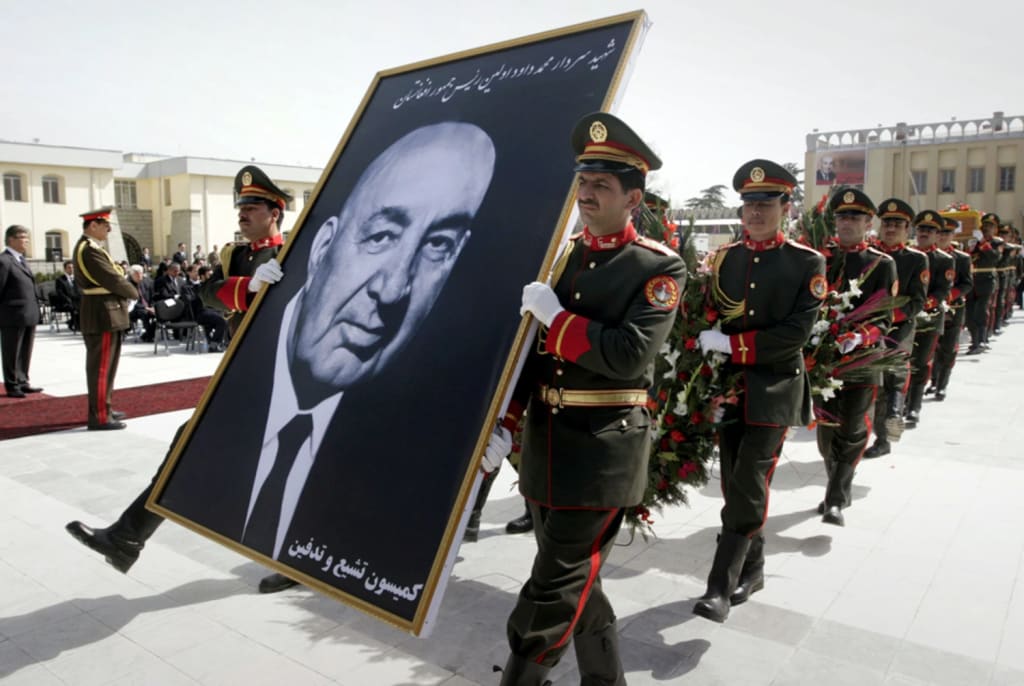
Sardar Mohammed Daoud Khan: The Visionary President of Afghanistan
Sardar Mohammed Daoud Khan, born on July 18, 1909, in Kabul, was a bold and visionary leader who played a key role in shaping modern Afghanistan. Belonging to the royal Barakzai dynasty, he was the cousin and brother-in-law of King Mohammed Zahir Shah. Educated in Kabul and trained in military science, Daoud Khan began his political career in the 1930s and quickly rose through the ranks due to his strong leadership skills and determination.
In the 1950s, Daoud Khan served as Prime Minister of Afghanistan under King Zahir Shah. During his time as Prime Minister (1953–1963), he pursued an ambitious agenda of modernization. He prioritized industrial growth, infrastructure development, and expanded educational opportunities, particularly for women. His government built roads, schools, hospitals, and hydroelectric projects. He also encouraged a closer relationship with the Soviet Union, from which Afghanistan received significant military and economic aid. This relationship, however, created tensions with neighboring Pakistan and the West, especially because of Daoud Khan’s support for the Pashtunistan movement, which sought autonomy or unification for Pashtuns living in Pakistan’s tribal regions.
His assertive policies eventually led to his resignation in 1963, partly due to pressure from King Zahir Shah and discontent among political elites. For the next ten years, Daoud Khan remained in the background, quietly observing the political developments under the new constitutional monarchy introduced in 1964.
On July 17, 1973, while King Zahir Shah was in Italy for medical treatment, Daoud Khan seized the opportunity to lead a bloodless coup. With support from military officers and leftist political groups, he abolished the monarchy and declared Afghanistan a republic. He became the country’s first President and Prime Minister, bringing an end to 226 years of monarchy.
As president, Daoud Khan initially aligned with progressive elements, including the People’s Democratic Party of Afghanistan (PDPA), a communist-leaning group that helped him come to power. He envisioned a strong, independent Afghanistan with a neutral foreign policy. He began to reduce dependence on the Soviet Union and reached out to countries like Iran, India, and Egypt for support, hoping to balance international influence. Domestically, he focused on centralizing power, improving women’s rights, and launching economic reforms, including land redistribution and industrial expansion.
However, Daoud Khan’s rule became increasingly authoritarian. He dissolved all political parties in 1975, including those that had supported his coup, and concentrated power in his hands. His relationship with the PDPA soured, especially as he cracked down on leftist opposition and imprisoned many communist activists. His shift away from the Soviet Union toward a more non-aligned and nationalist stance further strained relations with Moscow.
By the late 1970s, dissatisfaction among communists, parts of the military, and students grew. On April 27, 1978, the PDPA launched a violent coup known as the Saur Revolution. Tanks rolled into Kabul, and after fierce fighting, Daoud Khan’s government was overthrown. The next day, Daoud Khan, along with most of his family, was killed in the presidential palace—ending the life of a man who had tried to modernize Afghanistan on his own terms.
Sardar Daoud Khan remains a complex figure in Afghan history. He was a nationalist and modernizer who aimed to strengthen Afghanistan’s independence and identity. His bold moves—especially the abolition of the monarchy—reshaped the country’s political landscape. Yet, his centralization of power and growing repression ultimately led to his downfall and paved the way for decades of conflict, including communist rule, foreign interventions, and civil war.
Today, many Afghans remember Daoud Khan with respect, viewing him as a proud leader who sought to modernize his nation while maintaining its sovereignty. In 2009, more than three decades after his assassination, Daoud Khan and his family were given a state funeral, and his legacy continues to be discussed as part of Afghanistan's turbulent journey through the 20th century.
About the Creator
Ihsas Feeling
I'm a writer writing information about technology. Discovery. history .Etc....Sta
Keep reading
More stories from Ihsas Feeling and writers in History and other communities.
The Iron Amir: The Story of Abdur Rahman Khan
The Iron Amir: The Story of Abdur Rahman Khan In the heart of 19th-century Afghanistan, when the winds of empire and rebellion blew fiercely across the mountains, a man of steely will emerged to forge unity from chaos. His name was Abdur Rahman Khan, a prince in exile, a warrior by blood, and the man who would become known as “The Iron Amir.”
By Ihsas Feeling 8 months ago in History
Venezuela’s President Under Pressure: Arrest Calls, Indictments, and a Nation at a Crossroads
How the Arrest Narrative Began The idea of arresting Venezuela’s president did not appear out of nowhere. It stems from years of accusations that range from human-rights abuses to corruption and drug-related activities. U.S. authorities have filed formal charges against Nicolás Maduro, linking him to cocaine trafficking networks and large-scale financial misconduct. These cases place him among the few sitting leaders facing active international legal pressure.
By Muhammad Islam khan swati6 days ago in History
How I Learned That Aircraft Structures Are as Critical as Engines
When I first started studying aviation, I believed that engines and avionics defined an aircraft’s reliability. Over time, as I explored aerospace history and manufacturing records, I realized how incomplete that understanding was. Aircraft safety does not depend solely on thrust or navigation systems. It is deeply rooted in structural engineering, certified manufacturing, and the disciplined production of components that passengers never see.
By Beckett Dowhan2 days ago in History


Comments
There are no comments for this story
Be the first to respond and start the conversation.