
Saddam Hussein and the Geopolitics of Power: A Turbulent Legacy of War and Dictatorship
An Analysis of Iraq’s Conflicts, Global Tensions, and the Political Persona of a Controversial Leader

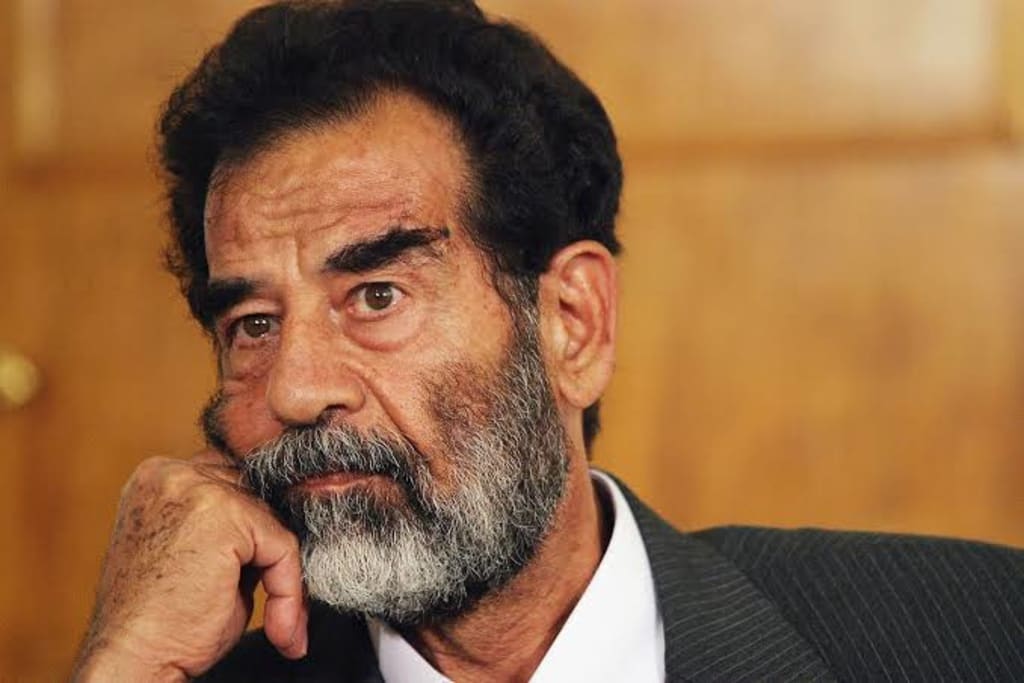
Saddam Hussein’s Leadership and Dictatorship
Saddam Hussein rose to power in 1979, becoming the President of Iraq and cementing himself as the country’s absolute ruler. His rule was marked by a highly centralized and oppressive governance system. The text repeatedly emphasizes Saddam’s dictatorial style, portraying him as a ruthless and feared leader. He controlled the state apparatus with an iron grip, suppressing dissent through surveillance, purges, and military force. His personality cult was carefully constructed, with extensive use of propaganda portraying him as both a strong nationalist and a protector of Iraq's sovereignty.
While known for his authoritarianism, Saddam also implemented populist policies aimed at strengthening domestic support. These included free education and health services, which were meant to project a modern and powerful Iraq. Interestingly, the text notes his admiration for the film "The Godfather", a symbolic association that underscores his self-image as a powerful and commanding figure, often feared yet respected.
Iraq’s Regional Conflicts and International Relations
A significant portion of the narrative revolves around Iraq’s aggressive foreign policy, particularly Saddam’s invasion of Kuwait in 1990, which triggered the Gulf War. This move shocked the international community and led to swift military retaliation led by the United States and its allies. The text outlines the escalating tensions between Iraq and Western powers, especially the U.S., which demanded Saddam’s withdrawal from Kuwait and later engaged in extensive military campaigns against Iraq.
The Gulf War not only exposed the fragility of Iraq’s military might but also led to prolonged economic sanctions and international isolation. The conflict is portrayed as part of a broader geopolitical struggle over oil resources, with suggestions that the U.S. and Britain had vested interests in Iraq’s vast petroleum reserves. These references hint at a cynical interpretation of international involvement, implying that oil politics rather than humanitarian concerns drove much of the Western intervention.
Weapons of Mass Destruction and Military Confrontation
Another major theme is the alleged possession of weapons of mass destruction (WMDs) by Iraq, including chemical and nuclear weapons. The fear that Saddam could unleash such weapons contributed heavily to the justification for U.S. military action, especially during the 2003 invasion. While the actual existence of these weapons was never conclusively proven, the narrative reflects the intense global anxiety around Saddam’s ambitions and Iraq’s potential threat to regional stability.
Descriptions of military confrontations—including American bombings, tanks, and troop deployments—illustrate the scale and intensity of the conflict. The text also alludes to civilian suffering, noting that many Iraqi cities were emptied or destroyed, and the general population bore the brunt of the war’s destruction and ensuing humanitarian crisis.
Perception, Propaganda, and Polarization
The portrayal of Saddam Hussein in the global media varied widely. Domestically, he was glorified as a hero and defender of Arab identity, while internationally, he was often seen as a tyrant and war criminal. The text captures this duality, noting that Saddam used religious and nationalist rhetoric, invoking Allah and Arab unity to consolidate his rule and resist Western influence. At the same time, he was portrayed by Western powers as a destabilizing force in the Middle East, aligning him with broader narratives of extremism and despotism.
The chaotic nature of the narrative reflects the complex interplay of propaganda, international diplomacy, and public sentiment. There are mentions of Saddam’s attempts to influence U.S. opinion, including efforts to sway American senators and portray himself as a victim of Western aggression. The language used throughout the text is emotionally charged, filled with references to patriotism, betrayal, and resistance, revealing the deeply polarized discourse surrounding Saddam’s era.
About the Creator
Keep reading
More stories from Zain Ul Abedin Khan and writers in History and other communities.
The Wali of Swat's Financial Support to Pakistan: A Legacy of Generosity
Introduction: A Time of Challenge and Hope When Pakistan emerged as an independent state in August 1947, it faced enormous challenges. The partition of British India had created a new nation almost overnight, with limited resources, infrastructure, and financial reserves. The early days of Pakistan were marked by political instability, mass migrations, and conflicts, including the first Indo-Pak war over Kashmir.
By Zain Ul Abedin Khan8 months ago in History
3 Ordinary Places That Hid Something Truly Disturbing for Years
Most of us take comfort in ordinary places. Schools feel safe. Homes feel familiar. Workplaces feel predictable. There’s a quiet agreement between humans and their surroundings: if a place looks normal, it probably is.
By Enoch Saginiabout 21 hours ago in History
Stanislav Kondrashov’s Oligarch Series: Renaissance Merchants and Their Support for the Arts
In his *Oligarch Series*, **Stanislav Kondrashov** examines how wealth has shaped political, economic, and cultural systems across history. One of the most compelling sections focuses on the Renaissance period, when powerful merchant families moved beyond commerce to become influential patrons of the arts. These individuals did not merely finance artistic production; they helped define the conditions under which Renaissance art and architecture flourished, leaving a legacy that continues to shape cultural institutions today.
By Stanislav Kondrashov4 days ago in History



Comments (1)
You've got an interesting take on Saddam Hussein. His rule was clearly authoritarian, and the invasion of Kuwait was a huge blunder. The geopolitical stuff around oil makes for a complex picture.