
rowing every day for a month
"The Benefits of Consistent Rowing: A Month-Long Journey to Improved Fitness and Mental Clarity"

Rowing every day for 30 days can have a transformative impact on your body, leading to numerous potential benefits. This consistent fitness routine helps establish discipline and habit formation. By committing to rowing daily, you build momentum and increase the likelihood of maintaining an exercise habit in the long term. Rowing is a full-body workout that engages multiple muscle groups, improving overall strength, endurance, and cardiovascular fitness over the course of 30 days. You can expect noticeable improvements in muscle tone, weight management, and cardiovascular health.
One of the key advantages of rowing is its low-impact nature, making it a gentle yet effective exercise option for individuals looking for cardiovascular and strength benefits without placing excessive stress on their joints. Unlike high-impact exercises like running, rowing minimizes the impact by employing a smooth and gliding motion. The seated position and fluidity of the rowing stroke reduce strain on the knees, hips, and ankles.
This low-impact characteristic makes rowing particularly beneficial for individuals with joint issues, arthritis, or those recovering from injuries. It allows for a comprehensive workout while minimizing the risk of aggravating existing conditions. The design of rowing machines, with their sliding seats and adjustable resistance, enables users to customize the intensity of their workouts, accommodating different fitness levels and reducing the chances of overexertion or injury.
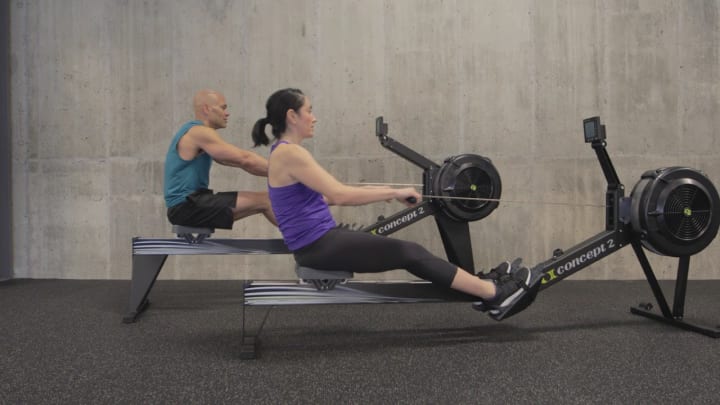
Rowing is an inclusive exercise option suitable for people of all ages and fitness backgrounds. Whether you are a seasoned athlete seeking a joint-friendly cross-training activity or a beginner starting your fitness journey, rowing's low-impact nature makes it accessible and sustainable for promoting overall health and well-being.
During rowing, multiple muscle groups are engaged, including the legs (quadriceps, hamstrings, and calves), back (latissimus dorsi muscles), shoulders (deltoids), arms (biceps and triceps), core (abdominal and lower back muscles), glutes (gluteus maximus), forearms, and grip. Holding onto the rowing handle strengthens the forearm muscles and improves grip strength.
Using a rowing machine offers a multitude of benefits beyond cardiovascular exercise. It combines both strength and endurance training, providing an efficient full-body workout. The rhythmic rowing motion engages major muscle groups such as the legs, back, shoulders, and core, promoting muscular development and toning. What sets rowing apart is its low-impact nature, ensuring minimal stress on the joints compared to high-impact exercises. This makes it an excellent option for individuals with joint concerns or those seeking a workout that is gentle on the body while still delivering significant results.
Rowing also promotes cardiovascular health by increasing heart rate and enhancing lung capacity. The continuous and fluid nature of the rowing motion fosters endurance and stamina. In addition to the physical benefits, rowing can provide a mental boost. The repetitive and meditative aspect of the rowing stroke, combined with the sense of accomplishment as you glide along the resistance, can be a calming and stress-relieving experience. Whether your goal is weight loss, overall fitness, or a dynamic cross-training option, the rowing machine is a versatile tool that not only transforms your body but also supports holistic well-being.
To see the impact of rowing every day for 30 days, consider the inspiring transformation of Billy Brendan. In just one month, he went from 252 pounds (114.5 kg) to 226 pounds (102.7 kg), losing an impressive 26 pounds (11.8 kg). As Brendan improved his rowing skills, he gradually increased the duration of his sessions. In the first week, he rowed for 1000 meters. In the second week, he added 500 meters to the length. By the third and fourth week, Brendan rowed a total of 2000 meters, double the distance of his first week. He also made adjustments to his resting periods throughout each week, but always remained committed to his daily rowing practice.
About the Creator
Keep reading
More stories from Md Babul Hossain and writers in History and other communities.
core type 3 ab workout
What does the workout entail? The workout consists of three bodyweight plank exercises that are performed consecutively. A total of three rounds of the circuit will be completed. If necessary, a brief pause of a few seconds may be taken between circuits to reset.
By Md Babul Hossain2 years ago in History
When Allies Disagree: How Global Partnerships Are Being Redefined
When Allies Disagree: How Global Partnerships Are Being Redefined For much of the modern era, global alliances appeared firm and predictable. Powerful countries formed blocs, promised mutual support, and stood together during times of war and crisis. But in today’s world, those alliances are changing. Recent disagreements between long-standing partners show that global cooperation is no longer based on automatic loyalty—it is increasingly shaped by national interests, public opinion, and long-term stability.
By Wings of Time 7 days ago in History
3 Times the Wrong Person Was in Charge at the Worst Possible Moment
Leadership matters most when things go wrong. In calm times, almost anyone can appear competent. Meetings happen. Papers get signed. Coffee is consumed with confidence. But crises are different. Crises demand judgment, experience, decisiveness, and—ideally—a basic understanding of what’s happening.
By Enoch Saginia day ago in History
So You Decided To Become a Nurse Practitioner:
So you decided to become an "Advanced Practice" nurse. Congratulations!... is what I would say if this was a good idea. Grad school? In this economy? What were you thinking? Likely it was something along the lines of either 1) “I've seen these other chucklefucks do it— Why can't I?” or even 2) “I've got a nice career, I should shake it up. I miss feeling like I have no clue what I'm doing.”
By Sandor Szabo6 days ago in Fiction



Comments
There are no comments for this story
Be the first to respond and start the conversation.