
3 Times the Wrong Person Was in Charge at the Worst Possible Moment
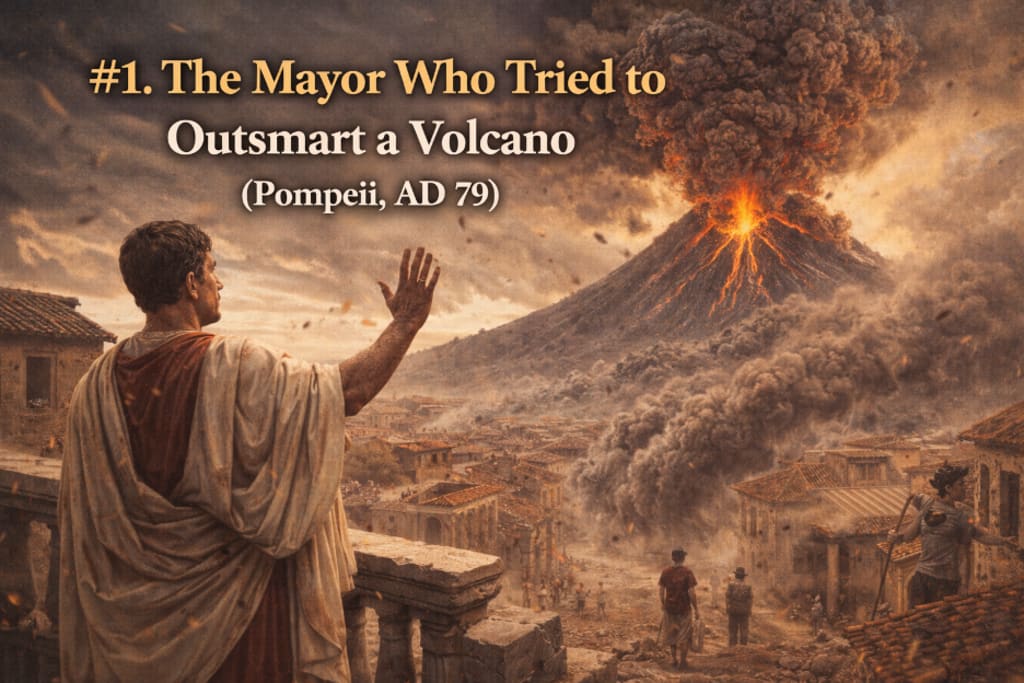
#1. The Mayor Who Tried to Outsmart a Volcano (Pompeii, AD 79)
Leadership matters most when things go wrong. In calm times, almost anyone can appear competent. Meetings happen. Papers get signed. Coffee is consumed with confidence. But crises are different. Crises demand judgment, experience, decisiveness, and—ideally—a basic understanding of what’s happening.
History, unfortunately, contains several moments when fate looked at a looming disaster and said, “Let’s put that guy in charge.”
These aren’t stories of cartoon villains or obvious fools. These are moments when the wrong combination of personality, ignorance, ego, or sheer bad luck placed someone wildly unprepared at the controls just as everything began to fall apart.
3. The Man Who Didn’t Believe the Titanic Could Sink (J. Bruce Ismay)
When the Titanic set sail in 1912, it was more than a ship—it was a floating declaration of human confidence. It was enormous, luxurious, and widely believed to be practically unsinkable. That belief mattered because the man who believed it most strongly was J. Bruce Ismay, chairman of the White Star Line.
Ismay wasn’t the ship’s captain, but his presence mattered. He was the company executive onboard, observing his creation and quietly encouraging one dangerous idea: speed.
Multiple accounts suggest Ismay pressured Captain Edward Smith to maintain high speed through iceberg-filled waters to arrive early in New York. The ship had received repeated iceberg warnings. The North Atlantic was unusually dangerous that night.
Ismay, however, was focused on prestige.
When the Titanic struck the iceberg, leadership clarity was immediately needed. Instead, confusion ruled. Lifeboats—already too few—were launched half-full. Passengers weren’t properly informed of the danger. The seriousness of the situation took far too long to sink in—much like the ship itself.
Then came the moment that cemented Ismay’s place in infamy.
As women and children were still boarding lifeboats, Ismay stepped into one himself and survived. He later claimed there were no women nearby at the time. Public opinion was unconvinced.
Ismay lived the rest of his life as a symbol of failed leadership—less for surviving than for being the wrong mindset aboard a ship that desperately needed humility instead of confidence.
2. The Tsar Who Left the Country While It Collapsed (Nicholas II of Russia)
In early 20th-century Russia, the country was a pressure cooker. Poverty was widespread, food shortages were common, and political unrest simmered constantly. Russia was also fighting World War I, which it was handling poorly.
At the center of it all sat Tsar Nicholas II, a man described by historians as personally kind, deeply religious, and catastrophically unsuited to leadership.
In 1915, Nicholas made one of the worst-timed decisions in modern history: he personally took command of the Russian army.
This meant two things. First, he placed himself in charge of a military he did not understand. Second—and far worse—he left the capital, Petrograd, in the hands of his wife, Alexandra, who relied heavily on a mystic named Grigori Rasputin for political advice.
While Nicholas struggled at the front, Russia unraveled at home.
Food distribution collapsed. Corruption flourished. Public anger exploded. With the Tsar absent, there was no authority capable of calming the situation—or even recognizing how bad it had become.
By the time Nicholas returned, the monarchy was already doomed. Protests turned into a revolution. Soldiers mutinied. The Tsar abdicated in 1917, ending over 300 years of Romanov rule.
Nicholas was not cruel or malicious. That’s what makes this moment so tragic. He was simply the wrong man for a moment that required ruthlessness, reform, and political instinct.
History does not reward good intentions when timing is terrible.
1. The Mayor Who Tried to Outsmart a Volcano (Pompeii, AD 79)
When Mount Vesuvius began rumbling in AD 79, the people of Pompeii didn’t immediately panic. Vesuvius had been quiet for centuries. No one alive remembered it as a volcano. To them, it was just a mountain that occasionally shook.
The local Roman leadership—city officials responsible for public order—had no volcano-response manual. That alone is understandable. What followed is less forgivable.
As ash began to fall, many residents hesitated. Authorities did not order a mass evacuation. Life continued awkwardly. People swept ash from rooftops. Some stayed indoors. Others waited for instructions that never came.
Why? Because the danger was misunderstood.
Roman science had no concept of pyroclastic flows—superheated clouds of gas and debris that move faster than a human can run. By the time the real threat arrived, escape was impossible.
Entire neighborhoods were instantly buried. People were frozen mid-action: cooking, sleeping, holding coins, clutching children.
The wrong leadership failure here wasn’t arrogance—it was false calm. Officials likely believed panic would cause more harm than waiting. They had no framework to understand what was coming.
Vesuvius did not negotiate.
Pompeii’s leaders weren’t villains. They were simply men facing a natural disaster they couldn’t comprehend, making decisions that felt reasonable until history revealed how fatally wrong they were.
Conclusion
What unites these moments isn’t incompetence in the cartoon sense. None of these people were idiots. None of them intended harm. They were wrong because they were misaligned with the moment.
The Titanic needed caution, not confidence. Russia needed reform, not tradition. Pompeii needed urgency, not reassurance.
Leadership failure often isn’t loud. It doesn’t announce itself. It wears confidence, tradition, or optimism—and waits too long.
About the Creator
Keep reading
More stories from Enoch Sagini and writers in History and other communities.
Abraham Lincoln: The Long Road to Leadership
Abraham Lincoln’s journey to leadership was not a straight path paved with privilege or certainty. It was a long, uneven road marked by hardship, failure, patience, and moral growth. Born into poverty and shaped by loss, Lincoln rose not through inherited power but through resilience and a deepening sense of justice. His life story is a testament to how character is forged over time, and how leadership often grows out of struggle rather than success. Lincoln was born on February 12, 1809, in a small log cabin in Hardin County, Kentucky. His parents, Thomas and Nancy Lincoln, were poor farmers who owned little land and even fewer possessions. The frontier life was harsh and unpredictable, and young Abraham learned early the realities of physical labor. He helped clear fields, split rails, and work the soil, developing the strength and endurance that would later become legendary. Yet it was not physical work alone that shaped him—it was loss. When Abraham was just nine years old, his mother died from milk sickness, a tragedy that left a deep emotional scar. The quiet, thoughtful boy grew more introspective, learning early how fragile life could be. Formal education was rare on the frontier. Lincoln attended school only sporadically, totaling less than a year of classroom learning. But he possessed an intense hunger for knowledge. He borrowed books whenever he could—reading the Bible, Aesop’s Fables, Shakespeare, and books on history and law. He read by firelight after long days of labor, teaching himself grammar, logic, and storytelling. This self-education sharpened his mind and gave him a powerful command of language, a skill that would later define his leadership. As a young man, Lincoln left home and moved to New Salem, Illinois. There, he tried his hand at various jobs: store clerk, postmaster, surveyor, and finally lawyer. Many of these early efforts ended in failure. His first business collapsed, leaving him deeply in debt for years. He lost elections, struggled financially, and endured periods of deep sadness. Yet each setback strengthened his resolve. Lincoln developed a reputation for honesty—earning the nickname “Honest Abe”—and for fairness in his dealings with others. People trusted him not because he was flawless, but because he was sincere. Lincoln’s first steps into politics came in the Illinois state legislature, where he served multiple terms. He was not a fiery revolutionary but a careful thinker who believed in progress through law and debate. During this period, he also trained himself in the practice of law, riding the legal circuit across rural Illinois. In courtrooms and taverns, Lincoln listened to people’s concerns, learned their values, and understood the rhythms of ordinary American life. These experiences grounded his leadership in empathy and realism. The issue that would ultimately define Lincoln’s legacy—slavery—was one he approached with moral seriousness and caution. He personally believed slavery was wrong, but he also understood the deep divisions it caused in the nation. Rather than calling for immediate upheaval, Lincoln argued that slavery should not expand into new territories. His belief was rooted in the idea that the nation could not endure permanently half slave and half free. This position brought him national attention during the famous debates with Senator Stephen A. Douglas in 1858. Although Lincoln lost that Senate race, the debates revealed his clarity of thought, moral conviction, and ability to speak to the conscience of the nation. In 1860, amid rising sectional tensions, Lincoln was elected the 16th President of the United States. His victory was achieved without carrying a single Southern state, highlighting how divided the country had become. Soon after his election, several Southern states seceded from the Union, and the nation stood on the brink of collapse. Lincoln entered the presidency at its darkest hour, facing a civil war that threatened the very existence of the United States. Lincoln’s leadership during the Civil War was tested daily. He was mocked for his appearance, criticized for his decisions, and blamed for the immense suffering the war caused. He faced generals who disobeyed him, politicians who doubted him, and citizens who lost faith. Yet Lincoln remained steady. He believed the Union must be preserved, not for power, but for the principle that a democratic nation could survive internal conflict. Over time, Lincoln’s thinking on slavery evolved. What began as a desire to limit its spread grew into a firm commitment to its abolition. In 1863, he issued the Emancipation Proclamation, declaring freedom for enslaved people in Confederate-held territories. Though limited in immediate effect, it transformed the moral purpose of the war. The fight was no longer only about saving the Union—it was about human freedom. Lincoln’s greatest strength as a leader was not dominance, but humility. He listened to opposing views, admitted mistakes, and learned from experience. His speeches reflected this depth of character. The Gettysburg Address, delivered in just a few minutes, redefined the war as a struggle for equality and democratic ideals. His Second Inaugural Address showed compassion even toward the defeated South, urging the nation to heal “with malice toward none, with charity for all.” Tragically, Lincoln would not live to see the full reconstruction of the nation he fought to preserve. He was assassinated in April 1865, just days after the Civil War effectively ended. His death shocked the nation and turned him into a symbol of sacrifice and unity. Abraham Lincoln’s long road to leadership teaches us that greatness is rarely born—it is built. It is built through hardship, patience, learning, and moral courage. Lincoln did not rise because he never failed; he rose because he never stopped growing. From a poor boy in a log cabin to a president who reshaped a nation, his life remains one of the most powerful examples of leadership grounded in humanity, perseverance, and principle.
By The best writer about 9 hours ago in History


Comments
There are no comments for this story
Be the first to respond and start the conversation.