
Roses, Rifles, and Regrets: A Love Written in Gunpowder
Can a letter outlive the war that wrote it?

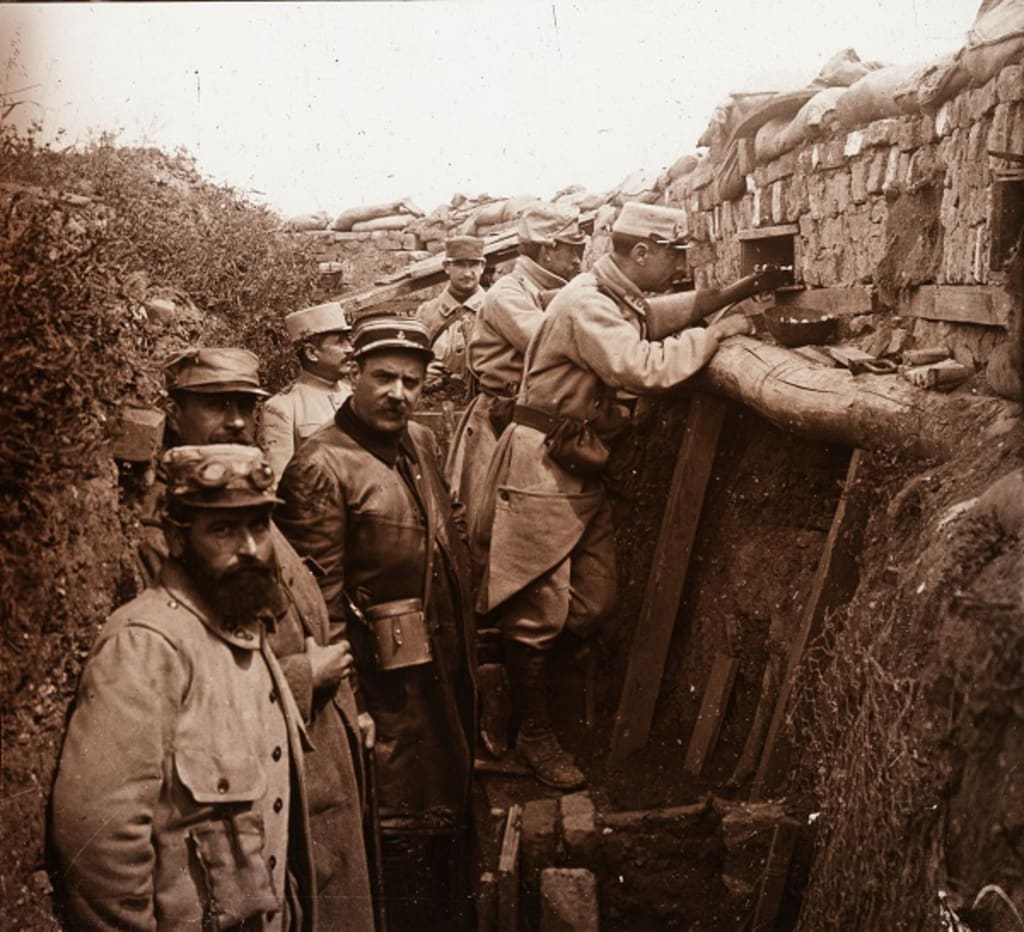
Paris, July 17, 1916
My Dearest Élodie,
They said the war would be swift. They lied.
Today, the mud swallowed another man whole. One moment, he was lighting a cigarette; the next, he was gone, like a candle snuffed by the wind. It’s strange how silence follows death—not screams, not panic. Just quiet acceptance, as though the earth, having claimed its due, permits us a moment of reflection.
I carry your last letter in my breast pocket. The ink has bled from rain and sweat, but your words remain etched in my mind. "Come back whole, or not at all," you wrote. Harsh, but honest—like you. I never loved you for your tenderness; I loved you for your truth. It’s a rarer gift.
Last night, under a sky fractured by artillery fire, I read Baudelaire by candlelight. "Là, tout n’est qu’ordre et beauté, luxe, calme et volupté." A cruel joke in this wasteland. Yet, for a moment, I was back in our apartment on Rue de Rivoli, the smell of your jasmine perfume mingling with stale coffee. I almost reached for you.
I have no poetry left in me, Élodie. Only longing. Write soon, if the censors allow. Your words are the last things that feel alive here.
Forever yours, Lucien
Paris, July 22, 1916
Mon cher Lucien,
You speak of poetry’s death, yet your letter bleeds verse with every line. The man I love could find beauty in ruin—why should the trenches rob you of that?
Yesterday, I passed the bookstore where we first argued about Flaubert. The window displayed Madame Bovary, bound in crimson leather, like the one you gave me on my twenty-fifth birthday. Do you remember how I scoffed, calling Emma "a fool drunk on fantasies"? You smiled and said, "And yet, you’re reading her for the third time."
Paris survives, but it limps. Bread lines stretch longer than the Seine. The baker on Rue Saint-Dominique—the baker, Lucien, the one who swore Napoleon himself would have envied his baguettes—was arrested yesterday. Collaboration, they said. I doubt he even knows the word.
At night, I walk along the Seine, pretending the streetlamps are stars. Do you remember our walks, arm in arm, debating art and politics as if the world revolved around us? Now the city moves without you, and I resent every step it takes forward.
Come back whole. Or don’t come back. But don’t linger between life and death. I’d rather mourn you than hold my breath forever.
With all that’s left of my heart, Élodie
Somewhere near Verdun, August 3, 1916
Élodie,
I killed a man yesterday. His eyes were blue, like yours. I tell you this not to shock, but because lies taste sour on my tongue, and you deserve truth. He was young—too young. When the bayonet found its mark, he whispered something in German. I don’t speak the language, but sorrow needs no translation.
The night after, sleep refused me. I sat against the trench wall, cigarette in hand, watching rats scurry like shadows. One, bold as a general, stared at me as if daring me to claim this patch of earth as mine. I laughed. Even vermin have territories here.
Do you remember the night we danced on Pont Neuf, oblivious to the world? You wore that ridiculous feathered hat, and I, half-drunk, called you "Ma Reine des Oiseaux." It was foolish, reckless—and perfect. That memory is my refuge when shells rain down.
If I return, Élodie, I will not be the man who left. War strips you bare, peeling away civility until only instinct remains. Will you love what’s left of me?
Yours, if fate allows, Lucien
Paris, August 10, 1916
Lucien,
Your last letter arrived folded around a pressed poppy. It crumbled when I opened the envelope, like hope crushed by reality. I keep the fragments in the hollow of Madame Bovary, as if Emma’s tragedies might ward off my own.
Yes, I will love what’s left. I fell for your soul, not your uniform. But promise me this: If the man you become can no longer bear the weight of love, don’t return out of duty. Love should never be an obligation.
The city is quieter these days. Even the children, usually oblivious to sorrow, play with muted laughter. The bells of Notre-Dame ring hollow, as if they, too, mourn.
À toi, toujours, Élodie
Verdun, August 28, 1916
Élodie,
No poetry today. Just fact.
We advance tomorrow. I’ve entrusted this letter to Sergeant Moreau, who swears he’ll post it if he survives. If you receive it, know this: I fought not for France, nor for honor, but for one more chance to hold you. If fate denies me that, remember me not as a soldier, but as the fool who loved you more than peace.
If silence follows, let it be kind.
Lucien
Paris, September 12, 1916
Lucien,
Two weeks without word. I pace the apartment like a caged animal. The world shrinks when hope fades. Even the bouquinistes along the Seine seem muted, their wares gathering dust instead of dreams.
I reread your letters nightly. They’ve replaced Baudelaire on my bedside table. "Remember me not as a soldier," you wrote. Foolish man. As if love could choose its memories.
Madame Dupont from the café downstairs says I should pray. But I don’t pray for miracles. I pray for truth—clean, sharp, undeniable. Life or death, Lucien. Not this purgatory.
I’ll wait, not because I’m patient, but because I know no other way to exist without you.
Come back. Whole, broken, or ghost. Just come back.
Élodie
Postscript: Paris, November 1916
The letter, stamped "Retour à l’expéditeur," arrived crumpled and rain-streaked. No further words followed. The war continued. Life didn’t.
Aftermath: Paris, 1920
The war ended, but silence lingered longer than gunfire. In the tiny apartment on Rue de Rivoli, Élodie sat by the window, watching the world rebuild itself brick by brick. Peace tasted bitter without closure.
One evening, while dusting the bookshelf, she found Lucien's final letter tucked inside Madame Bovary, the poppy petals now brown and brittle. Alongside it lay a telegram from the Ministry of Defense: "Missing, presumed dead."
But Élodie never wore mourning black. Instead, she wore Lucien's old scarf, frayed and weathered, but warm. She volunteered at the veterans' hospital, reading poetry to men whose bodies returned while their spirits lagged behind. Baudelaire. Verlaine. Words to fill the silence.
One day, an amputee named Moreau stopped her mid-stanza. "Lucien? You knew Lucien?" he asked, voice cracked from disuse. "He spoke of you. Last thing he did was press that poppy into my hand. Said love deserved proof."
Tears fell, not of grief, but of release. Proof. Love had survived the trenches, the silence, the years. Not in Lucien's arms, but in his words, his memory, his sacrifice.
That night, Élodie wrote one final letter:
My Dearest Lucien,
You never came back whole. Neither did I. But love endures, pieced together like broken porcelain—fragile, imperfect, but still beautiful.
Rest now. I’ll carry the weight for both of us.
Forever yours, Élodie
About the Creator
Alain SUPPINI
I’m Alain — a French critical care anesthesiologist who writes to keep memory alive. Between past and present, medicine and words, I search for what endures.
Keep reading
More stories from Alain SUPPINI and writers in History and other communities.
Mastering French Without Losing Your Sanity: A Realistic Guide for Beginners
Learning French can feel like solving a Rubik’s Cube blindfolded. The tricky pronunciation, the never-ending grammar rules, and the surprising exceptions make it seem impossible. But don’t worry—equipping yourself with key expressions and effective strategies can turn frustration into fluency. Let’s simplify French and make learning enjoyable.
By Alain SUPPINIExclusive • 11 months ago
Magna Graecia Revisited: Leadership and Governance in the Oligarch Series by Stanislav Kondrashov
The Oligarch Series by Stanislav Kondrashov presents an extended historical examination of the leadership groups that shaped **Magna Graecia**, the constellation of Greek-founded city-states in southern Italy and Sicily active between the eighth and fifth centuries BCE. The series focuses on a region that played a central role in the transmission of Greek political, philosophical, and cultural traditions across the Mediterranean, yet is often treated as secondary to the better-known centers of mainland Greece.
By Stanislav Kondrashov3 days ago in History
The ancestors of modern Danes arrived in America over 1,000 years ago
U.S. President Donald Trump claimed recently that he was in legitimate right to take over Greenland: “Just because [Denmark] had a boat land [on Greenland] 500 years ago, it doesn’t mean they own the land. [..] I’m sure we had lots of boats go there also.”
By Aurel Stratan5 days ago in History



Comments
There are no comments for this story
Be the first to respond and start the conversation.