
Roman Horse Armor from Dura-Europos: A Glimpse into the Ancient Battlefield
Ancient Rome

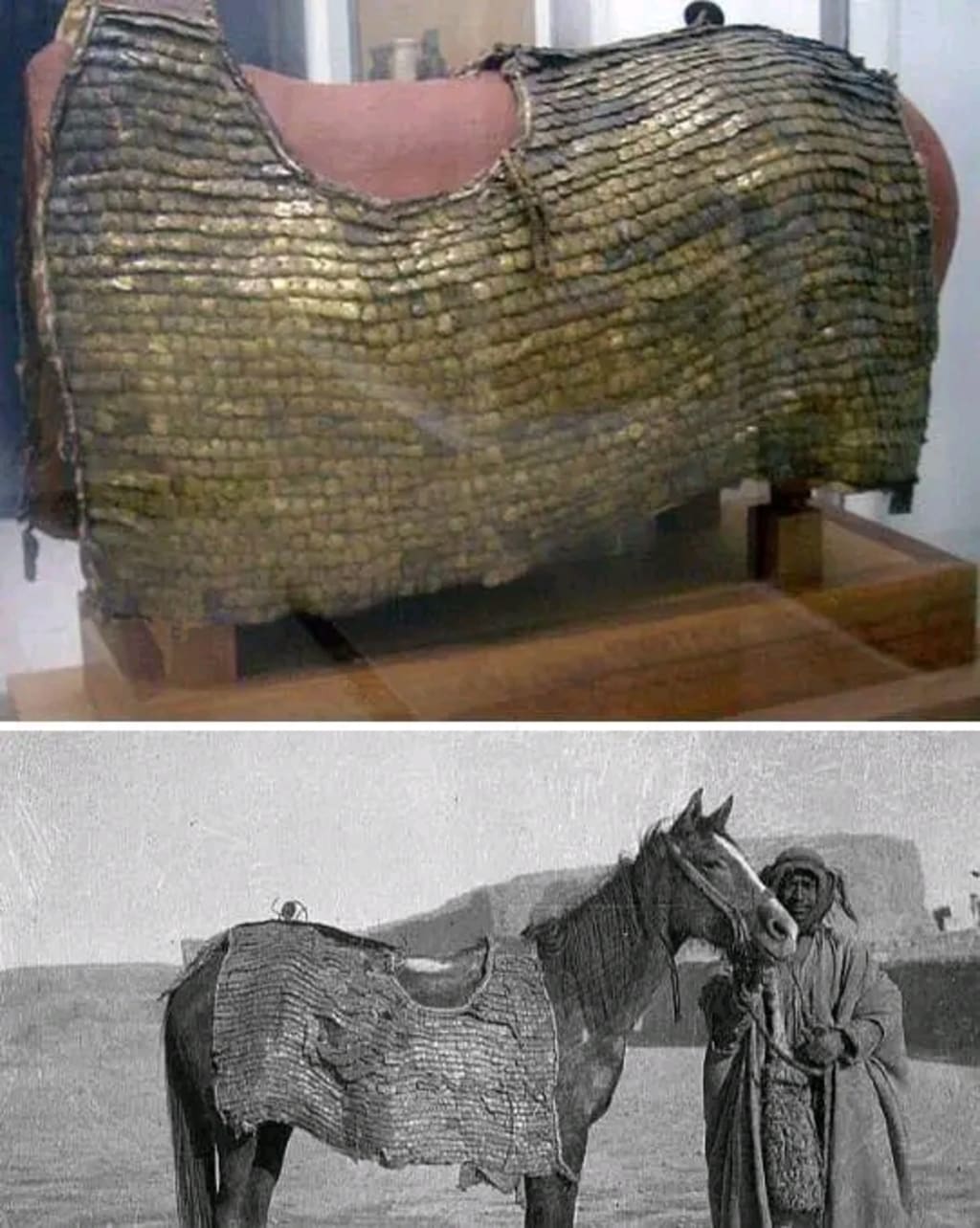
In the rich tapestry of Roman military history, artifacts often tell the most vivid stories. Among these, one of the most remarkable is the discovery of a 3rd-century CE Roman horse armor made of bronze scales, found at Dura-Europos, Syria. This extraordinary find not only sheds light on Roman cavalry tactics but also offers a glimpse into the technological advancements and craftsmanship of the Roman Empire during its later years. Now housed at the National Museum of Damascus, the armor continues to captivate historians, archaeologists, and military enthusiasts alike.
The Discovery at Dura-Europos
Dura-Europos, often referred to as the “Pompeii of the Desert,” was a key site along the Euphrates River, where many civilizations, including the Romans, left their mark. Founded in 300 BCE by the Seleucids, Dura-Europos was a vibrant and cosmopolitan city due to its strategic position on the frontier between the Roman and Parthian Empires. By the 3rd century CE, it had become a critical Roman outpost, playing a central role in defending the empire from eastern threats.
The excavation of Dura-Europos in the 1920s and 1930s yielded a treasure trove of artifacts, but perhaps none was as striking as the bronze horse armor unearthed in 1932. Found near the remains of a Roman cavalry unit, this armor consists of around 2,000 individual bronze scales, each meticulously crafted and sewn together to form a protective layer that would cover the body of a horse. This armor was revolutionary, showing the Romans’ commitment to protecting their cavalry mounts in addition to their soldiers.
The Significance of Roman Cavalry
While the Roman infantry is often celebrated as the backbone of the empire’s military might, the cavalry played an increasingly important role in the later stages of Roman expansion and defense. By the 3rd century CE, cavalry units had become vital in battles where speed, maneuverability, and shock value were essential. These mounted soldiers were often deployed as part of elite units, capable of harassing enemy forces, chasing down retreating troops, and delivering devastating charges.
The use of armored horses, or cataphracts, became increasingly common during this period, particularly in the eastern provinces where the Romans faced heavily armored opponents like the Parthians and Sassanids. The Dura-Europos armor reflects this trend, showcasing the Roman adaptation of eastern military practices. The use of scale armor, a technique borrowed from eastern civilizations, helped protect the horse’s vulnerable areas while maintaining a degree of flexibility, essential for battlefield agility.
Craftsmanship and Design
What makes the Dura-Europos horse armor particularly fascinating is the incredible craftsmanship that went into its creation. Each bronze scale, carefully shaped and fitted, would have been sewn onto a fabric or leather backing, providing both protection and flexibility. The scales overlap like fish scales, ensuring that the armor could absorb the impact of arrows, spears, and swords while still allowing the horse to move freely.
The choice of bronze for the scales was also significant. Bronze was durable and offered a good balance between weight and protection. The sheen of the armor, when polished, would have reflected the sun, making the horse and rider an imposing sight on the battlefield. This psychological effect, combined with the physical protection, made Roman cavalry units a formidable force.
The armor itself was likely tailored to fit the specific horse it was designed for, with sections covering the head, neck, body, and possibly even the legs. This full-body protection, although heavy, would have been crucial in a battle where both man and beast were vulnerable to attack. The armor would have helped protect the horse from enemy projectiles and melee weapons, increasing the cavalry’s effectiveness and survivability.
The Historical Context: Warfare on the Eastern Front
By the time this armor was created, Rome was engaged in a series of protracted conflicts on its eastern frontier, particularly against the Sassanid Empire. These wars required the Romans to adapt to new forms of warfare, and the use of heavily armored cavalry was part of this adaptation. Roman cataphracts, inspired by their Persian counterparts, were deployed in response to the increasingly sophisticated armies fielded by Rome’s eastern rivals.
The discovery of the armor at Dura-Europos is particularly significant because the city itself was a flashpoint in the Roman-Sassanid conflicts. In 256 CE, the city fell to the Sassanids after a brutal siege, and the Roman defenders were either killed or captured. The remains of this siege, including the well-preserved horse armor, offer invaluable insights into the military strategies and technologies used by both sides.
The Legacy of the Dura-Europos Horse Armor
Today, the Dura-Europos horse armor stands as a testament to the ingenuity and adaptability of the Roman military. Its preservation, despite the passage of nearly two millennia, is remarkable, and it offers modern scholars a rare opportunity to study Roman cavalry equipment in detail. The armor’s intricate design and functional purpose reveal the level of sophistication reached by Roman military engineers, as well as the importance of cavalry in the empire’s later military campaigns.
Housed in the National Museum of Damascus, this piece of history serves as a reminder of the complex and often violent interactions between civilizations in the ancient world. The bronze scales, once part of a war machine, now rest in peaceful silence, offering a tangible connection to a world long past.
The discovery of this Roman horse armor at Dura-Europos is not just a story of ancient warfare; it is a testament to the enduring legacy of Roman innovation and the empire’s constant struggle to maintain its dominance in an ever-changing world. Through this armor, we gain a deeper understanding of the lengths to which the Romans went to protect their soldiers—and their horses—on the battlefield.
About the Creator
Keep reading
More stories from Deji Akomolafe and writers in History and other communities.
King Ramses III: Between Horus and Seth – An Egyptian Masterpiece
Nestled within the prestigious halls of the Cairo Museum is one of the most remarkable sculptures from ancient Egypt – a triad statue that represents King Ramses III flanked by two of Egypt’s most significant deities: Horus, the god of kingship and the sky, and Seth, the god of chaos and the desert. This statue, carved from a rare grizzled granite stone, is more than just a piece of art. It is a magnificent testament to the skill of ancient Egyptian artisans, their deep religious beliefs, and their reverence for the divine kingship embodied in their rulers.
By Deji Akomolafeabout a year ago in History
Discovery of a Massive Void Inside Khufu’s Pyramid Stuns Archaeologists
The ancient world continues to reveal its secrets, and one of the most remarkable discoveries in recent years has emerged from the heart of Egypt’s most famous monument—the Great Pyramid of Giza. Scientists and archaeologists have confirmed the presence of a large previously unknown void inside the pyramid of Pharaoh Khufu, sparking global excitement and renewed curiosity about how and why this monumental structure was built more than 4,500 years ago.
By Irshad Abbasi 6 days ago in History
Hottest in the Office
Dear Rafi, You’re very distracting to work around. For the first second I saw you the other day, I thought you were some type of executive. It took a moment to realize no, you were just the new guy, dressed up for the job he wants. Be still, my heart.
By Gabriel Shames6 days ago in Pride



Comments
There are no comments for this story
Be the first to respond and start the conversation.