
King Ramses III: Between Horus and Seth – An Egyptian Masterpiece
Egyptian History

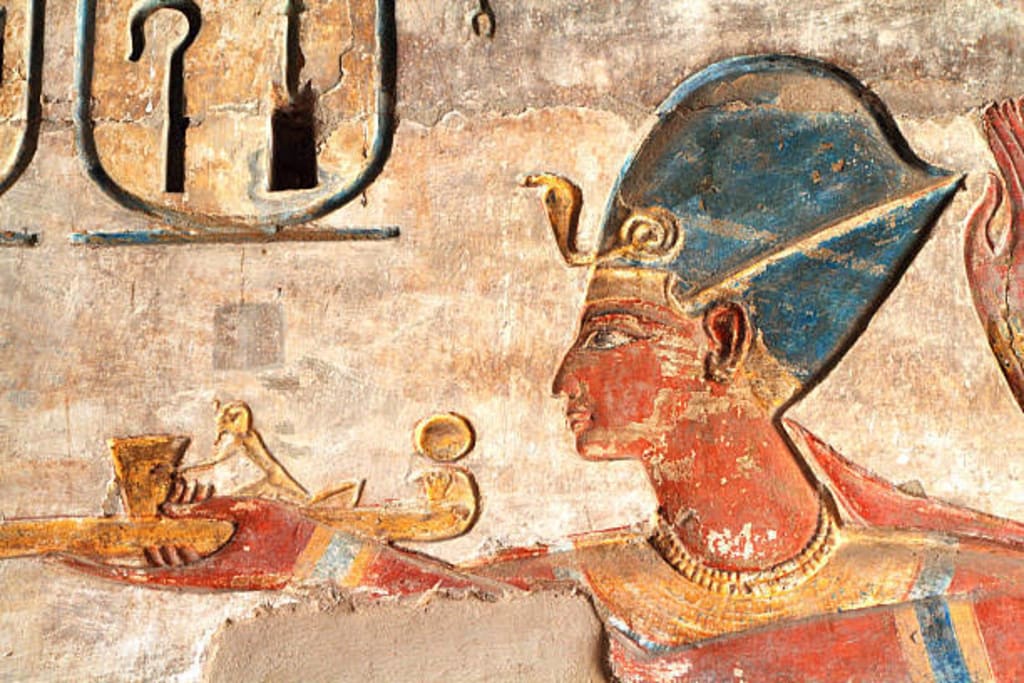
Nestled within the prestigious halls of the Cairo Museum is one of the most remarkable sculptures from ancient Egypt – a triad statue that represents King Ramses III flanked by two of Egypt’s most significant deities: Horus, the god of kingship and the sky, and Seth, the god of chaos and the desert. This statue, carved from a rare grizzled granite stone, is more than just a piece of art. It is a magnificent testament to the skill of ancient Egyptian artisans, their deep religious beliefs, and their reverence for the divine kingship embodied in their rulers.
The piece is considered one of the finest examples of ancient Egyptian sculpture, not only for its subject matter but also for the complexity of its craftsmanship. The stone itself – grizzled granite – was a challenging material to work with due to its hardness. Yet, the sculptors managed to create a highly detailed, expressive piece that stands as a monument to the height of Egyptian artistry and religious symbolism.
The Historical Context of Ramses III
Ramses III, often regarded as the last great pharaoh of Egypt's New Kingdom, ruled from 1186 to 1155 BC, during a time of considerable internal strife and external threats. His reign was marked by a series of invasions from foreign forces, most notably the Sea Peoples, whom he famously repelled in the Battle of the Delta. Though he succeeded in maintaining Egypt’s borders and power, his later years were overshadowed by palace intrigue, economic difficulties, and a failed assassination plot known as the "Harem Conspiracy."
Despite these challenges, Ramses III worked diligently to preserve the religious and cultural traditions of Egypt. He engaged in numerous building projects, restoring temples, constructing monuments, and dedicating offerings to the gods. His devotion to the gods is clearly illustrated in this masterpiece, where he is placed between Horus and Seth, symbolizing his divine right to rule and his position as the mediator between order and chaos.
Symbolism: Horus, Seth, and Divine Kingship
The triad statue is a powerful expression of the duality inherent in Egyptian kingship. Horus, on one side of Ramses III, was the god associated with the throne of Egypt. Represented as a falcon or a man with a falcon's head, Horus symbolized the divine authority of the pharaoh and the continuity of the Egyptian state. Every pharaoh was seen as the earthly incarnation of Horus, responsible for upholding maat – the ancient concept of cosmic order, truth, and justice.
On the other side of the king stands Seth, the god traditionally associated with chaos, storms, and the desert. While Seth is often viewed as a malevolent force, particularly due to his role in the murder of his brother Osiris, the Egyptians also believed he played an essential role in maintaining balance in the universe. Without chaos, there could be no order; without Seth, Horus’ rule could not be fully realized.
In placing Ramses III between Horus and Seth, the sculpture conveys the pharaoh’s role as the one who balances these opposing forces. He is not just a mortal ruler but a divine mediator, maintaining harmony in both the heavens and on earth. The highest ranks of coronation and priesthood are symbolized here, showing that the pharaoh’s power was not only political but also deeply spiritual.
The Complex Craftsmanship
The artistic complexity of this statue is immediately evident in its material. Grizzled granite, a rare and challenging stone to work with, requires tremendous skill to carve. Unlike softer stones like limestone or sandstone, granite is unforgiving, making it difficult to achieve the detailed facial features, the intricate headdresses, and the fine textures seen in the clothing and hieroglyphic inscriptions of the statue.
The sculptors of ancient Egypt, however, were undaunted by the difficulty of working with granite. Their ability to work this material to such precision speaks to their mastery of stone-working techniques. They used copper and bronze tools, along with abrasive materials like quartz sand, to gradually chip away at the granite and create smooth, polished surfaces.
The fact that this statue features not just one figure, but three, each with distinct details and proportions, further underscores the remarkable skill involved in its creation. Carving a single statue from granite is already a complex task, but creating a triad figure, with each part harmoniously integrated into the whole, required extraordinary vision and technical ability. This complexity elevates the piece from a mere representation of figures to a true masterpiece of ancient sculpture.
The Legacy of the Statue
Today, the triad of Ramses III, Horus, and Seth continues to captivate historians, archaeologists, and art enthusiasts. Its placement in the Cairo Museum allows modern audiences to appreciate not only the religious and political significance of the piece but also the incredible craftsmanship behind it. As an artifact, it tells us much about the values of ancient Egyptian society, where religion, kingship, and art were inextricably linked.
Ramses III’s position between Horus and Seth reflects the ancient Egyptian belief in the pharaoh as the divine intermediary. He was tasked with maintaining the balance between order and chaos, a role that was as much spiritual as it was temporal. The meticulous detail of the sculpture, carved from an unforgiving material, is a tribute to the artisans’ skill and the importance of Ramses III’s reign.
As we gaze upon this ancient masterpiece, we are reminded of the extraordinary accomplishments of the Egyptian civilization. From their mastery of stone-working to their sophisticated religious symbolism, the Egyptians created works that continue to resonate with us, thousands of years later, as symbols of the complexity and beauty of human culture.
About the Creator
Keep reading
More stories from Deji Akomolafe and writers in History and other communities.
The Legacy of Tupac Amaru: From Incan Resistance to Modern Symbolism
The name “Tupac Amaru” echoes through history as a powerful symbol of resistance, courage, and sacrifice. It originates with the last indigenous Inca leader to challenge the Spanish colonizers, Tupac Amaru I, whose execution marked the end of the Inca resistance in South America. His legacy, however, did not end with his death. Centuries later, Tupac Amaru II emerged as another champion of indigenous rights, leading a massive rebellion against the Spanish rule in the region now known as Peru. Both men, killed and martyred for their efforts, left an indelible mark on history, shaping the identity of the Andean people and becoming enduring symbols of defiance against oppression.
By Deji Akomolafeabout a year ago in History
Frozen Ground
Silence meant the guns were cooling. It meant men were waiting. It meant something was about to break. We were dug in along a frozen stretch of road near the Imjin River, the kind of place that didn’t look important until history decided otherwise. The cold wasn’t just uncomfortable—it was personal. It crept into your boots, your bones, your thoughts. At night, I dreamed of heat: radiators, kitchens, the smell of coffee. I woke up with frost on my helmet.
By Gaofeng Wang5 days ago in History
Miss Persephone's Manual to a Seemingly Ordinary Life
Miss Persephone was found at the dining table, her blue eyes swollen, her tears arriving and retreating like the tides of the ocean. Earlier that day, her family had visited her in the retirement home where she had lived for eight years. It was her eightieth birthday.
By Imola Tótha day ago in Fiction




Comments
There are no comments for this story
Be the first to respond and start the conversation.