
Researchers think they have finally discovered the cause of the extinction of dinosaurs.
We were aware that the end of the dinosaur era was predicted by an asteroid. Researchers now claim to have identified a crucial component in their extinction.

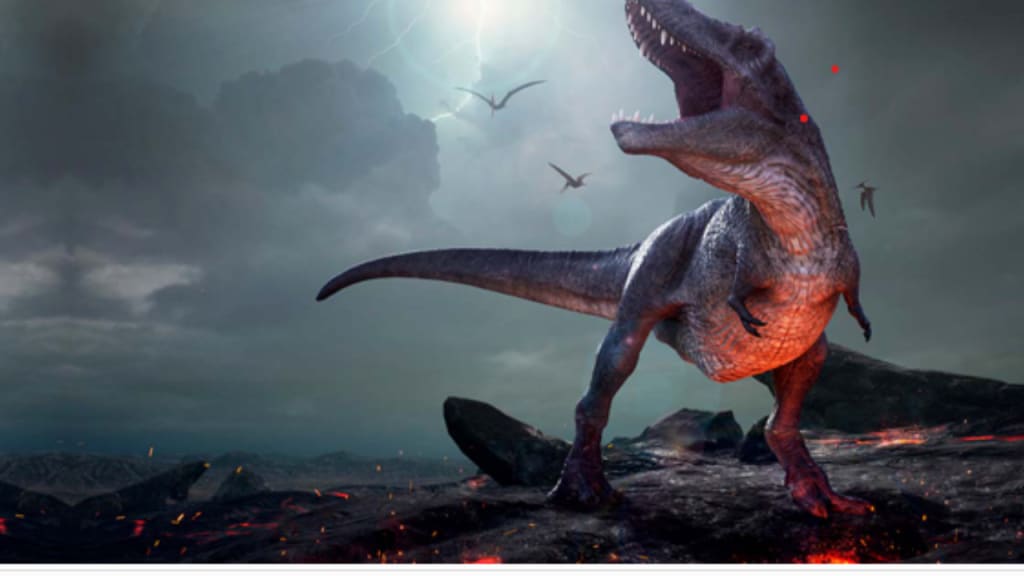
Long-held theory is that an asteroid hit terminated the dinosaur era, but new research suggests that one crucial component may have been more important than previously believed.
About 66 million years ago, the Yucatan Peninsula in Mexico was struck by an asteroid that was between 10 and 15 kilometers large. The impact of the asteroid wrought destruction, triggering megatsunamis, earthquakes, and wildfires, ultimately causing the ecology that supported life to collapse.
Researchers estimate that, although these additional effects would have gravely damaged hundreds of dinosaur species, earlier research had overlooked the significance of an additional effect: millions of tonnes of dust that might have been launched into the atmosphere when
Dark clouds of silicate dust and sulfur were said to have been spinning throughout the atmosphere, shutting out the sun's rays and causing the entire surface temperature to drop by as much as 15 degrees Celsius. This is why Belgian researchers believe that the asteroid produced a "global winter."
The absence of light would have made it difficult for plants to thrive, which would have led to the starvation of herbivores, the loss of prey for predators, and the mass extinction of 75% of species at all levels of the food chain.
It's estimated that 2,000 gigatonnes of dust—more than 11 times the mass of Mount Everest—were strangling the atmosphere. Simulated sediment from a North Dakota fossil site was used by researchers. They discovered that the dust may have prevented plants from photosynthesizing for up to two years and may have remained in the atmosphere for fifteen years, ultimately leading to the collapse of the natural ecosystem.
According to the findings, the dinosaurs were gradually wiped out over a few years by the asteroid, despite suffering a catastrophic initial hit. According to some scientists, the repercussions of the asteroid crash could be comparable to those of an Earth-shattering nuclear explosion.
Researchers, led by Professor Cherly Harrison of Louisiana State University, predicted last year that smoke and black carbon would be released into the atmosphere, obstructing the sun and causing a "Nuclear Little Ice Age."
Even though the dinosaurs came to a terrible end some 66 million years ago, their extinction might have been essential to the evolution of the human species. Planetary scientist and research co-author Philippe Claeys stated, "Dinos dominated Earth and were doing just fine when the meteorite hit."
"Without the impact, my guess is that mammals - including us - had little chance to become the dominant organisms on this planet." Even though the powerful dinosaurs were incredibly resilient, they were unable to withstand the devastating climate catastrophe caused by the collision of a massive asteroid with the ocean off the shore of the Yucatan Peninsula in Mexico about 66 million years ago. A study that was published in the journal Nature Geoscience has provided new insight into the reasons why the dinosaurs were destined to perish as a result of this extraordinarily violent and destructive catastrophe. There have always been doubts about the precise sequence in which the extinction of these enormous beasts transpired after the asteroid strike.
It appears that the collapse of the food chain as a whole after this catastrophe, which left the Earth as a vast wasteland and almost wiped out all life on the planet permanently, ultimately did in the dinosaurs, as this fascinating new study demonstrates.
The "Death" of the Sun and the Dinosaurs Due to the Chicxulub Asteroid Seventy-five percent of all plant, animal, and insect species have completely disappeared as a result of the Chicxulub asteroid, which crashed with Earth about 66 million BC. Researchers studying extinction scenarios and climate change associated with this cosmic episode have concentrated on the possibility that high atmospheric sulphur concentrations contributed to the nearly uninhabitable state of Earth.
A remarkable 112-mile (180 km) wide impact crater in the shallow waters of the Gulf of Mexico was created by the Chicxulub asteroid, which is thought to be the largest asteroid to ever crash into Earth. Between 30 and 500 gigatons of sulfur were spewed into the Earth's skies as a result of this intense collision.
The asteroid only hastened the inevitable extinction of dinosaurs. Research Begins on a Crater That Could Explain the extinction of dinosaurs A 65 million-year span
This is an unfathomably large amount of this element, which, when exposed to other gases in the atmosphere, became sulfate aerosols. These dense gases were dispersed throughout the entire planet.
They prevented so much when combined with the smoke from raging flames. worldwide temperatures decreased by between 3.6 and 14.4 degrees Fahrenheit (two to eight degrees Celsius), depending on the area, as a result of the sun's heat not reaching the surface.
Cold-blooded creatures like the dinosaurs would have perished from such temperature drops. This apparent reality led one to believe that the global cooling brought on by sulfur was the primary cause of their extinction.
These experts attribute the extinction of the dinosaurs and other plant and animal species to the fine dust created from crushed rock that was sent high into the earth's atmosphere near the site of the asteroid impact. The planet's surface experienced extreme darkness for two years due to the thickness of the dust cover, which reduced the amount of light that could pass through the dust.
The Belgian scientists claim that although the planet's temperature increases were awful, the loss of surface sunlight was considerably more disastrous. The photosynthetic process in plants would have abruptly stopped everywhere in the absence of sunshine, endangering all plant life as we know it.
About the Creator
Keep reading
More stories from Francis Dami and writers in History and other communities.
Nanchang: A Modern Symbol of China’s Naval Power
In recent years, the world has closely watched the rapid modernization of the Chinese People’s Liberation Army Navy (PLA Navy). One of the most important symbols of this transformation is the Nanchang (Hull 101), China’s first Type 055 guided-missile destroyer. Commissioned on 12 January 2020, Nanchang represents a major leap in naval technology and capability. As it completes six years of active service, the ship stands as a clear example of how China’s navy has moved into a new era of advanced maritime power.
By sehzeen fatima6 days ago in History
Where the Pulse Ends
© 2026 Sai Marie Johnson The humidity in the city didn’t just hang; it leaned. It was a thick, stagnant soup of diesel exhaust, ozone, and the metallic tang of blood that drifted from the "Compliance Zones." Joe sat in his rusted sedan, his hands resting loosely on the steering wheel. He wasn't gripping it. He wasn't angry. Anger was a chemical spike, a biological inefficiency. Joe was simply... focused.
By Sai Marie Johnson3 days ago in History
Ludacris and Nelly draw backlash over bookings at MAGA-coded music festival
Ludacris and Nelly headlining a mostly right-wing event is good for them. It’s also great for the genre of hip hop. The two rap veterans have showcased their talents on other stages. Why can’t they perform for mostly MAGA folks and grab that bag?
By Skyler Saunders4 days ago in Beat




Comments
There are no comments for this story
Be the first to respond and start the conversation.