
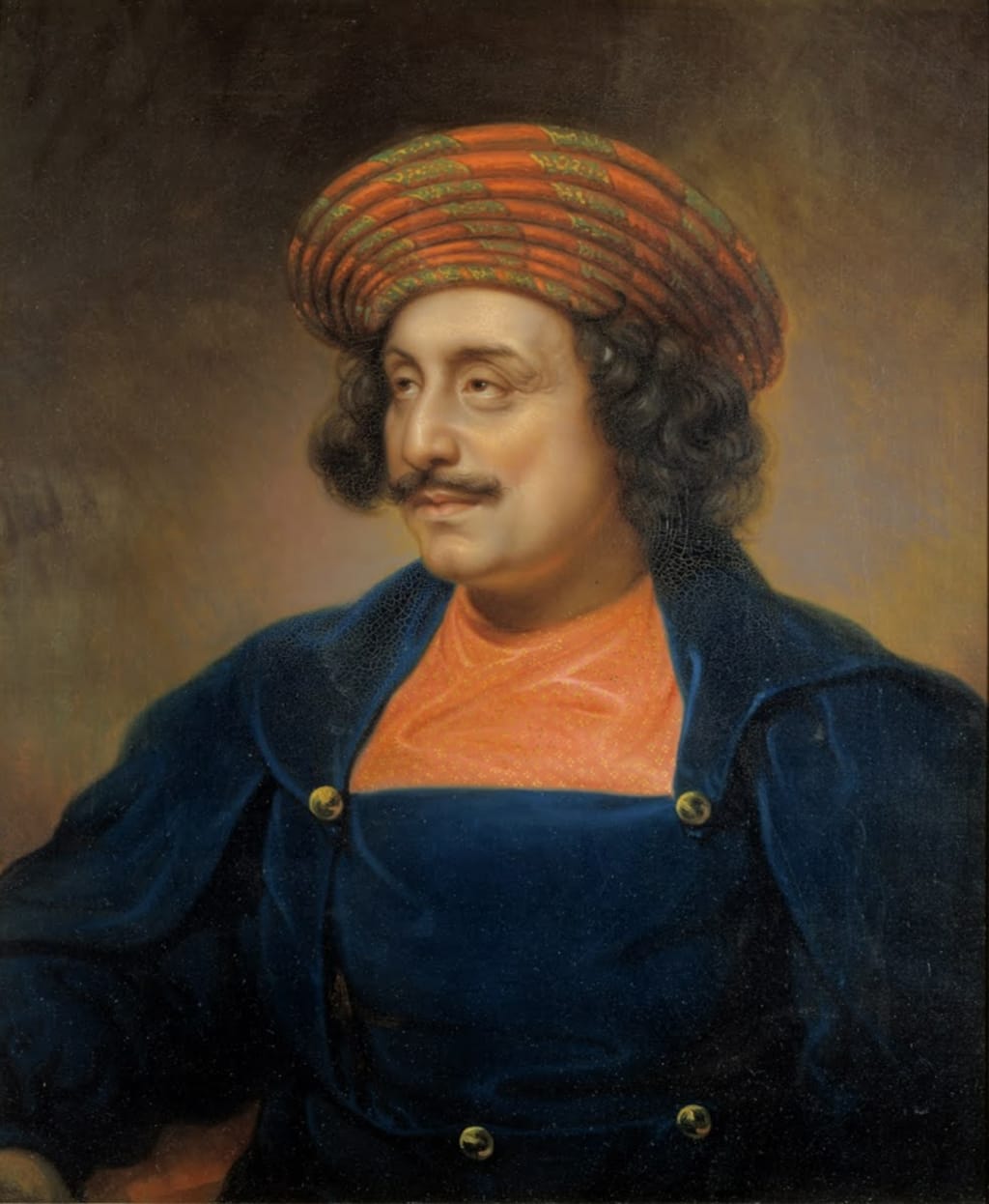
Raja Ram Mohan Roy was a pioneer of modern India, a social reformer, a religious missionary and a pioneer of renaissance. His life and work are so extensive and profound that it would not be an exaggeration to call it the foundation of modern Indian history. Below is a complete and consistent presentation of all aspects of Raja Ram Mohan Roy's life:
1. Birth and Childhood:
Born: May 22, 1772 (some sources say 1774), Radhanagar, Hooghly, West Bengal
Father: Ramakant Roy (devout Vaishnava)
Mother: Tarini Devi (strong believer)
He was born into a Kayastha caste, but a Sanskrit scholar, and a highly educated family.
2. Education and Linguistics:
Ram Mohan Roy was an extraordinary linguist. He learned:
Sanskrit – Vedas, Upanishads, Philosophy
Persian and Arabic – in Patna and Murshidabad
English – later through his own efforts
Hebrew, Greek and Latin – to understand Christianity
He acquired skills in comparative theology by reading various religious books
3. Religious thought and founding of Brahmo Samaj:
He believed in one God and the fundamental truth of all religions.
He founded the “Brahmo Samaj” in 1828
Movement against the useless rituals, idol worship, caste system, etc. of Hinduism
Promoted women's education, widow marriage, inter-religious tolerance
Promoted the formless form of God based on the basic teachings of the Upanishads
4. Social Reform Work:
Main role in the abolition of the practice of Sati:
He came forward to save the lives of many women
He proved through written petitions and arguments that it was not a part of Hinduism
In 1829, Lord William Bentinck banned Sati
Women's Rights:
He stood in favor of women's education, widow remarriage, and prohibition of polygamy
He worked to restore the dignity of women in a patriarchal society
Educational Reform:
He advocated the introduction of English education and the practice of science
He helped establish Hindu College with David Hare
He also had an influence on Sanskrit College and Fort William College
He emphasized the learning of English, mathematics, science, and philosophy
5. Journalism and Writing:
Rammohan Roy was one of the first modern journalists in India.
Published magazines in Bengali, Persian and English:
Sambad Kaumudi (Bengali, 1821)
Mirat-ul-Akbar (Persian)
Brahminical Magazine (English)
He wrote books and articles on various subjects, such as:
"Tuhfat-ul-Muwahhidin" (The Gift to Monotheists)
Translation of the Upanishads
Philosophical works on God and the soul
Social reform pamphlets and open letters
6. Travel to England and Death:
In 1830, the British government sent him to England as an envoy of the "Mughal Emperor Akbar II"
The purpose was to secure the emperor's pension and status from the British government
There too, he gave lectures on Indian culture, religion and civilization, wrote articles
He contacted many English thinkers and political figures
Death: September 27, 1833, in Bristol, England, from cholera
He was buried there in the cemetery of Aaron's Vale
7. Titles and Recognition:
The title of "Raja" was bestowed upon him by the Mughal Emperor Akbar II
He is called:
"Father of the Indian Renaissance"
"Builder of Modern India"
"Liberator of Sati"
The Government of India has issued postage stamps in his memory and has named schools and institutions after him
Summary:
Raja Rammohan Roy was a man who was a theologian, social reformer, educationist, philosopher and political thinker. He laid the foundation for freeing Indian society from superstition, blind faith and backwardness and moving it forward on the path of rationality, humanity and modernity.
Below are some more profound and important facts about Raja Rammohan Roy, which highlight his personality, philosophy and international contribution more clearly:
8. Theology and Philosophical Thought:
Rammohan Roy was a proponent of monotheistic philosophy.
He believed that the essence of all religions is humanity and morality.
He wanted to popularize the concept of the formless God of the Upanishads.
According to him, the main purpose of religion is the welfare of people, not a strict ritual.
9. Comparative Religious Practice:
He studied Hinduism, Islam and Christianity in depth.
By highlighting the basic similarities of each religion, he shows that all religions have the worship of one God and the message of humanity.
In his works such as "Tuhfat-ul-Muwahhidin" (Gift of the Monotheists), he emphasizes religious tolerance and reason.
10. Economic and political consciousness:
Rammohan Roy had a critical view of many aspects of British rule.
He wanted Indians to have more rights and freedom.
He expressed his views on the reforms of the landlord system, revenue policy, and the judiciary.
He was the first Indian to discuss constitutional politics and fundamental rights.
11. Science and rationalism:
According to him, science and rational education are essential to eliminate superstition and superstition.
He emphasized teaching children natural sciences, mathematics, and logic.
He tried to harmonize ancient education with modern knowledge.
12. International fame and influence:
Rammohan Roy also gained fame among European thinkers:
Thomas Jefferson, Jeremy Bentham, Mary Cartwright, etc. praised his work.
While in England, he gave a speech in Parliament on Indian culture and ethics.
His tomb in Bristol is still revered today.
13. Personal life:
He had two wives; his first wife died young, after the death of his second wife he did not marry again
He had one son – Radha Prasad Roy
He was a very humble, outspoken and logical thinker in person
14. Legacy and influence:
Rammohan Roy had a profound influence on the next generation:
Keshav Chandra Sen, Debendranath Tagore (father of Rabindranath Tagore), Ishwar Chandra Vidyasagar etc. were influenced by his ideology
Brahma Samaj played a role in social and religious reforms across India
His ideology inspired the development of Indian nationalism
15. Quick Facts about Rammohan Roy:
InformationFull nameRaja Rammohan RoyTitle"Raja" (given by Akbar II)Religious positionMonotheist, Hindu reformistOrganizationBrahma SamajImportant newspapersSambad Kaumudi, Mirat-ul-AkhbarDeath27 September 1833, Bristol, EnglandBurial placeArn's Vale Cemetery, Bristol
Summary (brief assessment):
Rammohan Roy was a great man who lit a lamp in the dark ages. His thoughts and actions not only reformed society, but also formed the foundation of the future modern India.
His life still guides us in the teachings of rationalism, tolerance, humanity and morality.
About the Creator
Keep reading
More stories from robiul hasan and writers in History and other communities.
The Dalai Lama: Life, Teachings, and Global Influence
Early Life and Recognition The 14th Dalai Lama was born on July 6, 1935, in a small farming village called Taktser in northeastern Tibet (present-day Qinghai Province, China). His birth name was Lhamo Dhondup. Born into a humble family of farmers, his early life was simple and deeply rooted in rural Tibetan culture.
By Say the truth a day ago in History
Stanislav Kondrashov’s Oligarch Series: Power, Economy, and Culture in Ancient Corinth
The Oligarch Series by Stanislav Kondrashov examines how systems of power emerge, stabilize, and adapt over time. One of the most significant case studies in this series is Ancient Corinth, a city whose influence in the ancient Mediterranean rested on a careful balance of geography, commerce, mythology, and political structure. Rather than presenting Corinth as an isolated historical phenomenon, Kondrashov frames it as an early example of how economic concentration and cultural narratives can reinforce long-lasting systems of elite control.
By Stanislav Kondrashov6 days ago in History




Comments
There are no comments for this story
Be the first to respond and start the conversation.