
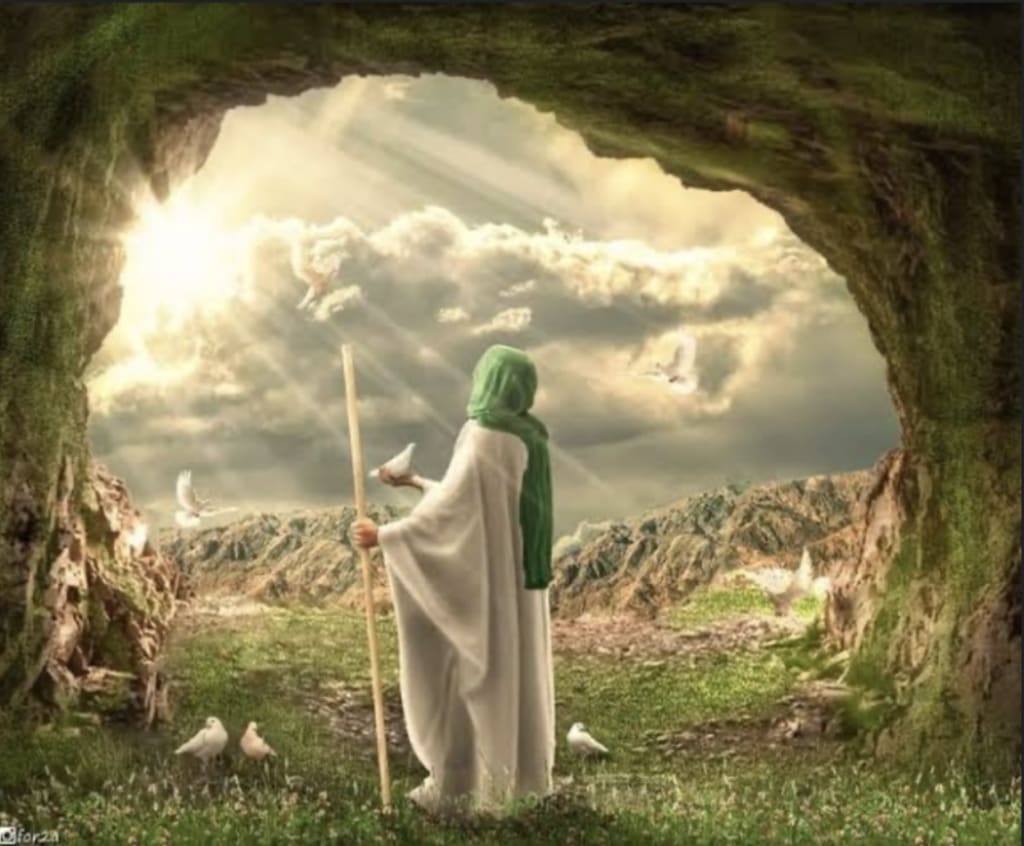
The first man on Earth, according to various religious and mythological beliefs, is often attributed to Adam in the Abrahamic religions such as Judaism, Christianity, and Islam. These traditions hold that Adam was the first human created by God and is considered the ancestor of all humans.
In Islam, according to some interpretations, Hawa (Eve) was created from Adam. It is believed that Hawa was created from one of Adam's ribs to be his companion. This story is mentioned in the Quran and is a significant part of Islamic teachings about the creation of humanity.
According to Islamic beliefs, Adam was created by Allah in Paradise (Jannah), which is considered a place of beauty and perfection.
In Islam, the creation of Adam holds great significance as it is believed to be the beginning of humanity. Adam is considered the first prophet and the first human being created by Allah. His creation symbolizes the power and wisdom of Allah in shaping and guiding human existence. Adam's story also teaches important lessons about obedience, repentance, and the consequences of human actions.
In Islam, Adam and Hawa (Eve) were sent down from Jannah (Paradise) to Earth after they ate from the forbidden tree. This event is known as the Fall of Adam and Eve, and it marks the beginning of their life on Earth according to Islamic teachings.
When Adam and Hawa were sent down to Earth, they began their life on Earth by seeking forgiveness from Allah for their mistake in eating from the forbidden tree. They repented and asked for guidance, showing the importance of seeking forgiveness and turning back to Allah after making mistakes.
In Islamic beliefs, Adam and Hawa had children after they were sent down to Earth. Their children were born on Earth after they started their life outside of Paradise.
Yes, Adam and Hawa had both sons and daughters. According to Islamic tradition, they had several sons and daughters who went on to populate the Earth.
During the time of Adam and Hawa, the system of marriage was based on the union between a man and a woman. The concept of marriage as a sacred bond between a man and a woman was established early on in human history, and it was a way to form families, procreate, and maintain social order. The details of the marriage system at that time are not extensively detailed in Islamic teachings, but the basic principles of commitment, partnership, and family formation were likely present even in the early days of humanity.
Adam lived for several hundred years according to Islamic tradition. His exact age is not explicitly mentioned in the Quran, but it is believed that he lived for around 930 years.
Adam lived for such a long time, around 930 years, according to Islamic tradition, because in the early days of humanity, people had longer lifespans. It is believed that as generations progressed, lifespans gradually decreased over time. This extended lifespan of Adam and some other early figures in history is seen as a unique aspect of that era.
In that era, there were several unique aspects, such as the direct communication between Allah and some of the early prophets like Adam. Additionally, the presence of angels interacting with humans was more common, and the knowledge and guidance provided to people were more direct and immediate. The environment was different, and the rules and laws governing human behavior were sometimes more explicit and direct.
In the era of Adam and Hawa, the environment was believed to be different from the present era. It is described as a time when nature was more pristine and the Earth was in a state of harmony. There are accounts of a more lush and fertile environment with abundant resources. The climate was said to be moderate, and there was a sense of tranquility and balance in nature. This era is often depicted as a time of purity and simplicity before the challenges and changes that followed.
In Islamic tradition, Adam is described as having been created with a tall stature, a strong build, and a radiant appearance. He is often depicted as being handsome and dignified, with a noble and majestic presence. Adam is believed to have been created in the best form and endowed with qualities that reflected his status as the first human being and the father of humanity.
In Islamic teachings, Adam plays a significant role as the first human being and the father of humanity. He is considered a prophet and a messenger of Allah who was chosen to lead and guide mankind. Adam's story serves as a lesson in humility, repentance, and the consequences of disobedience. His creation, life, and experiences are often cited to emphasize the importance of faith, obedience to Allah, and the consequences of sin.
Adam's story relates to everyday life by teaching us important lessons about humility, repentance, and the consequences of our actions. Just like Adam, we are all created with the potential to make mistakes but also with the ability to seek forgiveness and learn from our experiences. His story reminds us of the importance of staying connected to our faith, being grateful for our blessings, and striving to live a life of obedience and righteousness. It serves as a guide for us to navigate the challenges and temptations we face in our daily lives.
In modern life, we can apply the lessons from Adam's story by reflecting on the importance of humility, seeking forgiveness when we make mistakes, and striving to maintain a strong connection with our faith. Just like Adam faced challenges and tests, we too encounter difficulties in our daily lives. By learning from Adam's story, we can understand the significance of staying true to our beliefs, being grateful for our blessings, and taking responsibility for our actions. Ultimately, applying the teachings from Adam's story can help us lead a more conscientious, purposeful, and spiritually fulfilling life in the modern world.
About the Creator
Keep reading
More stories from Amina Afta and writers in History and other communities.
The Attack of Terrorist
The tragic events of September 11, 2001, commonly referred to as 9/11, left an indelible mark on New York City and the entire nation. The devastation caused by the terrorist attacks on the World Trade Center not only altered the physical landscape of the city but also profoundly impacted the lives of countless individuals. The sight of the Twin Towers collapsing, the heroic efforts of first responders, and the overwhelming loss of life created a collective sense of shock and grief that reverberated across the country.
By Amina Afta 2 years ago in History
The Invasion of Kuwait: Saddam’s Four-Day ‘Revolutionary Republic
On August 2, 1990, the world woke up to a geopolitical earthquake. Under the orders of Saddam Hussein, over 100,000 Iraqi troops, backed by hundreds of tanks, surged across the border into the tiny, oil-rich emirate of Kuwait. While history remembers this as the spark for the Gulf War, the first few days of the occupation featured a bizarre political theater: the creation of a short-lived puppet state known as the **"Republic of Kuwait."**
By Irshad Abbasi a day ago in History




Comments (2)
Interesting and amazing article
Thanks for sharing