
Prometheus of Ancient Greek Mythology
The First Book of Ancient Greek Mythology.

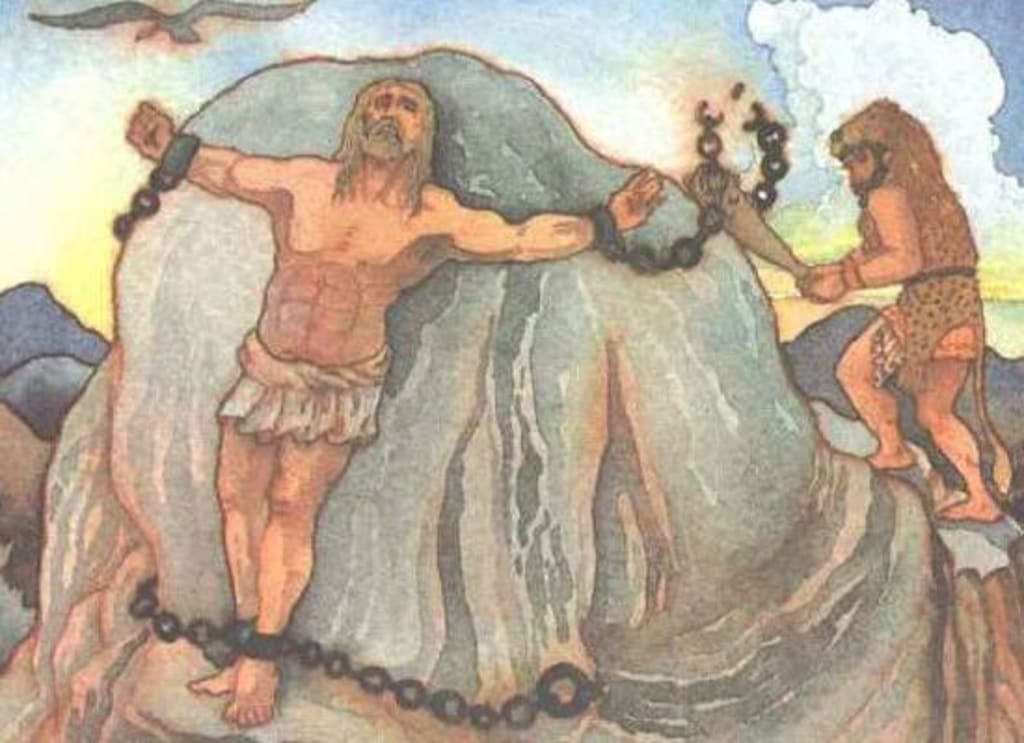
The heavens and the earth were created, and the waves of the sea rose and fell and lapped against the shore. Fish frolicked in the water and birds sang in the air. The earth was teeming with animals, but there was not yet a single higher being with a soul that could dominate the world around it. At this time Prometheus was born, a descendant of the ancient race of gods banished by Zeus, the son of Iapetus, born of Caius, the mother of the earth, and Uranus. Intelligent and wise, he knew that the seed of the gods was in the clay, so he took up the clay,
moistened it with river water, mixed it, and formed it into a human form in the likeness of the god of the world, the god of the heavens. To give life to this clay man, he took the two characters, good and evil, from the souls of animals, and sealed them into the human breast. Among the gods of heaven he had a girlfriend, Athena, the goddess of wisdom; and marvelling at this creation of the son of the Titan god, she breathed her divine breath upon the clay man with half a soul, and gave it spirituality.
In this way the first men appeared in the world, and they multiplied, and soon formed a great multitude, which spread everywhere. But for a long time they did not know how to use their limbs, nor their divinely given souls. They turned a blind eye and a deaf ear, like human forms in a dream, and walked about aimlessly, but did not know to play their part. They do not know how to quarry stone, burn bricks, cut down forest trees to make rafters and beams, and then build houses out of these materials. Like ants, they hibernated in sunless holes and did not perceive the winter or the spring or the summer; they did everything without a plan.
So Prometheus came to the aid of his creatures. He taught them to observe the rising and setting of the sun, the moon and the stars; he invented numbers and writing for them, so that they could calculate and exchange ideas in words; he also taught them to drive animals to share their labour, so that they knew how to harness a horse to pull a cart or use it as a mount. He invented the ship and the sail to enable them to navigate the sea. He cared for every other activity in human life. Once upon a time, sick people did not know how to cure themselves with medicines, how to apply ointments or take pills to ease their pain, and many sick people died miserably for lack of medical care. Now Prometheus taught them to make potions to combat various diseases. In addition, he taught them to divine, to fulfil dreams, to interpret the flight of birds and the various signs shown by sacrifices. He guided them in prospecting for minerals underground so that they could discover ores and mine iron and gold and silver. He taught them the art of farming so that they could live more comfortably.
Not long ago, Zeus banished his father, Cronus, and overthrew the ancient race of gods from which Prometheus came. Now that Zeus and his sons were the new rulers of the heavens, they began to take notice of the newly formed human race. They demanded that mankind honour them, and in doing so, they protected mankind. One day, in Mercogne, Greece, the gods assembled and conferred to determine the rights and duties of mankind. Prometheus attended the meeting as the defender of mankind. At the meeting, he managed to keep the gods from making harsh sacrificial conditions for promising to protect mankind. This son of Titan was determined to use his wisdom to deceive the gods. He slaughtered a large bull on behalf of his creation and asked the gods to choose their favourite part. He cut the sacrificial bull into pieces and divided it into two piles. One pile was filled with meat, offal and fat, covered with cowhide and topped with the stomach of the bull; the other pile contained all the bones of the bull, skilfully wrapped in the slate oil of the bull. This pile was somewhat larger than the other. Zeus, the all-knowing father of the gods, saw through the trickery and said, ‘Son of Iapetus, honourable king, my good friend, how unfairly you have divided the offerings!’ At this Prometheus, more and more convinced that he had deceived Zeus, laughed secretly and said, ‘Honourable Zeus, eternal father of the gods, pick a heap as your heart desires!’ Zeus was furious in his heart, but deliberately stretched out his hands for the snow-white slate oil. When he peeled off the oil and saw that it was all polished bones, he said angrily, as if he had not realised that he had been deceived until now, ‘I see, son of Iapetus, that you have not forgotten your trick of deception!’
About the Creator
Keep reading
More stories from Zhu Wilhelm and writers in History and other communities.
Situational art: a game-changing approach to task management
Imagine you've just run out to pick up your dry cleaning before a business trip tomorrow. You remember needing to do something else, but you can't remember exactly what. Sitting in the car park, you flip or scroll page after page through all your to-do lists trying to find it. A few minutes go by and you can't find it. Frustrated, you give up and just say you'll deal with it later.
By Zhu Wilhelm10 months ago in Art
The Deeds of Mullah Nasiruddin
The Deeds of Mullah Nasiruddin (Article No. 1270) Mullah Nasiruddin is a name that almost everyone has heard. His stories are famous across cultures for their humor, wisdom, and clever twists. Although he appeared simple and playful, Mullah Nasiruddin possessed sharp intelligence and deep insight. His actions often carried hidden lessons that made people laugh first and think later. The following incidents from his life highlight his wit, presence of mind, and moral intelligence.
By Sudais Zakwanabout 11 hours ago in History
The Quiet Collapse of Global Arms Control
The Quiet Collapse of Global Arms Control For decades, arms control agreements helped prevent the world’s most powerful weapons from spiraling out of control. Treaties limited nuclear stockpiles, increased transparency, and built fragile trust between rival states. Today, that system is quietly unraveling—and its collapse may define the next era of global insecurity.
By Wings of Time 4 days ago in History
Autonomy Is The Real Privilege
Good morning, freedom-seekers! Today we’re gonna be looking at autonomy. A strange word, I know; one many would probably look at blankly and run away from on sight. We’re gonna figure out what it actually means, consider how it’s achieved, and decipher just how deeply most of us are tangled up in dependence without realising it.
By That ‘Freedom’ Guy2 days ago in Humans



Comments
There are no comments for this story
Be the first to respond and start the conversation.