
Princes in the Tower Mystery
Shocking New Evidence Reveals Richard III’s Role in Princes in the Tower Mystery


The Tower of London, a stone sentinel on the banks of the Thames, stands as a testament to centuries of history, holding within its walls some of the darkest secrets of the past. Among the most enduring mysteries is the disappearance of the Princes in the Tower. In 1483, young Edward V, the rightful King of England, and his younger brother Richard, Duke of York, mysteriously vanished within these forbidding walls. Their fate remains one of history's most perplexing unsolved cases.
The boys, just 12 and 9 years old, were placed in the Tower by their uncle, Richard, Duke of Gloucester, under the pretext of protection. However, Richard soon declared himself King Richard III, casting a long shadow of suspicion over the princes’ disappearance. For centuries, theories have abounded—were they murdered, and if so, at whose command?
In 1674, the bones of two children were found and interred in Westminster Abbey as those of the princes, but without definitive proof, the passage of time only deepened the mystery. The princes' disappearance sent shockwaves through 15th-century England. Richard III, having claimed the throne, became the primary suspect, as his own legitimacy was already questioned, with rumors of illegitimacy surrounding the House of York. The disappearance of his nephews—the rightful heirs to the throne—only added fuel to the flames of suspicion.
While some historians argue that Richard had no reason to harm the boys and may have even planned to release them, circumstantial evidence has long pointed toward his guilt. The timing of their disappearance, just after Richard's coronation, seemed incredibly convenient. Furthermore, Richard had both the motive and the means to eliminate potential rivals to his newly acquired throne. For centuries, the narrative of Richard III as the villainous usurper responsible for the deaths of his nephews has persisted. However, recent historical investigations, bolstered by new discoveries, have started to challenge this widely accepted belief.
Enter Professor Tim Thornton, a historian with a sharp eye for detail and a passion for uncovering the hidden truths of history. His research led him to an unexpected source: the will of Margaret Capel, a lady-in-waiting to Elizabeth of York, the princes' mother. Among the detailed inventory of Capel’s possessions, Professor Thornton uncovered a remarkable find—a bequest mentioning a royal chain of office. This was no ordinary piece of jewelry. Royal chains of office were symbols of immense power and prestige, granted to individuals in high authority.
The chain mentioned in Capel's will was especially significant, as it had previously belonged to Sir James Tyrell, a close confidant of Richard III. This connection raises tantalizing questions: How did such a valuable artifact come into Margaret Capel's possession? Could this be the missing link that finally unravels the mystery of the princes in the Tower?
Professor Thornton’s discovery opens up intriguing new avenues of investigation. The presence of the royal chain in Capel’s possession suggests a direct link between Sir James Tyrell and the disappearance of the princes. Tyrell, a trusted lieutenant of Richard III, was known for his ruthless ambition, making him a prime suspect. Could Richard III, fearing for the stability of his reign, have entrusted Tyrell with the grim task of silencing his young nephews? The chain, possibly given as a reward or token of silence, may have found its way to Margaret Capel through clandestine channels.
Though further research is needed to solidify this connection, Professor Thornton’s findings offer compelling evidence that may finally bring us closer to the truth behind this centuries-old mystery. The whispers within the Tower of London may soon give way to concrete answers, rewriting the history of one of England’s most enduring enigmas.
About the Creator
ADIR SEGAL
The realms of creation and the unknown have always interested me, and I tend to incorporate the fictional aspects and their findings into my works.
Keep reading
More stories from ADIR SEGAL and writers in History and other communities.
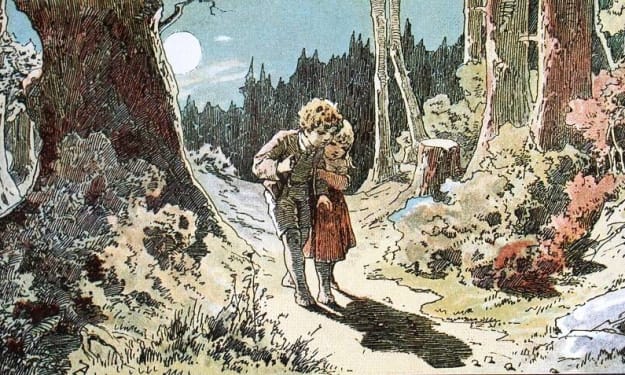
Cannibalism & Witchcraft: The True Story of "Hansel and Gretel"
Most European folktales, when viewed through a modern lens, seem quite disturbing, and Hansel and Gretel is no exception. The original version of the story includes themes of cannibalism, child abandonment, and witchcraft—bizarre elements that make you wonder why such dark subjects were part of a children's tale. The answer is equally surprising: cannibalism, child murder, and witchcraft were unfortunately not uncommon during the time the story was written. Although it’s hard to believe now, in medieval Germany, families sometimes resorted to eating their children, and witch hunts led to the slaughter of thousands. It was a brutal period that many have forgotten, and the story of Hansel and Gretel hides a dark and violent truth.
By ADIR SEGALabout a year ago in History
Thief who stole $3.5 billion but lost all in one phone call part 2
The following year, the owner of Silk Road was arrested and the FBI shut down the website, seizing about 170,000 Bitcoins. However, 51,680 Bitcoins were still missing, and investigators had been trying to trace them for years.
By Imran Ali Shah4 days ago in History
Guard Your Battery
Why are some people so attractive just by standing there? It’s not because they are "likable," but because they don’t need everyone to like them. I realized later that truly charismatic people allow themselves to be criticized, but they never criticize themselves. They never try to please the world; instead, the world stops to watch them.
By Emily Chan - Life and love sharing7 days ago in Poets



Comments
There are no comments for this story
Be the first to respond and start the conversation.