
Cannibalism & Witchcraft: The True Story of "Hansel and Gretel"
The sources of inspiration for Zanzel and Gretel
Most European folktales, when viewed through a modern lens, seem quite disturbing, and Hansel and Gretel is no exception. The original version of the story includes themes of cannibalism, child abandonment, and witchcraft—bizarre elements that make you wonder why such dark subjects were part of a children's tale. The answer is equally surprising: cannibalism, child murder, and witchcraft were unfortunately not uncommon during the time the story was written. Although it’s hard to believe now, in medieval Germany, families sometimes resorted to eating their children, and witch hunts led to the slaughter of thousands. It was a brutal period that many have forgotten, and the story of Hansel and Gretel hides a dark and violent truth.
Before we dive into that, let’s talk a little about the Brothers Grimm. Jacob and Wilhelm Grimm were German scholars who collected and published folktales during their youth. At the time, Napoleon's invasion had fragmented Germany, which led the Grimm brothers to fear for the future of German culture. In an effort to preserve German literature, they began gathering fairy tales, aiming their work not at children, but at fellow academics. Perhaps this is why they weren’t hesitant to include grim
subjects in their tales. Their dedication led them to collect hundreds, if not thousands, of folktales, one of which was Hansel and Gretel. The story was first sourced from a woman named Dorothea Wild, who later became Wilhelm’s wife. Over the years, the brothers made numerous alterations to the tale, modifying the motivations, aesthetics, and messages—many of which became more Christian—but the core of the story remained largely unchanged.
It’s important to note that the version of Hansel and Gretel most people know today might not be identical to the original, as the tale has been retold countless times. Here’s a recap of the original story from the Grimms’ publication:
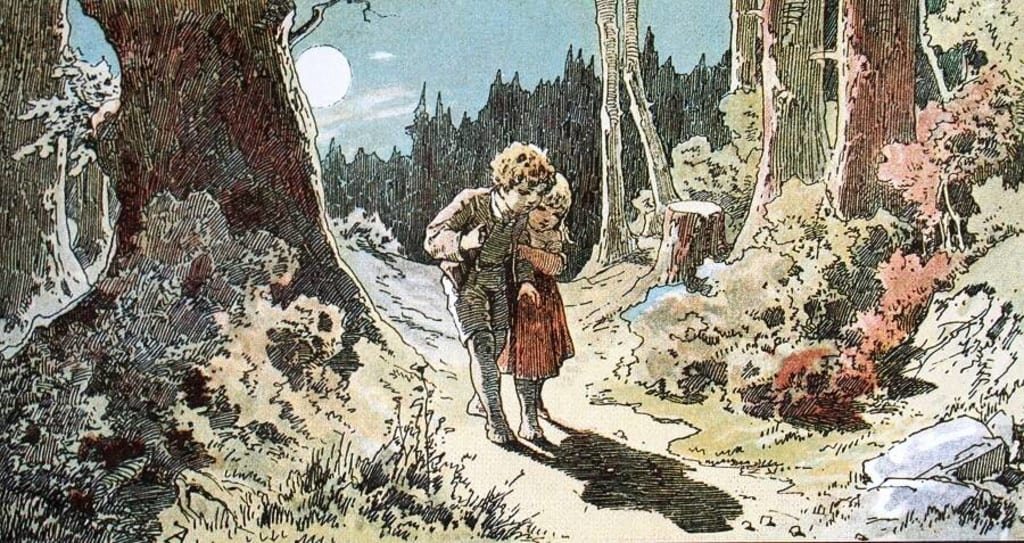
In the story, a poor family in Germany is faced with starvation. The mother convinces the father to abandon their children in the woods, where wild animals will supposedly kill them. Reluctantly, the father agrees, but their son, Hansel, overhears their conversation. The next morning, the parents lead Hansel and Gretel into the forest, but Hansel secretly leaves a trail of pebbles to find their way back. The parents abandon them, but when night falls, Hansel and Gretel follow the pebbles back home
. The father is overjoyed to see them, but the mother is furious. When food runs out again, the mother insists the children must be abandoned once more. This time, Hansel leaves a trail of breadcrumbs, but birds eat the trail. For three days, the children wander through the forest until they find a house made of candy. The woman inside, who seems kind at first, turns out to be a witch who lures children to eat them. She locks Hansel in a cage to fatten him up, while Gretel is forced to work. Eventually, Gretel tricks the witch into checking an oven and pushes her inside, burning her alive. The children steal the witch’s jewels, and eventually find their way home, where they reunite with their father. It’s revealed that their mother has died in the meantime.
Child abandonment and cannibalism are undoubtedly the most shocking elements of the story, but in medieval Europe, they were not as unusual as one might think. In the early 1300s, a mini ice age and relentless rains devastated crops across Europe, leading to famine. As food became scarce, many families faced the heartbreaking decision to abandon their children, hoping that the children might survive, or at least have a more merciful death. In extreme cases, some families turned to cannibalism to survive. The Great Famine of 1315 saw widespread starvation, and the desperate choices families made likely inspired the Hansel and Gretel story, which was first recorded in the 1800s but most likely originated around the 1300s.
Witchcraft also plays a major role in the tale, and this too ties back to historical events. After the famine, Europe, particularly Germany, experienced one of the most intense witch hunts in history. Many people were looking for someone to blame for the disaster, and witches became convenient scapegoats. These witch hunts led to the torture and execution of thousands, including many women who were accused based on superstition. Between 1560 and 1700, courts in Southwestern Germany executed around 3,200 people for witchcraft. The widespread panic often resulted in mass executions, and in some cases, entire villages were targeted. Witch trials and witchcraft stories, like the one in Hansel and Gretel, were deeply intertwined with the fears and paranoia of the time.
Interestingly, Hansel and Gretel is not unique in its themes. Versions of the tale, or stories with similar plots, can be found throughout European folklore. For example, the Italian tale Nilo e Nella features an evil stepmother who abandons her children in the woods, and the French story Fette Sraon involves a royal couple who leave their children to die in the forest, where they encounter an ogre and a hag. Similarly, in the tale Little Thumb, children are abandoned in the woods, only to trick a giant into killing his own daughters.
Ultimately, while Hansel and Gretel is not a true story in the literal sense, it reflects the harsh realities and cultural beliefs of the time. It’s a window into the struggles of medieval Europe, where survival often came at the cost of morality and human decency. These stories, though dark, are fascinating and offer insight into the past.
About the Creator
ADIR SEGAL
The realms of creation and the unknown have always interested me, and I tend to incorporate the fictional aspects and their findings into my works.
Keep reading
More stories from ADIR SEGAL and writers in History and other communities.
The Dark History of Human Experimentation
Throughout history, numerous inhumane experiments were conducted on humans, often disguised as "scientific research." Many of these experiments took place during times of war, political upheaval, and scientific curiosity, and they resulted in the suffering and death of thousands. Below, we explore some of the most notorious and horrifying instances of human experimentation.
By ADIR SEGALabout a year ago in History
World War I
The morning fog lay thick over the trenches of northern France, clinging to the earth as if it too feared what was about to happen. Private Thomas Hale pulled his coat tighter around himself, though it did little to stop the cold from seeping into his bones. He had been in the trenches for six months, yet the damp smell of mud, smoke, and fear still felt unfamiliar, like a nightmare he could not wake from.
By Maavia tahir5 days ago in History
Chicago Hospital Held Newborn Baby for 8 Months Over an Unpaid Medical Bill
Debts were handled much differently in the 19th and early 20th century. Back then, people who accrued debt had more to fear than letters and calls from collection agencies the same way we do today, especially if they owed a hospital or doctor money.
By Criminal Matters6 days ago in History
How to Succeed at the Benson Directory®
Congratulations and welcome to the Benson Directory® employee #22391! As our newest call handler, you will have the privilege of speaking with dozens of unique and interesting people on a daily basis as well as the opportunity to earn bonuses for high performance. Contained within this handbook you will find a set of ease to follow instructions designed to help you settle in to your new role and begin paving the way to success.
By S. A. Crawforda day ago in Fiction



Comments
There are no comments for this story
Be the first to respond and start the conversation.