
Pompeii’s Last Breath: The Day Vesuvius Turned a City to Stone
When the sky turned to fire and the earth swallowed a city whole

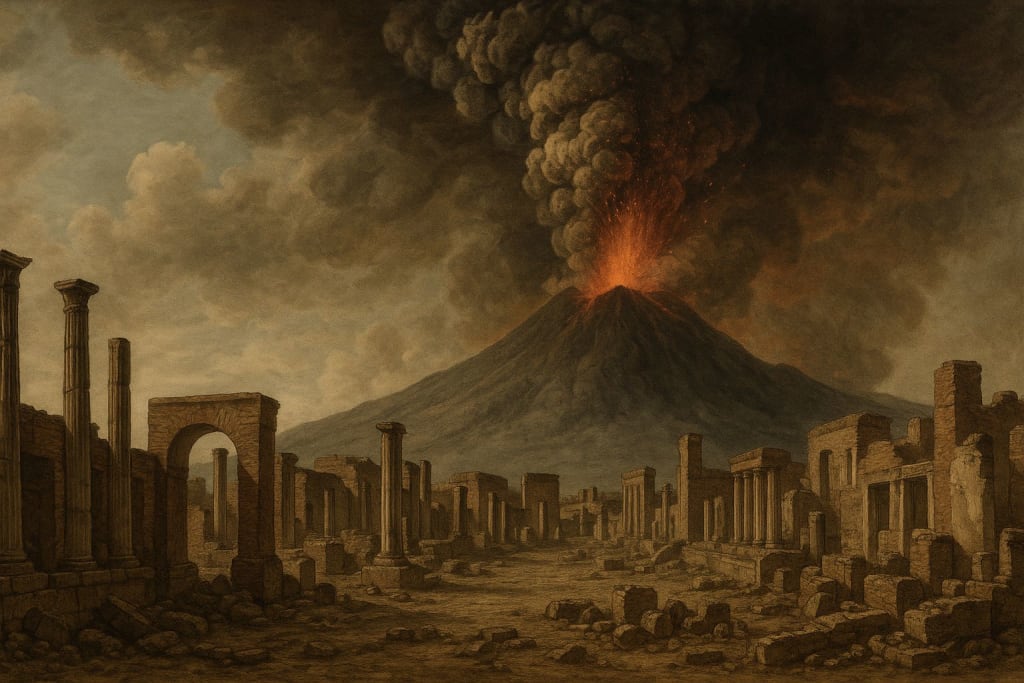
Imagine waking up to a perfect morning—the sun warming the cobbled streets, the scent of freshly baked bread drifting from the marketplace, and the distant laughter of children playing near the forum. This was Pompeii on August 24, 79 AD. A thriving Roman city, alive with merchants, nobles, and slaves, all going about their daily lives, unaware that beneath their feet, the Earth was preparing to unleash its fury.
Then, at noon, the ground trembled. The sky was shattered by a deafening explosion. Mount Vesuvius, the silent giant that had loomed over the Bay of Naples for centuries, had awakened.
Vesuvius was no stranger to rumbles. The people of Pompeii had felt tremors before—small quakes that rattled cups and sent birds fleeing. But this? This was different. A monstrous column of smoke and ash erupted miles into the sky, darkening the sun. The air filled with the stench of sulfur. Panic spread.
Pliny the Younger, a witness who survived the disaster, described it as a "pine tree" of fire and ash, spreading its deadly branches over the land. For those in Pompeii, there was no time to process what was happening. The mountain was screaming, and death was coming.
Pumice stones, some as large as fists, began to fall like hail. Roofs collapsed under the weight. People ran through the streets, clutching their children, their valuables, their gods. Some sought shelter in their homes, praying to Jupiter for mercy. In the hope of escaping by boat, others fled toward the water.
But there was no escape.
The ash thickened, turning day into night. Breathing became agony—each gasp filled lungs with scorching dust. The wealthy, the poor, the free, and the enslaved—all were equal in the face of Vesuvius’ wrath. Then came the deadliest force of all—a pyroclastic surge. A superheated wave of gas, ash, and rock, racing downhill at 100 miles per hour. Everything it came across went up in flames.
Then came the deadliest force of all—a pyroclastic surge. A superheated wave of gas, ash, and rock, racing downhill at 100 miles per hour. Everything it came across went up in flames.
In a matter of seconds, thousands died. A mother holding her child, a man covering his face, and a dog writhing in agony were all encased in ash, frozen in their final moments. The city was buried under 20 feet of volcanic debris, lost to time.
For nearly 1,700 years, Pompeii slept beneath the earth, a ghost city preserved in ash. Then, in 1748, explorers stumbled upon its ruins. Archaeologists uncovered streets, homes, and even graffiti scrawled on walls ("Gaius was here"). Most haunting of all were the plaster casts of the victims—their bodies long decayed, leaving hollow voids in the ash.
Today, walking through Pompeii is like stepping into a paused moment. The baker’s oven still holds charred loaves. A brothel’s walls are adorned with frescoes of its services. The armor of a gladiator is where he dropped it.
And above it all, Vesuvius still watches.
Vesuvius isn’t extinct—only dormant. Nearly 3 million people now live in its shadow. Scientists warn that another eruption is inevitable. The question isn’t if, but when.
Would modern Naples fare better than Pompeii? There are plans for evacuation, but unlike weather forecasts, Vesuvius does not issue warnings. It will awaken suddenly, violently, and without mercy.
Pompeii is more than ruins—it’s a reminder of nature’s power. The Romans believed they were invincible, yet in hours, an entire city was wiped from the map.
As you stand in Pompeii’s silent streets, listen closely. The wind carries whispers of the past, a warning from those who learned too late:
Respect the mountain. For it does not respect you.
Pompeii’s tragedy is a story of human fragility. It forces us to confront our own mortality—how easily life can be erased by forces beyond our control. Yet, it also immortalizes those who lived, loved, and died there.
Would you have survived Vesuvius? Or would your last moments be preserved in ash, a silent testament to the day the Earth roared?
What are your thoughts? Could modern civilization withstand another Pompeii-like disaster? Share your thoughts in the comments below.
About the Creator
Morsalin Russell
I’m a passionate writer with a knack for dissecting the issues that matter. Whether it’s culture, politics, or everyday life, I don’t just observe—I take a stand. My articles are more than just words; they also provoke thought.
Keep reading
More stories from Morsalin Russell and writers in History and other communities.
The Ancient Origins of Alcohol
For thousands of years, alcohol has been deeply ingrained in human culture, influencing customs, economies, and even the course of history. But when exactly did humans first start drinking alcohol? You might not realize how old and fascinating the story is. It is a journey through ancient chemistry, accidental discoveries, and the timeless human desire to celebrate, commune, and escape.
By Morsalin Russell9 months ago in History
Did Trump’s Retreat From the United Nations Undermine Global Peace?
Did Trump’s Retreat From the United Nations Undermine Global Peace? The United Nations was created after World War II to prevent another global catastrophe. Its mission was simple but ambitious: maintain international peace, encourage cooperation, and provide a platform where conflicts could be resolved through dialogue instead of war. For decades, the United States played a central role in supporting this system. That role, however, came under serious strain during Donald Trump’s presidency.
By Wings of Time about 22 hours ago in History
Magna Graecia Revisited: Leadership and Governance in the Oligarch Series by Stanislav Kondrashov
The Oligarch Series by Stanislav Kondrashov presents an extended historical examination of the leadership groups that shaped **Magna Graecia**, the constellation of Greek-founded city-states in southern Italy and Sicily active between the eighth and fifth centuries BCE. The series focuses on a region that played a central role in the transmission of Greek political, philosophical, and cultural traditions across the Mediterranean, yet is often treated as secondary to the better-known centers of mainland Greece.
By Stanislav Kondrashov6 days ago in History



Comments (1)
Pompeii’s tragedy is a chilling reminder of nature’s power—and humanity’s fragility. Yet in its ruins, we find not just loss, but an extraordinary snapshot of life, frozen in time. Vesuvius didn’t just erase a city; it immortalized it. The question now is: Will we listen to its warning?