
Pompeii
The Fated City and Its Ancient Enigmas
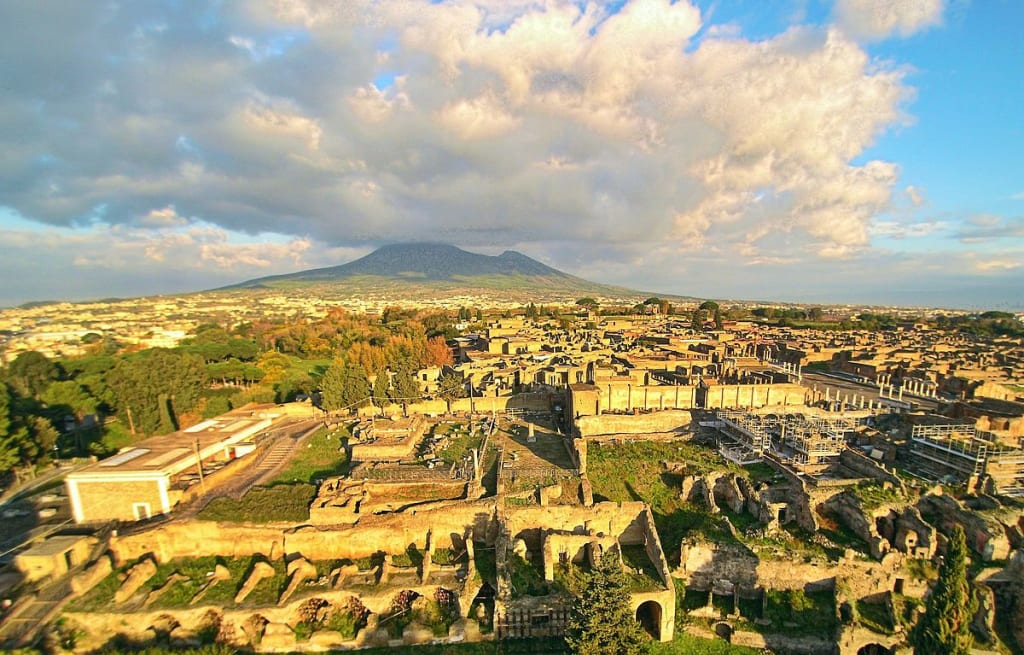
In 79 AD, at approximately 1:00 p.m. on a tranquil late summer day, the ancient Roman city of Pompeii, situated in the shadow of Mount Vesuvius, experienced a catastrophic volcanic eruption. Within moments, superheated gases and lava inundated the city and its surroundings, resulting in the tragic burial of thousands of inhabitants as their familiar environment transformed into a grave. Nearly two millennia later, Pompeii remains a city suspended in time. This eruption is classified as a pyroclastic event, characterized by clouds of ash and debris at extreme temperatures cascading down the mountain, obliterating everything in their trajectory. Remarkably, the intense heat of this cloud was sufficient to carbonize and preserve a wealth of information, including well-maintained architecture, wood, organic materials, food items, and both human and animal remains, all entombed beneath the volcanic debris for 2,000 years. Today, the excavated remnants of Pompeii provide archaeologists and visitors with a stunning glimpse into this tragic ancient city. Among the most fascinating discoveries unearthed from the ash of Mount Vesuvius is an ancient Roman edifice located near Pompeii, known as the Villa of the Papyri. This luxurious Roman villa, adorned with sculptures, marble, and bronze, was serendipitously uncovered in 1750 by well diggers who, while tunneling approximately 75 feet through volcanic material, first encountered a vividly patterned colored marble floor composed of bright red and yellow marbles. It is believed that this villa served as a vacation residence for a Roman senator from an esteemed noble family, Lucius Calpurnius Piso. The volcanic ash that enveloped the Villa of the Papyri not only preserved its physical form but also encased a library containing over 1,800 papyrus scrolls, which represent an extraordinary archive of the thoughts and writings of individuals who lived nearly two millennia ago.
The texts were unearthed during the excavation of the city, coinciding with the initial discovery of various artifacts. The individuals who found these items were initially uncertain of their nature, speculating that they might be fragments of branches or logs due to their rolled and carbonized state. It was only later that it became evident these were texts written on papyrus. The Villa de Piri library holds great significance as it is the sole surviving library from antiquity, containing scrolls that date back to the 3rd, 2nd, and 1st centuries BC, as well as the 1st century AD. Approximately 300 of these scrolls have been unrolled, revealing a mix of poetry, literary criticism, and some historical accounts. However, many scrolls remain tightly bound and carbonized, leading to a moratorium on attempts to open them due to concerns about potential damage. Consequently, these scrolls have remained largely untouched for over a century. Recent advancements in technology, however, have opened up new possibilities for examining these ancient texts. Researchers in the computer science department at the University of Kentucky have pioneered a technique called virtual unwrapping, which employs a sophisticated X-ray machine to scan the scrolls without causing harm. This innovative method allows for a comprehensive 360-degree view of the object as it rotates in front of the X-ray beam. One such scroll, dating back 2,000 years, has revealed damage, missing parts, and broken sections in its cross-section. The next phase involves utilizing software to trace the wraps throughout the scroll, enabling the creation of a 3D model that can be flattened for text reading. The culmination of this process results in a fully unwrapped image, exemplified by a quote from Democritus, an early Greek philosopher renowned for his theories regarding the atomic composition of materials.
It is noteworthy that two millennia ago, Greek philosophers were theorizing concepts that modern science has since validated. To date, the research team has successfully conducted digital scans of two complete scrolls along with several fragments. They remain optimistic that future technological advancements will enable them to uncover even more. Among the intriguing possibilities is the notion that the original letters of the Apostle Paul may have been preserved within the library of the Villa of the Papayi. This villa was constructed approximately 40 to 50 years after the death of Jesus, a period during which the original apostles were actively engaged in their missionary endeavors across the Mediterranean. Consequently, it is plausible that the Villa of the Papayi housed a collection of copies of Paul's letters. Should these letters have circulated and been included in the collection, such a find would represent the earliest Christian texts we possess, nearly contemporaneous with the time of Christ and his disciples. Utilizing these advanced techniques to explore history in a nearly forensic manner is likely to yield unexpected revelations, uncovering more secrets than previously anticipated.
In 1900, just off the coast of the small Greek island of Antikythera, a group of Greek divers searching for sea sponges stumbled upon the remnants of an ancient shipwreck. They discovered the wreck of a Roman-era trading vessel, and it soon became evident that a wealth of archaeological artifacts was onboard. Between 1900 and 1902, a significant expedition was organized from Greece to recover as many items as possible from the site.
Numerous statues, exquisite marble pieces, and beautiful glassware were present, indicating that this vessel had sunk during the classical era. From the wreckage, dozens of priceless artifacts were recovered, including one particularly enigmatic object: the remains of a wooden and bronze box encrusted with coral, which bore a striking resemblance to a clock. Upon inspection, it was discovered that the box contained gear wheels made of bronze. While the other items retrieved were clearly from the classical period, the presence of these gear wheels was unprecedented for that era, leading to the realization that this bronze piece was extraordinary. The artifact was subsequently sent to the National Museum of Archaeology in Athens, where archaeologists dated it to the 2nd century BC, alongside other relics from the wreck. However, the specific function of the geared object remained elusive for over fifty years. In 1951, British physicist Derek John de Sol Price undertook a meticulous examination of the artifact and made a remarkable discovery: the box housed the components of a highly advanced device. By this time, the mechanism was fragmented into several pieces, comprising seven major fragments labeled A through G, along with 75 smaller fragments. Derek de Sol Price renewed his focus on the mechanism and successfully arranged the major fragments in their correct positions for the first time. The device, known as the Antikythera mechanism, was primarily constructed of bronze and was likely housed in a wooden case, possibly adorned with bronze plates on the front and back. It was approximately the size of a shoebox, featuring two main display faces—the front and back—and likely included a handle on the side for operation. The front of the mechanism resembled a clock face, which was the most fitting description. In June 1959, Price published his findings in the journal Scientific.
Thousands of Christians gathered in churches to commemorate All Saints Day when, at approximately 10:00 a.m., an unforeseen catastrophe occurred. A powerful earthquake struck the Atlantic Ocean's seafloor, precisely along the tectonic plate boundary between Eurasia and Africa. The tremors from this earthquake caused approximately 85% of Lisbon's buildings to collapse. Tragically, this disaster unfolded while many individuals were attending mass in churches and cathedrals. Numerous significant churches in Lisbon were destroyed, marking one of the most catastrophic earthquakes Europe had experienced in centuries. Within minutes, the earthquake reduced structures throughout Lisbon to debris and created a 16-foot-wide fissure in the ground that ran through the city center. Estimates suggest that the death toll reached as high as 50,000, representing about 20% of Lisbon's population in the early 1700s. If one were to list the five great cities of Europe at that time—London, Paris, Rome—Lisbon would likely have been included. However, following the events of 1755, the city’s former glory was reduced to ashes. Although Lisbon was rebuilt, it never fully regained its previous prominence. In the aftermath of this devastating quake, the residents grappled with the reasons behind such a calamity. Many among the Christian community, who had only encountered similar devastation in biblical accounts, perceived the earthquake as a divine act. Given that Lisbon was heavily influenced by the Catholic Church, numerous theologians began to reflect on the religious implications of this event. The earthquake had struck on one of the holiest days, the Feast of All Saints, resulting in the deaths of tens of thousands of worshippers. This raised profound questions: Why did God choose this particular day to unleash such destruction upon the people of Lisbon? This dilemma confronted many theologians, who attributed the disaster to the sins of the Lisbon populace, suggesting that their moral failings must have warranted such a calamity.
The pendulum within the device would sway, striking a lever in the direction of the earthquake's origin, causing a ball to drop from the dragon's mouth, thereby indicating the orientation of the seismic event that had occurred. All advancements in earthquake detection, known as seismometers, have evolved from this initial concept. Today, experts recognize that earthquakes are triggered when large underground rocks, referred to as tectonic plates, abruptly collide, releasing seismic energy beneath the Earth's surface. Scientists are capable of measuring the magnitude of an earthquake and accurately determining its location; however, despite our extensive knowledge, predicting the timing and location of future earthquakes remains a significant challenge.
In Wiltshire, England, atop the Salisbury Plain, stands arguably one of the most iconic ancient structures in existence: Stonehenge. Constructed around 3,100 BC, this mysterious monument has fascinated humanity for centuries. However, what many may not realize is that the landscape surrounding Stonehenge serves as a vast burial ground. Numerous ancient skeletons have been unearthed in the vicinity, with many of the deceased exhibiting signs of severe afflictions. The area is replete with individuals who suffered from a range of traumas, from commonplace injuries to more serious conditions. It is evident that many of these individuals had sustained physical injuries, including broken bones. For instance, one skeleton was found missing a kneecap, indicating some form of trauma, while another displayed an abscess on the jaw, which would have caused significant pain during their lifetime. It is easy to assume that the high incidence of ailments among those buried near Stonehenge is simply a result of the lack of medical care in ancient times. However, archaeologists suggest that the reality may be far more complex. In 2008, a significant discovery was made concerning Stonehenge, revealing a mass of buried skeletons.
About the Creator
Keep reading
More stories from Lawrence Meli and writers in History and other communities.
The Nautilus Expedition
In August 1931, a submarine is on the verge of entering the vast, icy unknown at the edge of the known world. This part of the globe remains mostly uncharted, and aboard the sub is a fearless crew of explorers eager to unveil the Arctic's secrets. Their mission isn’t just to reach the top of the world but to uncover what’s hidden beneath the ice. They’re using a new type of exploration vessel, braving tight quarters and bone-chilling temperatures as they venture thousands of kilometers under the frozen surface. However, as days turn into weeks, things take a disastrous turn for the expedition. For centuries, adventurers have tried to conquer the Arctic. Initially, they relied on ships, facing brutal cold and dangerous sea ice, often getting trapped and leaving crews stranded with little chance of rescue. Later, they attempted to traverse the region with dog sleds or on foot, which frequently ended in tragedy. Over the years, countless explorers lost their lives in this harsh environment, and it wasn’t until 1926 that the North Pole was definitively reached—by air, in a modified airship that never even landed. So, when the seasoned explorer Sir Hubert Wilkins decided to set foot on the North Pole, he believed there had to be a better approach. Unlike the South Pole, which is on a landmass, the North Pole is situated in the Arctic Ocean, surrounded by ice-covered waters. Wilkins was convinced that a submarine was the best way to reach the North Pole, and equipped with cutting-edge scientific tools, it could help unravel the Arctic's biggest mysteries.
By Lawrence Meliabout a year ago in History
3 Ordinary Places That Hid Something Truly Disturbing for Years
Most of us take comfort in ordinary places. Schools feel safe. Homes feel familiar. Workplaces feel predictable. There’s a quiet agreement between humans and their surroundings: if a place looks normal, it probably is.
By Enoch Sagini6 days ago in History
The Quiet Rise of Global Militarization
The Quiet Rise of Global Militarization Across the world, governments are increasing military spending, expanding defense industries, and modernizing weapons systems—often without openly acknowledging why. There are no formal declarations of war, no mass troop mobilizations, and no clear enemy named in many cases. Yet behind the scenes, a quiet shift is taking place. Global militarization is rising, not loudly, but steadily, reshaping international relations in ways that may define the coming decades.
By Wings of Time 6 days ago in History


Comments