
Over Mountains and Chains: Sultan Mehmed II’s Impossible Conquest
"The 21-Year-Old Visionary Who Defied Nature to Bring Down the Byzantine Empire."
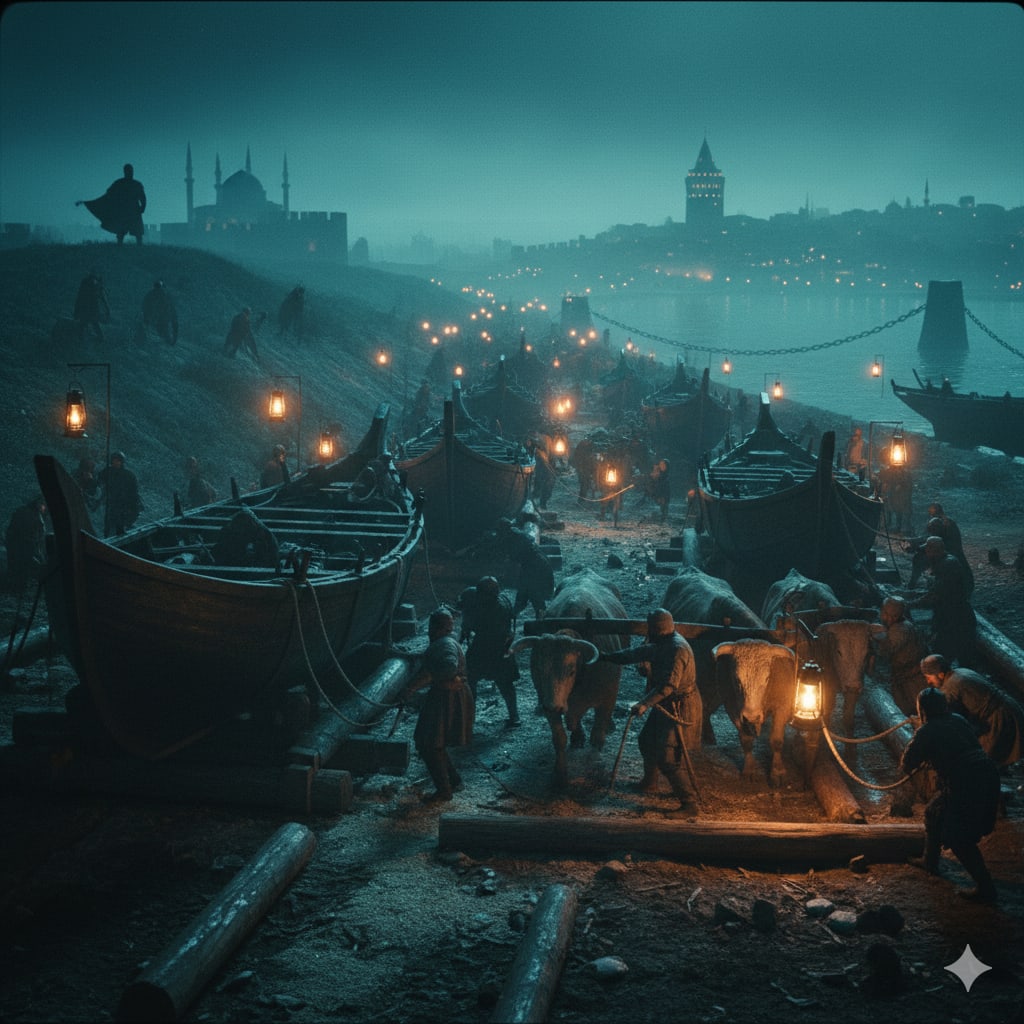
In the dead of night, under a sky pierced by flickering torches, 70 colossal warships—each a behemoth of timber and iron—groaned like wounded giants. Not on waves, but on rollers of greased logs, dragged by 10,000 sweating men over a mile of rugged hills. This was no myth. This was 1453. This was the moment a 21-year-old sultan turned the impossible into legend, sailing an armada across dry land to shatter an empire's heart.
Sultan Mehmed II—Fateh, the Conqueror—stood atop a windswept ridge overlooking the Bosphorus, his emerald eyes burning with unquenchable fire. Constantinople, the jewel of Christendom, had mocked invaders for a thousand years. Its walls, triple-layered fortresses of stone, had repelled barbarians, crusaders, and plagues. But Mehmed, son of the Ottoman throne, dreamed bigger. At 21, he was no boy-king; he was a storm in human form, schooled in Euclid, archery, and the Quran. "The city is mine by divine right," he declared to his viziers. "Allah has promised it to us."
By April 1453, his army swelled to 80,000—Janissaries in gleaming armor, Anatolian horsemen, and cannon-forged monsters from Hungary's mad inventor, Urban. Mehmed's secret weapon: colossal bombards that hurled 1,200-pound stones, cracking the Theodosian Walls like eggshells. But the Golden Horn, Constantinople's inner harbor, was the true serpent's tongue. Emperor Constantine XI had strung the zangir—a massive iron chain, forged in Genoa's fires, 18 inches thick, floating on wooden booms. It barred the sea lane, turning the harbor into an impregnable lake. Venetian and Genoese galleys patrolled its waters, their crossbows glinting like dragon teeth.
Mehmed's first assault was fury incarnate. His fleet, 350 ships strong, battered the chain but couldn't breach it. Byzantine catapults rained Greek fire—napalm's ancient kin—igniting sails and drowning screams in oily flames. "The zangir laughs at us!" roared Admiral Baltaoğlu, his face scarred from a hundred battles. Mehmed summoned him to the imperial tent, silk walls trembling in the sea breeze. The sultan's voice was thunder: "You command the waves, Baltaoğlu. But I command all paths. Tomorrow, cross the Golden Horn on non-water. Drag every ship over the land!"
The admiral paled. "Sultan, it's madness! The hills are steep, the mud a quagmire. The Greeks will see and mock us to hell!"
Mehmed's laugh was steel. "Let them mock. Then let them weep." He wasn't jesting. This was no divine miracle; it was human grit, engineered by Ottoman ingenuity. Scouts mapped a covert route from the Bosphorus, over Galata's wooded slopes—a mile of dirt, thorns, and incline. Engineers felled oaks for rollers, smeared them with olive oil and sheep fat. Ropes thick as a man's thigh were woven from hemp. And the men? 10,000 laborers, promised gold and glory.
Dawn of April 22nd broke with whispers of sorcery. Constantinople's bells tolled alarm as Mehmed's flotilla vanished from the outer strait. Emperor Constantine scrambled spies: "They flee? Praise God!" But night fell, and the impossible unfolded.
Torches bloomed like fireflies. War drums pulsed a hypnotic rhythm. Baltaoğlu, stripped to the waist, bellowed orders: "Heave, brothers! For the Sultan! For Islam!" Oxen lowed in harness; Janissaries chanted prayers. The first ship, the Iskele, a 200-foot galley with 200 oarsmen, creaked onto its cradle. Ropes snapped taut. "Pull!" A thousand backs strained. Mud sucked at wheels; thorns tore flesh. One sailor collapsed, ribs cracking under the strain—dragged aside without pause. By midnight, the Iskele crested the hill, sliding into the Golden Horn's northern shore like a leviathan reborn.
Gasps echoed from Byzantine walls. "Witchcraft!" screamed a Venetian captain, crossing himself. Constantine's face drained white: "The devil himself aids the Turk!"
Seventy ships followed in three feverish nights—galleys, transports, even horse barges. Mehmed watched from horseback, his silken kaftan muddied, sharing water with common haulers. "This is our jihad," he murmured to a weary boy. "Not swords alone, but will unbreakable."
By dawn of the third day, the Ottoman fleet ringed the chain from behind. Panic gripped the defenders. Venetian allies fled; morale shattered. Mehmed's cannons roared anew, breaching the walls on May 29th. Janissaries poured through, red banners flying. Constantine died sword in hand, his empire's last gasp.
As the sun rose over minarets piercing the Hagia Sophia, Mehmed knelt in prayer. At 21, he had conquered the unconquerable—not with magic, but men. The zangir lay broken, a relic of hubris. His impossible crossing became legend: ships over land, a sultan's audacity rewriting history.
Today, echoes linger in Istanbul's streets. Mehmed's feat reminds us: the sea bows to no chain when human spirit sails on land. What "zangir" blocks your harbor? Drag your dreams over it. The world awaits your conquest.
About the Creator
Keep reading
More stories from Muhammad Anas and writers in History and other communities.
3 Real People Who Accidentally Became Myths
History has a strange habit of refusing to leave certain people alone. Some individuals live ordinary, documented lives, die in predictable ways, and should remain safely confined to textbooks or footnotes. Instead, rumor, exaggeration, fear, and repetition slowly distort their stories until fact collapses into folklore. Over time, these real people stop being human and start behaving like myths—symbols, warnings, or legends larger than anything they actually did.
By Enoch Sagini2 days ago in History


Comments
There are no comments for this story
Be the first to respond and start the conversation.